
Turning education upside-down

Online College Edu Blogger Scholarship ContestNote revised @ 12:30 p.m. CDT March 12, 2009.

This is my official entry into the 2009 Edu Blogger Scholarship Contest, and I want readers to know that if I am fortunate enough to win one of the three cash prizes, I will donate half of the winnings to the Missouri S&T Staff Council. This is my effort to help give a little bit back to an organization that means so much to our hard-working staff. But, I need your help. Part of the criteria for winning this award has to do with traffic back to the sponsoring site, so please click on the image above to help out. Thank you.

I took a fairly traditional route to a college degree — community college for two years, then on to the major state university — so I don’t have a lot of first-hand experience in the area of distance or online education. But in my work as a university communicator, I’ve written a lot about the distance and online programs we have at Missouri S&T. A few years ago, our staff published a magazine all about our online education program, and I had the good fortune to interview one of the pioneers of distance learning, Professor Ken Ragsdell, who teaches in our engineering management department. And through that interview, I learned a lot about the philosophy of education — not just online education, but all education.

Ken’s first shot at teaching students from a distance came in 1973, when the dean of engineering at Purdue, where Ken taught at the time, asked him to teach a course over live television. Thirty-six years later, he’s still teaching distance courses, both online and via satellite. What he’s learned over the years may look odd to many educators, but as he told me back in 2004, “Once you slip into this world of trying to look at education in a different way, innovation looks normal.”

And what is that different way?

The professor’s role switches now from expert/judge to coach. When I was younger, I saw myself as the major source of knowledge for my students. Now I have to be an educational manager and provide many paths to learning so students can easily navigate through a course — to put the students more in control of their educational experience and provide opportunities for all students to learn and realize their potential.

You’ve got to turn the educational process upside-down and put the student at the center. It’s a bit humbling, because as a professor you lose some control. But the reward for that is better student learning and much better retention.

What online learning also does, according to Ragsdell, is flip-flop higher learning’s traditional paradigm. Universities are organized around synchronicity. Classes and semesters begin and end at specific times. When time’s up, students are judged by what they’ve learned during that period.

What would happen, though, if universities ditched the obsession with sequential education in favor of a model more in step with online education?

  • What if students could complete a course at an accelerated pace, taking the final exam long before semester’s end?
  • What if students could elect to take only one or two hours of a three-hour course, what Ragsdell calls “micro-modules”?
  • Or what if students could enroll in two courses offered at the same time? If all the material is available online and professors are accessible, there’s no reason why the paradigm could not shift.

Those are some of the what if’s Ragsdell ponders. Turning education upside-down seems to make sense.

What do you think?

Oh, and don’t forget to click:
Online College Edu Blogger Scholarship Contest

Tradition as a tool for student recruitment

Blogger’s note: There appears to be a problem with the ocmmenting form on this post. I hope the prblogs.org folks are working on it. Thanks for your patience. – AC

* * *

And how do we keep our balance? That I can tell you in one word: Tradition!

— Tevye, “Fiddler on the Roof”

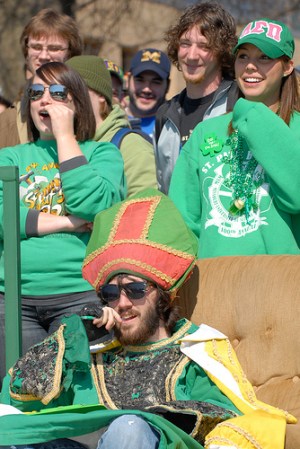
The 2008 St. Pat, Paul Voss, watches St. Pat's Follies last March along with a throng of S&T students. (How'd that guy with the Michigan cap get in there?)
Every college and university has its share of traditions. Starting today, Missouri S&T kicks off one of its oldest and most celebrated traditions: St. Pat’s Week.

Last year, we celebrated the centennial of St. Pat’s, which began on our campus in 1908. (Full disclosure: We stole the idea from our sister campus in Columbia, where engineering students a few years earlier designated St. Pat the patron saint of engineers. But here in Rolla, where we had a much higher proportion of engineering students, we appropriated the celebration and rechristened it as our very own.)

This particular celebration is an important part of our history as a university. It probably means nothing to you, unless you happen to live in Missouri. (Research among Missourians in the 1990s revealed that our campus was known for two things: “excellent engineering programs” and “St. Pat’s.”) But it means a lot to alumni of many generations, who fondly recall it as a one-of-a-kind rite of spring and an important part of their college days. It means a lot to a segment of our student body, too.

But how important are such traditions to prospective students? Where does tradition fit into a recruitment strategy?

I haven’t read or heard much about this. It seems most colleges and universities neglect the power of their traditions as a marketing tool for prospective students. This seems to be a mistake, because traditions usually come with great stories. I know ours does.

We talk about our St. Pat’s tradition in our recruitment materials, but it is never front and center. We prefer to talk more about how our campus is the ideal place for a certain type of student. We talk about our range of majors, the availability of financial aid, and all the other stuff every other college or university talks about, only we try to do it in a way that sets us apart from everybody else.

But one of the things that really sets us apart is this tradition thing. Every institution has them. Maybe we should be using them more to distinguish us from the competition.

Although, to be honest, our St. Pat’s Celebration doesn’t have the greatest history. Like many things associated with St. Patrick’s Day, it has a lot of connections to drinking, and more than its fair share of debauchery. There have also been a couple of student deaths connected to a former student group that used to run the event. So maybe it isn’t the kind of thing you want to draw too much attention to.

Still, it’s part of what we are. Traditions, like family, stick with you, whether you want them to or not.

There ought to be some way to incorporate the best of our traditions into student recruitment. Don’t you agree?

Or maybe you’re already doing that. If so, please share.

P.S. – As part of last year’s 100th celebration, we started a blog to help promote the event and keep our far-flung alumni connected. We’ve resurrected that blog again, perhaps beginning a tradition of our own.