
As a follow up to my recent post about confronting the blank page (or blank screen), I wanted to describe my writing routine and, I hope, prompt some of you to share yours in the comments.
But first, a short back story:
Once upon a time I journaled consistently. Then I fell out of the habit. I don’t know why. Got busy, I guess.
Then one day a little over a year ago, I found myself flipping through some old, unfinished journals. Half-hearted, failed attempts to commit myself to the practice of consistent writing. Reviewing some of them added to my winter doldrums.
One entry was particularly brimming with self loathing. Titled “But You’re Almost Sixty” (I put titles on my journal entries in those days), it began:
Ideas in my head. I want them on paper. Turned into pages, into books to be read. “But you’re almost sixty,” says the voice, implying: “You’re too late! You’re too old. You should have done all that long ago.”
Almost sixty. Huh. Barely fifty-nine, actually. But whatever.
The voice is strong, harsh, mocking as I sit to write. The voice throws doubt up in my face. Remember, it tells me, all the times you were going to write that novel? That memoir? Remember, it says, all of your unfinished stories and essays, incomplete notebooks, half-empty journals. Remember, it says, your incompleteness, your false starts, your half-assed attempts.
Personal journal entry, January 9, 2020
Maybe you’ve been there?
I was at the point that the urge to write was welling up within me, and I felt like I had to do something about it. But in the days that followed, the urge to write, the welling up that I’d felt, began to subside until I closed the journal, put away the pen, and got on with the more pressing matters of life.
The spirit was willing, but the flesh was weak.
Fast forward nearly three years, and somehow I mustered up the courage to start over, with a resolve to write something, anything, every Monday through Thursday (giving myself long weekends off). Part of the motivation was knowing that I would be retired from my full-time job within a year, that after retirement I was planning to devote more time to writing, and that I needed to get in shape through some sort of regular writing regimen, much as a marathoner might begin training for the big race a year or more in advance.
And so on Thursday, December 15, 2022, I took up my pen and wrote this:
My writing routines have become like my fitness routines: atrophied, like my muscles. A few minutes of working the writing muscles may be all I can do for now. Short sprints. No, short slogs. I’m not up to sprint speed yet — nowhere near it. …
“Just like starting over,” John Lennon sang. That snippet of lyric popped into my head as I opened this notebook.
And so it begins. Again.
Personal journal entry, December 15, 2022
And so it began, and continues today.
The routine
My journaling routine begins early in the morning. Writing longhand in a notebook is one of the first tasks of my day. It happens right after I make the bed, start a pot of coffee, feed the cat, and clean the litterbox. My wife, who goes to work very early, is already gone, so I have the luxury of privacy (except from the cat, who will occasionally interrupt the writing practice).
With those chores behind me, I sit down at the kitchen table, open the notebook, put the day’s date at the top of the blank page, and write the old-fashioned way, with pen on paper.
The subjects
What do I write about?
Some days, I have a kernel of an idea of what to write about. Some days, that kernel is a nagging sense that I don’t feel like writing due to a lack of inspiration or, more often, a lack of motivation.
Other days, the idea may be a reflection on some recent news or life situations, or thoughts about the previous night’s big game. Most often, I write about ideas that have been marinating in my consciousness. This morning, for example, I wrote about the bare trees of January and how their leaflessness exposes them, how the lichen on the bark of the sycamores and oaks and maples show up like liver spots on our aging human limbs. The entry was a meditation on thoughts I’ve had while walking along a nearby path on cold winter days.
I’ve also used writing prompts of various kinds. The internet teems with prompts (here’s one resource), or you can come up with your own. For 30 days last year I turned my notebook into a gratitude journal by writing about three things I’m thankful for each day. I first learned of this idea from a TED Talk by psychologist Shawn Achor. Some days I found myself writing about other things, too, but if the well was dry I always had the gratitude topic for content fodder.
Whatever the topic, or no topic at all, I power through, telling myself that if I just write one page in the journal, I will have accomplished something. Some days, I tell myself that al I need to do is fill half a page.
The most important thing for me is that I keep my commitment to myself and show up to write something, anything, four days a week.
Afterward, I reward myself with the morning’s first cup of coffee before getting on with the rest of the day, and I’m grateful that, if I accomplish nothing else on this day, I will have at least written.
Further thoughts
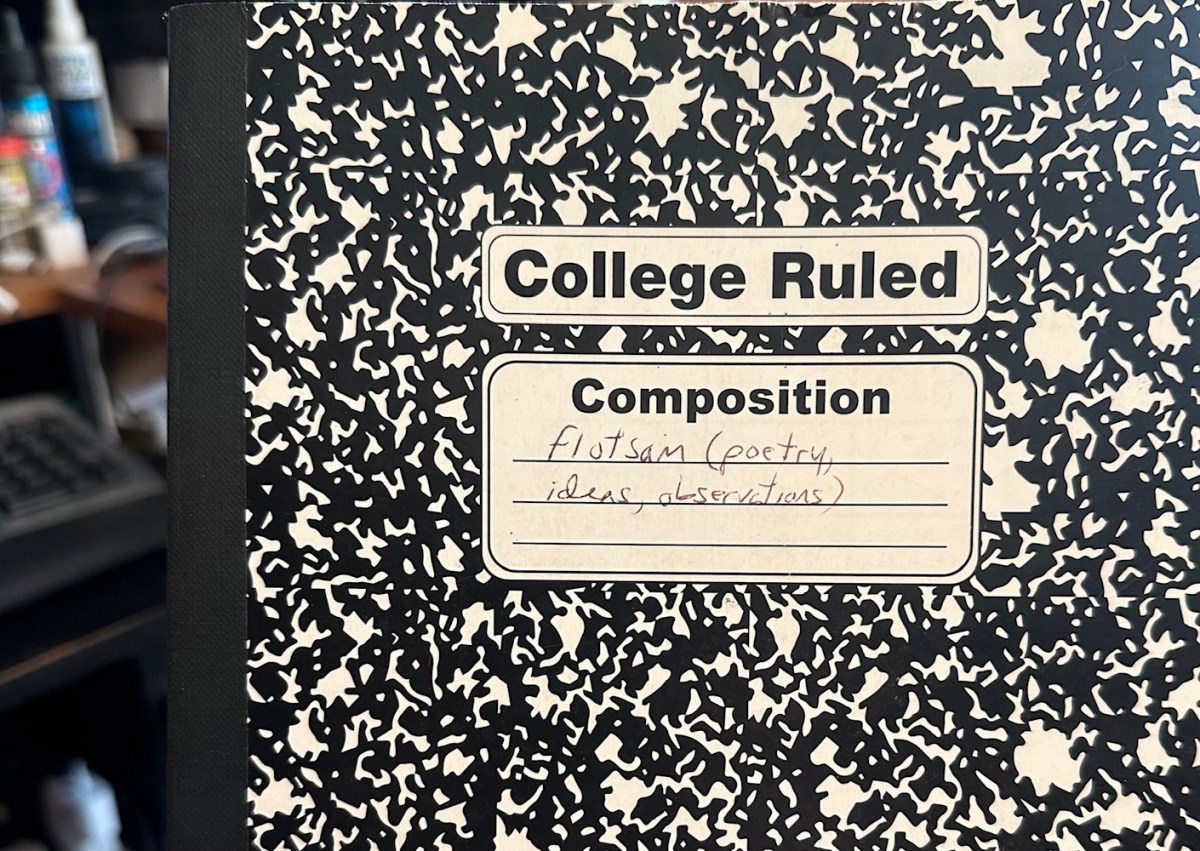
- What kind of notebook? Some writers suggest using a good, leather-bound journal to write in. I’ve written in fancy journals, and I’ve written in college-ruled composition notebooks. Frankly, I prefer the composition notebooks (like the one pictured above) because they have more flexible spines. But I also have a good supply of nice leather-bound notebooks I’ve amassed from vendors who gave them away at the many conferences I attended in my nearly 33-year career in higher education, so I am not likely to run out of notebooks to write in any time soon. The short answer is, any notebook that has a flexible spine is fine by me. I also try to keep a small 3×5 notebook in my hip or coat pocket at all times so that I can record thoughts on the fly as they happen — at the grocery store, in line at the bank, while eavesdropping at a coffee shop or restaurant (great sources for snippets of dialogue), etc. If I don’t have a small notebook on hand, I use the notes app on my smartphone to record these thoughts.
- What about the computer? I use the computer for certain types of writing — just as I am right now, with this blog post — but I find that for journaling, I want to slow down the process and make the process more tactile. I want to hold the pen in my hand and guide it along the page, slower than my thoughts. I’ve found that the more I do the physical writing, the better able I am to slow down the writing process and stay focused on it. If I’m on the laptop, clacking away on the keyboard, I usually have several other browser tabs open, and those are each portals to various and sundry rabbit holes of distraction.
- What kind of writing instrument? I use a standard-issue ballpoint pen. Again, nothing fancy, and again, I’ve amassed quite a collection of pens from vendors throughout my higher ed marketing career. I don’t use pencils for much of anything.
- What time of day? I’ve become a morning person, so I find that writing first thing in the morning works best for me. I have more energy in the morning, more focus, and fewer distractions. Early morning is my preference, and as I say above, completing a journal entry first thing in the morning gives me a feeling of accomplishment, which is motivating. Occasionally I’ll write during other times of day, especially if a seemingly good idea pops into my head that I need to capture right away.
What about you?
What is your writing or journaling routine? I’d love to hear from you in the comments below.

 Andrew Careaga
I could write for days about this. I used to use notebooks a lot, but weaned myself off them back when I was at the university. Microsoft OneNote helped me do that.
I do like morning writings, especially when you can have a ritual (like you do). But I’m mostly a night owl, so most of my writing happens at night.
A typical writing experience involves finding some music and going in from there. Maybe from my desk, in the basement at our new home, or using a portable device like a laptop and going moving for a change of view. I get cabin fever easy. I often use Pomodoro technique as well, though slightly tweaked for writing. 20 minutes writing, then ten minutes break, 20 minutes writing, 10 minutes break, and that’s the first hour. This is really helpful if having trouble getting started.
Thanks for mentioning the Pomodoro technique. That sounds like a great way of breaking down a writing project 8nto more manageable chunks. I may need to try it.
It really is. I first discovered it back at the university and would use it when doing work at a pc. Since my job at the end involved a lot of research, it was a great way to be like, “20 minutes of research, go!”