Friday Five: ‘Rainbow Road’ author/road warrior Scott Laudati

‘As soon as I decided to just be exactly me, and stop playing other people’s games, this whole sea parted.’

I rarely get the chance to meet, in person, a writer I know only through social media. Beyond the occasional local poetry reading, I don’t get to many literary events.

So when I found out that one of those writers I’ve known only through Twitter/X, Scott Laudati, would be doing a poetry reading at the Osage Arts Community in nearby Belle, Missouri, I made plans to be there. Scott was on the road, as he often is, and in the middle of a multi-state tour to read from his latest poetry collection, Rainbow Road, which I’d read over the summer, along with his 2022 semi-autobiographical novel Play the Devil.

Me exchanging books with Scott Laudati in Belle, Missouri, prior to Scott’s reading at Osage Arts Community, August 2026.

Scott’s a child of the working class, New Jersey born, and those roots come through in his writing, especially in Play the Devil, a tale of a mid-twenties college dropout who returns to his hometown, works a summer as a pool boy, and attempts to discover a lost love while discovering himself along the way. Although it takes place in one section of the country, it’s as much a journey as the road trip saga that is Rainbow Road.

That Scott would include Belle, population 1,381, on his itinerary of travels–which took him from Brooklyn to Connecticut, West Virginia, Ohio, Illinois, Detroit, Philadelphia, and elsewhere–should not surprise anyone who knows much about him or follows him on social media. He’s a true literary road warrior who has more wanderlust than a dozen Jack Kerouacs. He seems to be born for the road, and he revels in discovering out-of-the-way places and what they say about the overall American experience.

Scott documents his travels not only through poetry, but also via the medium of video. On his YouTube channel, you can find great videos of several ghost towns he visited earlier this year along old Route 66, the Mother Road, which is celebrating its 100th anniversary in 2026.

When he isn’t tramping around the country, experiencing and celebrating the country like a 21st century Walt Whitman, he also fronts a band known as Camp Winapooka, which released an EP, Capture the Flag!, earlier this year. Scott sometimes performs solo at his poetry readings. Here’s the band’s official Rainbow Road music video.

Oh, and did I mention that Scott is also an artist? This fall, he will be back in Belle to exhibit some of his paintings. So if you’re in the area, stop by!

In today’s Friday Five, Scott talks about his many creative interests, early influences, life on the road, and treading water while on mushrooms.

So buckle in. We’re going for a helluva ride.

1. You are a man of many artistic interests: a poet, a novelist, an artist, a musician, a filmmaker, a pizza connoisseur, and probably many other things I’ve failed to mention here. How do you describe yourself, artistically speaking?

I was a boy that felt like I had something to prove. My dad was my enemy growing up and I can’t say I had any real friends. So I always thought there was something wrong with me–I was ugly, or dumb, or just generally repulsive to everyone else who seemed to have it very easy. Art was the thing I realized I could hide behind. I didn’t have to be appealing on the outside or try and be a different person, I could let the work speak for itself. So I became a psycho about it, diving into every medium with a ton of discipline because every day that I got better was a day further from this exterior I was born with, and I trusted that if I kept working at it eventually I’d be a person of value. I guess I’d describe myself as a bro with a great head of hair.

2. How did you first become interested in writing, and why have you pursued poetry so intensely?

I was grounded every day growing up so I read a ton of books. The first book I remember something sparking was Hatchet by Gary Paulsen. I felt just as lonely and scared as the main character but I also knew I was brave like him, too. That’s when I realized I could channel what I was feeling into characters that didn’t have to be me, but I could write pieces of myself into them.

Poetry wasn’t something I took very seriously at first and I really had no
foundation at all. I didn’t know living people were still writing poetry until I started sending mine out to get published. I always saw myself as a novelist but now I really think the power is in poetry. I love coming up with these kinds of mini campfire stories to tell about the life I’ve lived and my friends have lived and all these highways we’ve driven through night after night, between cities and states most people will never see. And it’s so much easier to get people to read a poem than a novel.

3. Your latest collection of poetry, Rainbow Road, is phenomenal. What inspired you to create this book?

Mushrooms. I was opening pools this spring and I was unbearably depressed because somehow no matter how many unions I join or girls I fall in love with I end up back in New Jersey every 3 years cleaning pools. It’s like a nightmare you think you’ve woken up from and then something insane happens and you realize you’re stuck in sleep paralysis and the only way out is death. And I was so sick of playing games with publishers, and which publisher was really hot right now and whichever one had been last year was totally irrelevant now. And none of them do anything for you anyway except posting about your book twice on their instagrams. So I was really ready to throw in the towel.

One of the owners of a pool we opened gave us a whole bunch of mushroom chocolate bars as a tip. I went home and thought, “Well, I hate my life anyway, I might as well eat all these mushrooms.” And can I tell you, I had the most beautiful 12 hours, treading water in my parents’ pool, rolling around in the lawn with the dogs, and I realized that no one could write like me and I couldn’t write like anyone else, and I had a story to tell about dragging my flag from one end of this country to the other that no one else could tell, so before I quit I knew I needed to get this last batch of poems out, and I decided to give this thing one more go, and it’s been incredible. The response has been great. I’ve met so many amazing people. As soon as I decided to just be exactly me, and stop playing other people’s games, this whole sea parted. It’s a lesson I learned early, and I almost forgot, and it basically killed me creatively. But it saved me too. I’ll fight to the death for my art; I feel like I have. No one else is going to do that for you.

4. Music is an obvious influence on your creative life, as evidenced by the title of Rainbow Road (Kris Kristofferson) and your publishing house, Bone Machine (a Tom Waits reference). Who are some of your other influences, either from the world of music or writing or filmmaking, or other fields? Please narrow to three or four, with a brief explanation of why they influence you.

This is going to sound so stupid but Green Day is the most important thing that ever happened to my life. I went to Catholic school and never really heard any music until my neighbor, Philip, a Jewish kid who went to public school invited me over in third grade. I went to his house and he played me Kerplunk by Green Day and it was like a nuclear bomb going off in my soul. It was really like a person who’d lived in a cave their whole life suddenly being handed a slice of the best pizza. It changed the whole game. After that everything was boring. I’d been handed the Rosetta Stone of a different Universe. And it set the rest of my life in motion.

That’s the only important influence. Everyone else steered me lyrically, or expanded on my consciousness, but Green Day was the revolution. My whole life, for good or bad, was just a result of that day in Philip’s bedroom.

5. What is the most challenging aspect of the road warrior artist’s lifestyle?

Going home. The road is the only way to live in “the now.” All you have to do is soak in a new city, sell yourself to the audience, and then hang out with a bunch of cool people after the show. You haven’t eaten, you haven’t slept, you’ve been hungover every day for a month. It’s the best. Going home is hard. Once you’ve gone feral it’s impossible to become a citizen again. You’re just looking for the next way out.

BONUS QUESTION: Your final poem in Rainbow Road, “Outer Sunset,” is a heartbreakingly beautiful piece that end with the lines “The last poem I’ll ever write/never to begin again.” Should we readers take this statement literally? Is this truly the end of the road for Scott Laudati the poet? If so (or if not), what comes next? (Okay, that’s three questions. Sorry.)

I think I’ve said everything I have to say. I think I said it all in my first book and I’ve just been rewriting the same poem for almost two decades. Men used to go out to sea when they felt like this. I found a church in Rich Fountain, Missouri, that called me up the mountain to its altar. I’m not sure what it means but I think I will soon.

***

New essay: ‘Secondhand Guitar’

A 500-word micro-essay published in Pittsburgh Review of Books

Some artifacts of our lives become lost to time but live on in our memories. Such is the case of some hand-me-down guitars I once owned. These were the beginner’s instruments that blistered my tender fingers and spurred me to continue to practice as I dreamed of rock’n’roll glory, until I became a guitar player of some competency, if not proficiency.

My essay, “Secondhand Guitar,” is a 500-word piece about some of the guitars that shaped my growth as a musician. It was published earlier this week in the Pittsburgh Review of Books as part of its Object Lessons Impressions series of mini-essays–or “essayettes,” as PRoB calls them–“on the hidden lives of ordinary things.”

I wrote “Secondhand Guitar” thanks to the encouragement of Dr. Margret Grebowicz, the Weiner Distinguished Professor of Humanities at my former employer, Missouri University of Science and Technology. Margret also created and leads the Public Scholars Network at Missouri S&T, and last spring invited me to join the group. The network includes academics, mainly, who want to get their work out into the world beyond academia. I’m all about that, so I readily agreed to join the network, and I’m happy to add “Secondhand Guitar” to my growing list of music-themed writings. I hope you’ll give it a read and let me know your thoughts.

Cover image via Pexels.

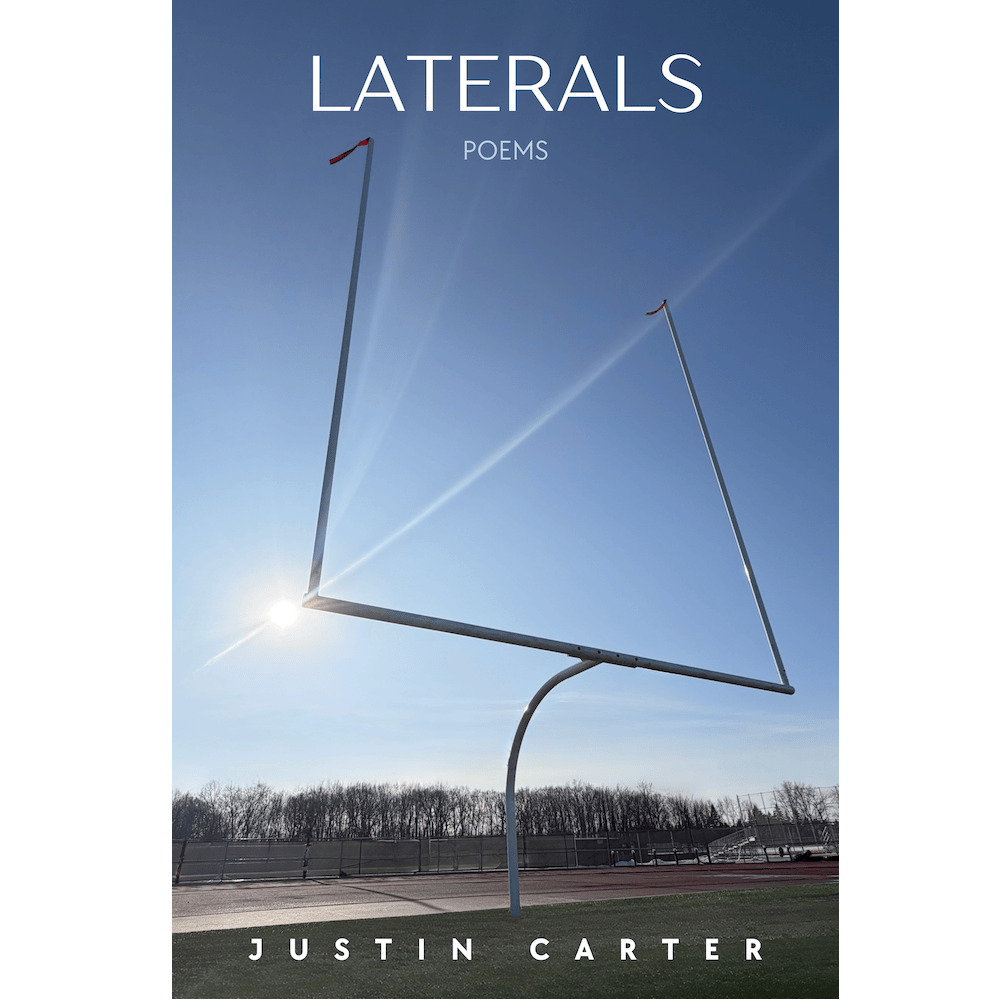
Justin Carter’s ‘Laterals’: the poetry of sport

Evocative meditations on life viewed through the lens of athletics: futility, desperation, heartbreak, and–most importantly–hope

In football, the lateral pass is one of the great acts of desperation. It ranks up there with the Hail Mary pass, baseball’s suicide squeeze, and pulling the goalie in hockey. Losing teams attempt these plays as a last resort. Most often they fail, but they offer fleeting moments of suspense and hope, and they keep fans on the edge of their seats and viewers glued to the TV.

And on those rare occasions when these acts of desperation work, they can be poetry.

Frustration, futility, desperation, heartbreak, and hope populate the sports-themed and sports-adjacent poems in Justin Carter‘s latest collection, Laterals. Published by .406 Press, Laterals arrives September 9, which coincides with opening day of the 2026-27 National Football League season. You can pre-order the book now.

Carter landed on Laterals as the book’s title “because I think it contains so much good and bad at the same time,” he explained in an email to me.

“So often, we think of laterals in football as a kind of exercise in futility—the kick return team tossing the ball around in hopes of creating something out of nothing at the last minute, but most of the time, it fails,” he explained. “Still, when it does work, it’s this thing of real beauty. I love how the title & the poems capture this quality—to be stuck, but to believe you aren’t stuck &, sometimes, to be right about that.”

As a fan of many professional and collegiate sports, I’m naturally drawn to the subject matter of this book, and I wish sports, being such an integral part of our culture, were the focus of more poetry. (More about that below.)

But even if I weren’t as interested in the topic, I’m pretty sure I still would enjoy this volume. Carter takes a playful and witty perspective of the topics, even when he was writing about the most futile of situations. And although Carter grew up in the Houston area and follows/followed many of that city’s current and former sports franchises, I, a longtime St. Louis Cardinals fan who remembers those NL Central rivalries with the Houston Astros in the late 1990s and early 2000s, have tried to set aside my bias to offer an impartial perspective on Laterals.

Justin Carter

Steeped in sports

Sports touches many aspects of Carter’s life. Readers of this site (he was featured in a Friday Five here last spring) may know him mainly as the editor of the literary journal Some Words or from his substantial body of prose and poetry, including his first collection of poems, Brazos. But Carter also writes professionally about women’s basketball, auto racing, the National Football League, and other sports endeavors.

Topics of Laterals‘ poems include Houston teams like the Rockets (NBA); the former WNBA powerhouse Comets, which folded in 2008; and the NFL’s Houston Oilers (now the Tennessee Titans) and their legendary coach, Bum Phillips, as well as local hero Nolan Ryan, Major League Baseball’s all-time strikeout leader. Now living and working in Des Moines, Carter arrived in Iowa in time to witness the Caitlin Clark era of women’s basketball at the University of Iowa and all the craziness that ensued.

The trick about writing about specific teams or sports or eras in sports history is that the subject matter can sometimes come across as an inside joke–insider baseball, if you will, to those unfamiliar with the some of the teams or moments. But with each poem, Carter deftly connects his free verse and prose poetry, even when they’re about highly specific things, to the universal.

Take, for instance, “I Wish I Remembered the O.J. Chase.” With this poem, Carter turns one of our culture’s “where were you when…” moments into a free-association piece connecting his infant son’s need to pee and a piece of fan clothing–his Houston Rockets Hakeem Olajuwon shirsey–to the famous slow-motion chase he doesn’t remember, even as he connects it to a more important cultural touchstone for him and fellow Houston Rockets fans. As he writes, “…maybe it’s fine if sometimes/we can’t find a way to make a thought grand—/maybe it’s fine for observations/to be just observations…”

Another piece that taps into universal truths through the lens of sports is “Poem For Which The Houston Comets Are A Metaphor For Grief,” a contemplation on how “we cease to exist in ways/that only vaguely resemble how/we spent our best years.” Ah, sweet futility.

These are just two of the sixty-something poems in Laterals that view life through the lens of sports and sports-adjacent topics. They include the Madden NFL video game, the COVID-19 pandemic, Monster Jams, the Pop-Tarts Bowl, Twitter, open tabs in a web browser, and playing pickup basketball at dawn after being turned away from a New York Dolls concert, among others. With Carter’s permission, I’ve posted a few of my favorite poems below.

Many of the pieces deal with the heaviness of life–the grief, the mourning, the futility of life as viewed through the lens of sports. The one about American stock car legend Dale Earnhardt Jr.’s first race after the death of his father, Dale Sr. is especially heartrending (“…It was/the first time you’d been there/since your father died/& I can’t even drive past the hospice/where my grandmother took/her final breath without/feeling broken…”). But the volume includes its share of hopeful moments, even a poem called “Loss” (“a player only gets a hit/40% of the time & yet we still/call it greatness”).

A distinctive position in the world of poetry

Apart from being an excellent collection, Laterals holds a distinctive position in the world of poetry. Think about it. How many poems about sports can you name, off the top of your head? For me, it’s a grand total of two: that famously depressing baseball poem, “Casey at the Bat,” and the paean to a boxing legend, “The Ballad of Muhammad Ali,” which I learned about only after its lines “He floats like a butterfly/He stings like a bee” were incorporated into a reggae-style radio hit (video) that was popular in my junior high days.

Let’s hope Laterals is the buzzer beater, the trick play, the Hail Mary pass that defies all odds and opens the gates to more sports-themed poetry in the future.

After all, as every sports fan knows, there’s always hope, right?

Excerpts from Laterals

Everyone In Des Moines Wants To Talk About Caitlin Clark

& they don’t want to talk about the dissonance

of loving women’s sports at a time

when the governor is pushing the whole state

to the right, an acceleration

toward limiting so many things. This guy

walks up to me in a bar & asks if I

can tell him something he doesn’t know

about Caitlin Clark. I could have said

anything. I could have told him

that birds shoot from her hands when she releases

the logo three. Could have said

she knocked one in off the jumbotron.

Everything’s believable if you have

the right subject matter. My in-laws

complain that the game is on ESPN tonight

& they don’t have ESPN. We could fix that—

I could log them in so they could watch

what might be her collegiate swan song,

but I’m not sure they want that,

to potentially witness her end. No one

does. On Twitter, the sports business guy

makes another uninformed post about NIL

like that might change something,

a different decision. His words

fork no lightning. Tell me, the man says again because I have stood

there & said nothing.

(Originally published in ONE ART)

***

When James Harden lifts for that first shot,

his body flailing as he releases,

everything is still okay—

we don’t know yet how many times

the ball will go nowhere,

or how there aren’t many months

of togetherness left. The lead’s twelve

at that point. It’s eleven

when Harden’s next attempt’s blocked,

the same score Eric Gordon misses

after that. By the fourth one,

the Rockets have actually managed

to widen the margin. Sometimes,

you get a little bit of hope—

not everything falls apart

in a linear fashion, like when I’m back

from college & my father

sleeps over. Still, it all unravels,

Harden begging for foul calls

that never arrive. I’m not sure what point

you realize how many times the ball’s gone

astray. I’m sure, watching it live,

I didn’t realize how bad it’d all gotten

until it was too late—even with the rock

clanging off, it takes until the third quarter

for Houston to lose the lead, for the game to finally slip away.

***

Some Tabs I Have Open Right Now

The Iowa State soccer schedule, because there were a lot of men in Iowa State apparel at the airport on the way to Houston—turns out, it was the rugby team, which we learned as we offboarded. The Wikipedia page for the Great Depression. The Wikipedia page for Tompall Glaser. A map of some bar in Nashville—I don’t remember why. The webcomic I’ve read for nearly two decades. A page about the WGA strike. The Idaho Vandals 2022 football schedule. The Google results for Loreen Eurovision. The McDonalds menu. The Google results for how many diapers does a newborn need. Ebay results for Steve & Barry’s jackets. The auction site where we had to bid on my wife’s grandmother’s things. The schedule for a cover band in Texas—this is there twice, months apart. Three different order screens for the bagel place down the street. The cocktail menu for a bar that recently shut down. The Google results for average novel length. The Wikipedia page for BoJack Horseman. A poem by Jane Mead.

Friday Five: short story writer Charlie Kondek

‘… in advertising I was a strategist, and I think I bring a strategist’s approach to writing.’

There’s a certain type of fiction writer who comes to the craft from the world of public relations and marketing, and brings that perspective and expertise to their work. A knack for straightforward storytelling mixed with a bit of salesmanship. Charlie Kondek is one of those people.

Charlie Kondek in his man cave, enjoying a libation and the liner notes of Gordon Lightfoot’s Sundown album.
Continue reading “Friday Five: short story writer Charlie Kondek”

New poem: ‘Our Crisis of Confidence’

How a literary magazine editor’s challenge prompted me to write this poem about my 19-year-old life

Once in a while, I encounter something online that ignites a spark of creativity.

That’s what happened in June, when Justin Carter, a writer and editor of the literary-magazine-that-looks-like-a-message-board Some Words, posted a challenge to writers on Twitter/X. Some of us were busy posting images of ourselves when we were 19. Many of us were working diligently at avoiding our writing by posting pics when Justin suggested we should instead “be writing poems about themselves at 19 & sending those poems to some words.”

Challenge accepted.

I spent that afternoon writing “Our Crisis of Confidence,” an impressionistic piece about my 19th year on this planet (November 1979-November 1980). It was a tumultuous time of high gas prices, stagflation, crisis with Iran, and a president that seemed to be fumbling everything he touched. Sound familiar? Plus ça change, as they say.

Here’s a peek at the intro:

OUR CRISIS OF CONFIDENCE

We found ourselves at Jack’s house
most Friday nights. Saturdays, too.
We’d hand over a buck or two, if
we had it to spare, to help cover
the cost of beer. Jack was of age
and always had a keg on tap
in his extra fridge on the back porch,
stacks of red Solo cups on the adjacent card table.
Sometimes the beer was flat.
We didn’t care. We came
to escape our mundane fast-food jobs,
our junior-college lives, our worries
about the uncertain future. We wanted
The Cars on Jack’s stereo, letting us know
it was okay to let the good times roll, oh-oh.

***

My thanks to Justin for posting this challenge back in June, and for accepting this piece for publication.