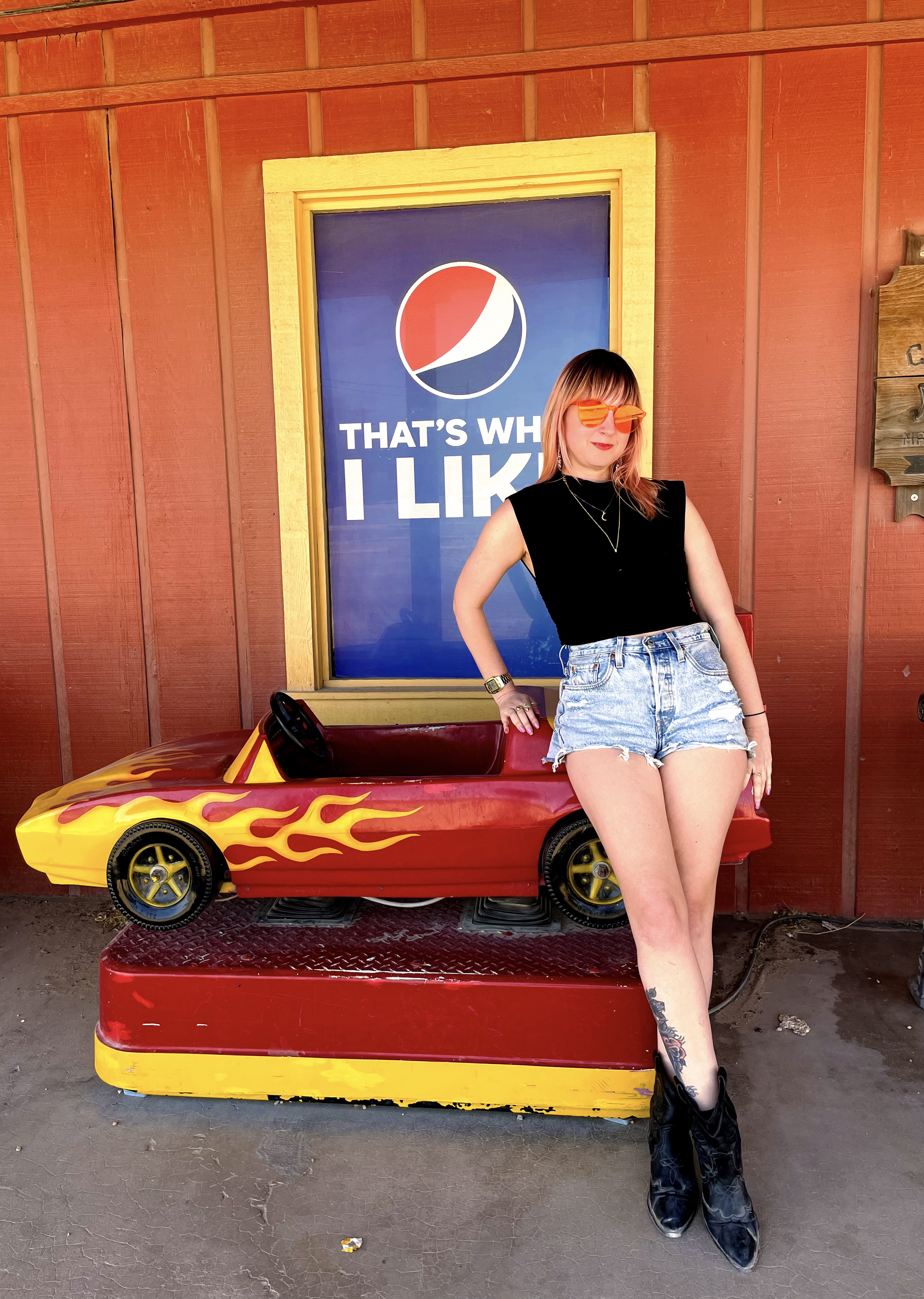
I rarely get the chance to meet, in person, a writer I know only through social media. Beyond the occasional local poetry reading, I don’t get to many literary events.
So when I found out that one of those writers I’ve known only through Twitter/X, Scott Laudati, would be doing a poetry reading at the Osage Arts Community in nearby Belle, Missouri, I made plans to be there. Scott was on the road, as he often is, and in the middle of a multi-state tour to read from his latest poetry collection, Rainbow Road, which I’d read over the summer, along with his 2022 semi-autobiographical novel Play the Devil.

Scott’s a child of the working class, New Jersey born, and those roots come through in his writing, especially in Play the Devil, a tale of a mid-twenties college dropout who returns to his hometown, works a summer as a pool boy, and attempts to discover a lost love while discovering himself along the way. Although it takes place in one section of the country, it’s as much a journey as the road trip saga that is Rainbow Road.
That Scott would include Belle, population 1,381, on his itinerary of travels–which took him from Brooklyn to Connecticut, West Virginia, Ohio, Illinois, Detroit, Philadelphia, and elsewhere–should not surprise anyone who knows much about him or follows him on social media. He’s a true literary road warrior who has more wanderlust than a dozen Jack Kerouacs. He seems to be born for the road, and he revels in discovering out-of-the-way places and what they say about the overall American experience.
Scott documents his travels not only through poetry, but also via the medium of video. On his YouTube channel, you can find great videos of several ghost towns he visited earlier this year along old Route 66, the Mother Road, which is celebrating its 100th anniversary in 2026.
When he isn’t tramping around the country, experiencing and celebrating the country like a 21st century Walt Whitman, he also fronts a band known as Camp Winapooka, which released an EP, Capture the Flag!, earlier this year. Scott sometimes performs solo at his poetry readings. Here’s the band’s official Rainbow Road music video.
Oh, and did I mention that Scott is also an artist? This fall, he will be back in Belle to exhibit some of his paintings. So if you’re in the area, stop by!
In today’s Friday Five, Scott talks about his many creative interests, early influences, life on the road, and treading water while on mushrooms.
So buckle in. We’re going for a helluva ride.
1. You are a man of many artistic interests: a poet, a novelist, an artist, a musician, a filmmaker, a pizza connoisseur, and probably many other things I’ve failed to mention here. How do you describe yourself, artistically speaking?
I was a boy that felt like I had something to prove. My dad was my enemy growing up and I can’t say I had any real friends. So I always thought there was something wrong with me–I was ugly, or dumb, or just generally repulsive to everyone else who seemed to have it very easy. Art was the thing I realized I could hide behind. I didn’t have to be appealing on the outside or try and be a different person, I could let the work speak for itself. So I became a psycho about it, diving into every medium with a ton of discipline because every day that I got better was a day further from this exterior I was born with, and I trusted that if I kept working at it eventually I’d be a person of value. I guess I’d describe myself as a bro with a great head of hair.
2. How did you first become interested in writing, and why have you pursued poetry so intensely?
I was grounded every day growing up so I read a ton of books. The first book I remember something sparking was Hatchet by Gary Paulsen. I felt just as lonely and scared as the main character but I also knew I was brave like him, too. That’s when I realized I could channel what I was feeling into characters that didn’t have to be me, but I could write pieces of myself into them.
Poetry wasn’t something I took very seriously at first and I really had no
foundation at all. I didn’t know living people were still writing poetry until I started sending mine out to get published. I always saw myself as a novelist but now I really think the power is in poetry. I love coming up with these kinds of mini campfire stories to tell about the life I’ve lived and my friends have lived and all these highways we’ve driven through night after night, between cities and states most people will never see. And it’s so much easier to get people to read a poem than a novel.
3. Your latest collection of poetry, Rainbow Road, is phenomenal. What inspired you to create this book?
Mushrooms. I was opening pools this spring and I was unbearably depressed because somehow no matter how many unions I join or girls I fall in love with I end up back in New Jersey every 3 years cleaning pools. It’s like a nightmare you think you’ve woken up from and then something insane happens and you realize you’re stuck in sleep paralysis and the only way out is death. And I was so sick of playing games with publishers, and which publisher was really hot right now and whichever one had been last year was totally irrelevant now. And none of them do anything for you anyway except posting about your book twice on their instagrams. So I was really ready to throw in the towel.
One of the owners of a pool we opened gave us a whole bunch of mushroom chocolate bars as a tip. I went home and thought, “Well, I hate my life anyway, I might as well eat all these mushrooms.” And can I tell you, I had the most beautiful 12 hours, treading water in my parents’ pool, rolling around in the lawn with the dogs, and I realized that no one could write like me and I couldn’t write like anyone else, and I had a story to tell about dragging my flag from one end of this country to the other that no one else could tell, so before I quit I knew I needed to get this last batch of poems out, and I decided to give this thing one more go, and it’s been incredible. The response has been great. I’ve met so many amazing people. As soon as I decided to just be exactly me, and stop playing other people’s games, this whole sea parted. It’s a lesson I learned early, and I almost forgot, and it basically killed me creatively. But it saved me too. I’ll fight to the death for my art; I feel like I have. No one else is going to do that for you.
4. Music is an obvious influence on your creative life, as evidenced by the title of Rainbow Road (Kris Kristofferson) and your publishing house, Bone Machine (a Tom Waits reference). Who are some of your other influences, either from the world of music or writing or filmmaking, or other fields? Please narrow to three or four, with a brief explanation of why they influence you.
This is going to sound so stupid but Green Day is the most important thing that ever happened to my life. I went to Catholic school and never really heard any music until my neighbor, Philip, a Jewish kid who went to public school invited me over in third grade. I went to his house and he played me Kerplunk by Green Day and it was like a nuclear bomb going off in my soul. It was really like a person who’d lived in a cave their whole life suddenly being handed a slice of the best pizza. It changed the whole game. After that everything was boring. I’d been handed the Rosetta Stone of a different Universe. And it set the rest of my life in motion.
That’s the only important influence. Everyone else steered me lyrically, or expanded on my consciousness, but Green Day was the revolution. My whole life, for good or bad, was just a result of that day in Philip’s bedroom.
5. What is the most challenging aspect of the road warrior artist’s lifestyle?
Going home. The road is the only way to live in “the now.” All you have to do is soak in a new city, sell yourself to the audience, and then hang out with a bunch of cool people after the show. You haven’t eaten, you haven’t slept, you’ve been hungover every day for a month. It’s the best. Going home is hard. Once you’ve gone feral it’s impossible to become a citizen again. You’re just looking for the next way out.
BONUS QUESTION: Your final poem in Rainbow Road, “Outer Sunset,” is a heartbreakingly beautiful piece that end with the lines “The last poem I’ll ever write/never to begin again.” Should we readers take this statement literally? Is this truly the end of the road for Scott Laudati the poet? If so (or if not), what comes next? (Okay, that’s three questions. Sorry.)
I think I’ve said everything I have to say. I think I said it all in my first book and I’ve just been rewriting the same poem for almost two decades. Men used to go out to sea when they felt like this. I found a church in Rich Fountain, Missouri, that called me up the mountain to its altar. I’m not sure what it means but I think I will soon.
***
- Follow Scott Laudati on Twitter/X at @ScottLaudati.
- Read this excellent interview of Scott by Jennifer Ostopovich on Hobart Pulp‘s website.