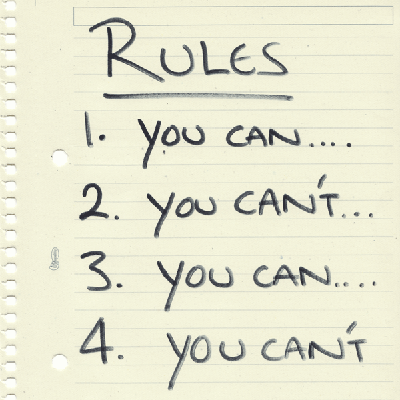
Sometimes you gotta break the rules

//fleetwoodwack.typepad.com/graphics/rules.gif</em>
Image via http://fleetwoodwack.typepad.com/graphics/rules.gif
As a serial contributor to the decline of social media — i.e., the disturbing trend of pushing RSS feeds of news releases to our university’s Twitter and Facebook sites — I was happy to read some positive reinforcement that, sometimes, it’s OK to post press releases to Facebook groups.

That’s the first of three social media “rules” addressed in this post by Bryan Howland, “Three Social Media Rules We’ve (Intentionally) Broken.” (Thanks to Malli Gero for posting the link on the PRWise LinkedIn group.)

The bottom line for a business [or university-ed.] engaging in social media is to give their audience/customers/fans, etc. what they want. It is far better to have happy customers than it is to worry about what the social media “purists” think about your efforts.

Here, here.

As for posting press releases in social media space, Howland points out that you can use press releases to create an interactive experience with Facebook fans or Twitter followers. “Sometimes,” he writes, “your fans want to read your press releases. … [D]on’t take advantage of your fans, or confuse promoting your business with engaging with them, but don’t be afraid to give ‘em what they want either.”

Our automated Twitter feed to Facebook pushes news releases and blog posts to our fan page. Sometimes, people even interact with those posts.

Then again, we try to mix things up a bit on both Twitter and Facebook. We manually post tweets and status updates from real live people typing on real keyboards, just like I’m doing right now. (Or so you assume.) As Rachel Reuben pointed out in a recent .eduguru post, “Something as simple as a [Facebook] status update that ties to an emotional time in new, current, and former students lives seems to resonate.”

So, what social media “rules” are you breaking?

Mark Greenfield’s Delicious bookmarks

Out there in the higher ed social media sphere, you’ll run in to all types of people. But when it comes to scouring the web for interesting, useful stuff, aggregating it and sharing it with the rest of us, you won’t find anyone better than Mark Greenfield.

Mark’s Delicious bookmarks are a fantastic resource. Connect with Mark’s Delicious feed, and you’ll connect with great resources about education, social media, marketing, etc., all reviewed and vetted by a seasoned marketing and web pro.

Mark is one of the few higher ed influentials out there who knows how to use social bookmarking as a connector to those of us who spend more time blogging and tweeting than bookmarking. He’s also one of the few true experts who manages to expand our knowledge base without inserting his ego into the mix. Thanks, Mark, for sharing all this great information in a straightforward, spin-free manner. We could use a lot more of that these days.

(Follow Mark on Twitter — @markgr — to get his latest finds.)

Friday Five: pay it forward edition

Happy Friday! Why not take some time today to pay it forward in your social mediasphere? Here are five ways you can do that:

  1. Comment on a blog. Spend a few minutes surfing some of your favorite blogs (or better than that, read some not-so-familiar blogs) and then post a comment on a post that especially resonates with you. Since the idea here is to pay it forward, the comment should be positive or constructive, but sincere. And make it meaningful — something more than, “Great post, Johnny!” (Note: I’m not purposely trolling for comments here.)
  2. Retweet — sincerely. On Twitter, the practice of retweeting has become a big part of the experience and has become the Twitter version of paying it forward. People retweet articles and blog posts they like, so that other members of their networks can get in on the action. But as often as many people retweet (RT) posts, I get the feeling some folks aren’t really reading the contents; they’re just forwarding the links the way your Aunt Gracie forwards emails about Microsoft money giveaways or Neiman-Marcus cookie recipes. So, don’t be one of those people. Don’t gratuitously retweet. But do retweet those posts or articles you find worthy of the act.
  3. Give a Facebook friend the thumbs up. Use Facebook’s “like” application to let some of your Facebook connections know you like or appreciate their status post.
  4. Give props. If you’re on the popular music site blip.fm and hear a song you like, give that DJ props. Better yet, reblip the tune. (Reblipping is the musical version of retweeting.)
  5. Send an email. Remember email? OK, technically it doesn’t fall under the social networking rubric. But still, it’s a good way to connect with some folks. How about dropping a line to someone today to congratulate that person on a job well done, or even just let that person know he or she is in your thoughts?

After who, what and how: testing, then tactics

In my previous post, 3 simple questions for communicators, I discussed the who, what and how questions to ask before embarking on any sort of communication campaign. To recap, the questions are:

  1. Who is your audience?
  2. What do you want to tell them?
  3. How do you want them to react?

There’s more to it than that, of course. If you haven’t read the earlier post, the following won’t make as much sense to you. So, please, go back and read it now.

Waiting…

Finished? OK. Now that those questions have been answered, it’s on to the next step:

1. Test your assumptions. You’ve figured out your audiences, your message and your desired result. Now it’s time for a reality check. Will your messages yield the desired results? Find some people from the audience and ask them. This doesn’t have to be a thorough or time-consuming process. You probably don’t have time to conduct a survey or focus group, anyway. Instead, go for coffee with an audience member or two, tell them what you’re trying to accomplish, and see what kind of feedback you get. Then adjust your messages accordingly.

Before you end the conversation, don’t forget to ask your audience members about…

2. Preferred media. What’s the best way to get your message to the audience? Would your audience be more likely to receive your message if it were printed on a postcard? Or would an email work better? Should you host an open forum to share your message, or will a simple news release work? Besides asking your audience, you can also rely on market research that’s readily available online. For example, we know from Noel-Levitz’s E-Expectations research (PDF) that 70 percent of college-bound high school seniors prefer to go online to complete an application but that when it comes to receiving a notice of acceptance into college, an equal percentage prefer to receive that message via snail mail.

3. Tactics — finally. OK. Now we’re ready to talk about the tactics. Here’s where you figure out how to get the message into the right vessel — the right medium — for shipping it to your audience. No need to get into depth here. You’ve done the hardest part, and if you’re reading this you’re already a seasoned communicator, so you know all about tactics.

But as you develop your tactics, be sure to build in some sort of measurement ability so you can evaluate the process later.

4. Evaluate and measure. How will you know whether your communication campaign was a success? You have to evaluate it. This in itself could be the subject of an entire series of blog posts, so I won’t get into this too heavily. But measurement takes many forms, some of which are more valid than others. If you’re trying to raise money, increase attendance, increase the admit rate for your school, etc., then it’s pretty easy to measure the numbers. But if you’re trying to measure awareness or some other nebulous concept, then it’s going to be tougher. You may have to conduct surveys or talk to your audiences afterward. If you want some insight on measurement, I highly recommend you subscribe to K.D. Paine’s PR Measurement Blog. K.D. is a leader in the business of measurement and analytics. I’d also recommend you take an extra step and buy K.D.’s terrific book, Measuring Public Relationships: The Data-Driven Communicator’s Guide to Success. It’s worth the investment.

Disclaimer: I don’t always follow my own advice. Sometimes I get caught up in the immediate, urgent screeches of “We need to do something! Now!” and forget that there’s a better, more effective way to do things.

If nothing else, writing these two blog posts has served as a reminder. I hope this and the previous blog post will help you in your future communications planning.

3 simple questions for communicators

It happened again last week. I got a panicky phone call from a mid-level campus administrator in a perceived communications crisis. The faculty member who chairs a committee this administrator staffs was in the room with her (and probably contributing to the staff member’s heightened state of anxiety), so she put me on speakerphone and outlined her concerns.

“Nobody knows about all the great things we’re doing,” she exclaimed.* “How can we get the word out?”

My response: “Who are you trying to reach?”

“Everybody.”

Then the faculty person chimed in: “We’ve got a bunch of great stories to tell. We really need to do more press releases about what the committee is doing.”

Hooboy.

So began a conversation that has, alas, become familiar terrain for me, and probably for many of you. Before we got too wrapped up in talking about tactics and vehicles — press releases, brochures, websites, etc. — I managed to steer the conversation toward my canned pitch about thinking strategically about communications and the three questions that must be answered before anyone can create an effective communications plan. The same questions work for any type of communications, including marketing communications.

The three questions that every communicator must answer before attempting to create a communication plan or strategy

1. Who? Who is your audience? Whom are you trying to reach? This is the first step. Define your audience. “Everybody” isn’t an audience. And it’s OK to have more than one audience. If that is the case, then:

  • Segment. List all possible audiences you want to reach. Then,
  • Prioritize and focus on the top three for starters.

Implied in step 1 is that you know something about your audiences. If you don’t know about certain audiences, then get up to speed quickly and learn something about them, or consult a member of that audience for some guidance. Find out what makes them tick. (I’m generalizing here, but you’ve got to start with something.)

2. What? What do you want to tell your audience(s)? What is your message? You may have more than one message for each audience, but try not to complicate things. Try to stick with two messages per audience, three messages at most. Keep the messages short, simple and to the point.

You’d think that we’d know what messages we want to communicate. But you’d also be surprised how little people actually think about messaging and just wing it. (I’m as guilty of this as just about anyone.)

3. How? How do you want your audiences to react? What action or response do you want from the audience? Do you want to increase giving rates? Raise awareness? Once you figure out the response from each audience, then go back and review your messages to see whether they’re likely to elicit the type of response you’re looking for.

These are three simple questions. But they aren’t necessarily easy. To answer these questions requires thought, planning and objectivity. (As for objectivity: You may think you know what messages will elicit the response you’re looking for, but your audiences may have other ideas. It wouldn’t hurt to test the ideas with members of those audiences, either formally or informally, before you go beyond the three-questions stage of planning.)

If you answer these three questions — or help someone else answer them — before you attempt any sort of communication plan or strategy, you’ll probably cut back on a lot of stress, angst, rework and false starts down the line.

In my next post, I’ll talk about the steps to take after answering these questions.

As for last week’s conversation, I followed up with an email outlining these steps with a simple spreadsheet seeded with possible audiences to help them get started. I’ll follow up at the end of the week to see if they’re making progress. If nothing else, maybe at least they’re thinking about communications a bit more strategically.

* To Tim Nekritz, if you’re reading this: I know I just violated your prime directive of news-release writing, which is also good advice for blogpost writing. But she really did exclaim. I swear she did. I could hear the exclamatory tone in her voice. At least I didn’t write, she panicked, which would also be accurate.