Social media: Policies or guidelines?

As my co-presenter Teresa V. Parrot and I continue working on the content for our upcoming Academic Impressions webcast, Starting A Social Media Policy, a recurring question arises:

Should universities have social media policies or social media guidelines?

I’d like to hear your thoughts on this subject. If your institution has a written social media document, is it a policy or a guidelines document? Which approach is preferable for your institution? Why? What are the advantages or drawbacks?

If you have strong opinions on this subject, please weigh in below. I’d love to steal your ideas.

Also, if you have a social media policy and would like to share the link, please also post it below. Thanks to those of you who shared your policies in the comments section of my earlier blog post on this subject.

Friday Five: 5 on 5

Like the day tripper of musical fame, I’m taking the easy way out on this week’s Friday Five. How so? By offering up five recent, more-than-decent blog posts, each about five things. Which means that this week you’re actually getting 25 things for the price of five. That’s better than your average Friday Five, which is always a great deal for the money. So, enjoy, and you’re welcome. Happy reading, and happy weekend.

  1. 5 (+1) keys to social media platform adoption, or “why some [social media platforms] catch on easily and others don’t.” Wise words from fellow higher ed blogger Tim Nekritz.
  2. 5 tactics for civil disagreement, a thoughtful post from Amber Naslund on disagreeing in ways “that can help take the disagreement in a constructive direction instead of leaving a wake of destruction, misunderstanding, and hurt feelings.”
  3. 5 innovative websites that could reshape the news, via Mashable, which says: “It’s difficult to predict whether or not these newly noticed innovators will become as popular as their predecessors, but they are introducing new approaches to the consumption of information that few have tried or thought of before.”
  4. Five reasons I’m not quitting Facebook, by Peter Shankman. Any blog that quotes Casey Stengel is worth sharing, if you ask me.
  5. Conan O’Brien’s 5 favorite YouTube clips, via Mashable again.

The big payoff

Commencement$$-2010-smPlease indulge my media relations persona for a moment as I talk about one reason I love working at a land-grant university with a focused mission on engineering, science and technology.

It’s because, even in this down economy for many college graduates, a lot of our new graduates are getting great starting salaries, and even multiple job offers. This is a great success story that resonates with a lot of people — especially parents of prospective students. And the news media, which cover this story with headlines like: Big Paychecks Still Obtainable for Some New Grads.

Of the 10 highest paying college degrees in the nation these days, our campus offers nine of them. And while we don’t offer the other one (industrial engineering) by name, our engineering management program is similar, and many grads from that discipline move into the same kinds of positions as industrial engineering majors.

I guess in a way I’m fortunate to work for such an institution during times like these. Engineering, IT and related fields are usually a safe bet in a down economy. Even so, we in the communications office sometimes philosophize about just how much we ought to crow about something so crass as starting salaries for our graduates. It’s not all about the money, is it?

This is what happens when you get liberal arts and journalism majors handling the PR and marketing for a university so focused on science, technology and measurable outcomes like starting salaries. (To make matters more difficult, one of us holds a minor in philosophy.) Some of us tend to side with one of the commenters on Seth Godin’s recent “higher ed meltdown” post (Seth Godin again!), who wrote:

The critical function of college education is to help students build a solid foundation of validated knowledge and to develop critical and analytical skills to identify the solid knowledge in the unevaluated mass of information that threatens to overwhelm us.

There’s nothing wrong with that. But those of us who work for land-grant universities have another, more pragmatic (even vocational) calling to prepare students for professional work.

Land-grant universities were created to train doctors, lawyers, agronomists, engineers to serve society in functional, pragmatic ways. To do that, of course they must have the critical and analytical skills the commenter quoted above insists is the critical function of higher education.

So, what is the big payoff of higher education? Is it the opportunity to start post-college life with a good job at a high salary? Is it a well trained critical mind? From my perspective, having the opportunity to do the work you love and to get paid well for it, while also being able to think critically, creatively and constructively, is the main thing. As our state’s governor, Jay Nixon, said in his commencement address to Missouri S&T graduates last weekend, our world needs philosophers as much as it needs physicists. And both should be able to make a living for their contributions to the greater good of society.

Photo: Missouri S&T May 2010 Commencement. Photo by B.A. Rupert.

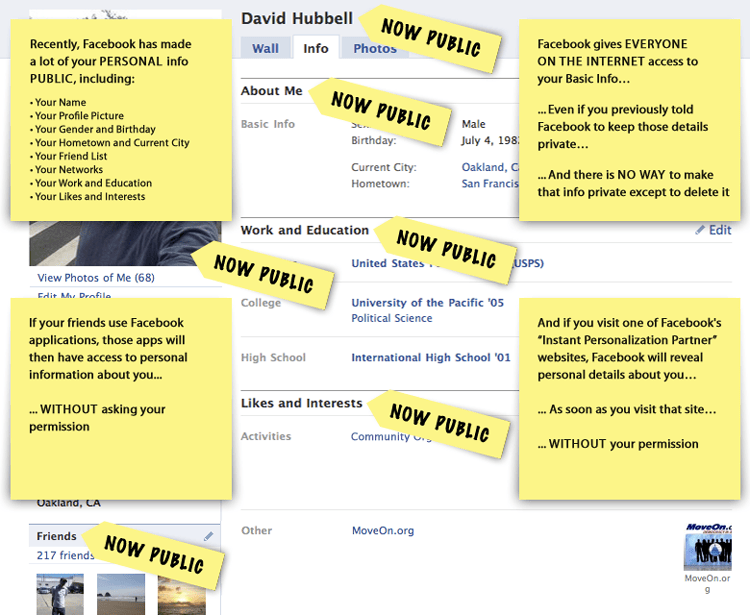
Infographic of the day: What’s public on your Facebook profile

In all the discussions I’ve read online about Facebook’s move from privacy to publicy, none have depicted the issue quite as accessibly as this infographic. Look below to see just how public the default settings of your Facebook profile truly are.

Facebook_Public

Thanks to Jeremiah Owyang for sharing via Twitter.

Friday Five: Facebook fallout edition

Was this the week the Facebook backlash reached a boiling point? It sure seems like it. The boil-over comes on the heels of concerns over Facebook’s decision (last month) to allow community pages. This created quite a bit of angst among Facebook page managers in the higher ed community. (For more on this, see Michael Fienen’s post, Facebook Hates Your Brand, and Jessica Kryosa’s follow-up, Facebook Communities: Now What?, both on .eduGuru.)

The bigger issue for many of us, however, is the continuing erosion of privacy for Facebook users. Here are five posts from some pretty smart people that ought to concern you, if you care about privacy matters.

  1. The Big Game, Zuckerberg and Overplaying Your Hand, by Jason Calacanis. “Over the past month, [Facebook creator] Mark Zuckerberg, the hottest new card player in town, has overplayed his hand. Facebook is officially ‘out,’ as in uncool, amongst partners, parents and pundits all coming to the realization that Zuckerberg and his company are–simply put–not trustworthy.” Hat tip to Michael Stoner for directing me to this blistering rant that outlines who’s been “Zucked” and how.
  2. Gizmodo offers the top 10 reasons you should quit Facebook. This one’s pretty blistering, too. Hat tip to Sasha Wolff for this one.
  3. Facebook and Privacy: What a Mess, from PC World, discusses new controls the company has initiated in an attempt to counter the backlash. But as PC World points out, “Neither [of two new controls] … does anything to fix the massive mess with how Facebook is handling your personal information.” (Via Mark Greenfield.)
  4. Facebook Fail: Publicy Backlash is Stowe Boyd’s analysis from last Saturday of the social network’s shift from privacy to “publicy.” “Facebook’s shifting policy from private as default to public as default is a reflection of the open web. … However, because Facebook is in a sense trying to track a general shift in the web, it is such a large player — and with so many users that aren’t at the forefront of this trend — a lot of innocent fingers are getting crushed in the machinery.” (Via Andrew Swenson, aka @wordpost.)
  5. Is There Life After Facebook? Leave it to old media stalwart The New York Times to ask such a heretical question.