

To call After Dinner Conversation an atypical literary magazine would be an understatement as well as a disservice to this multi-faceted media operation. Founder and editor-in-chief Kolby Granville (@kolbyg on X/Twitter) set out to create a magazine that used the art of fiction to delve into weighty ethical and philosophical issues, and he’s accomplished just that.
After Dinner Conversation Philosophy | Ethics Short Story Magazine is published monthly to offer, in the words of its website, “intriguing, thought-provoking conversations about ethics, philosophy, and social issues.” But After Dinner Conversation is more than a litmag. It includes podcasts, books, teaching aids, and more.
In addition to his busy work as a publisher, Kolby is also a practicing defense attorney. He took some time out of his hectic schedule to tell us a bit about After Dinner Conversation.
1 – With its focus on short stories that explicitly address ethical and philosophical issues, After Dinner Conversation is an unusual sort of literary magazine. Why did you decide to focus on ethics and philosophy?
Honestly, I decided on this format because these are the stories I enjoy reading. When you think of “great books” like Huck Finn, Slaughter-House Five, or The Great Gatsby, we don’t read those stories because we want to learn about the life on the Mississippi, or being a bootlegger in the 1920s. We read them because we want to learn about how our values are created, and how we hold onto idealized versions of lost love. We read those stories because the plot is a tool for the author to talk about some universal truth that is important and timeless. If you know that’s what makes great stories, why not focus on publishing those kinds of stories? Great books, at least for me, aren’t about what happens; they’re about helping me understand the human condition through story examples.
2 – Several of your more recent issues have been focused on specific themes. How do you decide which themes to highlight in these issues?
We actually don’t intentionally do themed issues. That said, it seems that our magazine issues do have themes. That, however, is just luck of the draw; we publish stories in the order we find them. Any themes that emerge are just by chance.
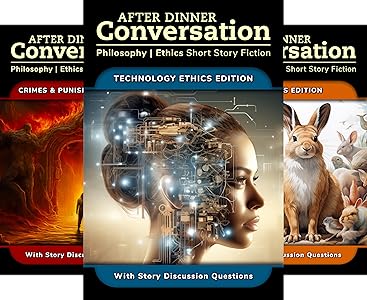
That said, in 2024 we published a series of nine themed books containing short stories previously published from our magazine issues. Those came about because we sent out a call to our readers to be guest editors. We accepted themed proposals and picked the ones we liked the best.
3 – Do you believe stories have to explicitly address an ethical or philosophical question to be effective? Why or why not?
Yes and no. Every author has things going on in their life and things they are thinking about. When they write a story, those themes they are thinking about naturally come out in their writing in small ways. Even the most plot-driven book is written by a human being, and that means they emotions they are feeling in their life turn up in them. Heck, even a Garfield comic has a theme. In the case of After Dinner Conversation, we would say to authors, “Think about what is going on in your life. Think about what moves you and what you are struggling with and chat with friends to explore every aspect of that idea until you have polished it down to its core issue. Then, write a short story that gives you a sharp tool for bringing that core issue to a focal point.” That’s the story we want to publish.
4 – What kinds of stories are best suited for publication in your journal?
Well, for sure, we publish short stories with ethical and philosophical questions in them. Something with a “help us get to a universal truth of what it means to be human” sort of thing. Genre is irrelevant, and just a tool for the end goal. Which begs the question, how do you come up with this kind of story? You talk with friends, and you play with moral examples. For example, let’s say you have a friend who is in favor of gun control, and you are not in favor of gun control. Talk with them until you have gotten to the very core of the human difference between the two of you on this issue. Your gun control opinion is the result of your belief system, not the cause. Your belief related to civil liberties is the cause of that opinion (maybe, maybe it’s something different). But, digging even deeper, maybe your belief in a person’s moral obligation to maintain their own life, even at the expensive of another’s life, is the real reason for your opinion. Keep digging. Eventually, you will find the core value that all other opinions flow out of related to gun control. Now that you have that core thing, forget gun control, and create a story that challenges people related to that core value in a clear way that reasonable people might have different opinions on. That’s how you write a great story we want to publish. The plot is the tool for the thing you really want to talk about.
5 – What advice would you give writers who are interested in tackling ethical or philosophical questions in their writing?
This is a tough one, as I certainly know people are the spotless mind, so to speak, and I’m not sure how you teach being something different. For some people, the world is just pretty pictures that move past you each day. But, at a core level, I would say, if you want to tackle these kinds of questions, first, seek to understand how smart people come to different reasonable conclusions. Then play with scenarios until you really draw out the sharp edge of why they are different.
- For educators, Kolby offers low-cost ($1.49 or less) lesson plans for grades 2 through college.
- Tune in to the After Dinner Conversation podcasts.
- Flash sale: purchase three issues of After Dinner Conversation Philosophy | Ethics Short Story Magazine for $1.
- Tune in to this interview with Kolby on the Short Story Today podcast.
- Follow After Dinner Conversation on Twitter at @afterdinnercon.

 Andrew Careaga
Another great Friday Five–thank you!