
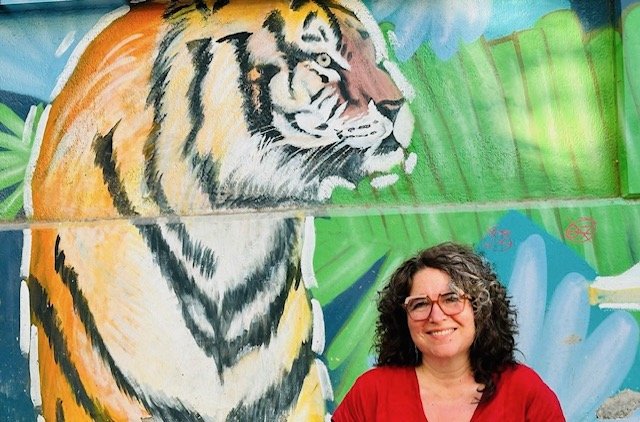
In today’s Women’s History Month Friday Five, I’m happy to feature Rebecca Tiger, a writer and sociologist known for her work in both creative and academic spheres. As an associate professor of sociology at Middlebury College in Vermont, she teaches courses on topics like punishment, deviance, drugs, and celebrity, often blending sociology with creative nonfiction. As a creative writer, she has published fiction and nonfiction in various literary journals, including an award-winning essay recognized in a 2024 creative nonfiction contest(“Where’s Charlie,” published by Roi Fainéant Press). Rebecca also teaches creative writing in jails.
I first discovered Rebecca’s writing via her flash fiction piece “Dissection,” a powerful story about life, death, and family published in Trampset. I’ve since read other pieces by her — fiction as well as nonfiction — and have always been moved by the power of her stories and the way she puts the words together. Read on to learn more about her writing and academic work, her advice to other writers, and teaching creative writing to the incarcerated.
1. As a writer of both fiction and creative nonfiction, how do you decide which form a story demands, and what’s the wildest thing you’ve learned about yourself through each?
My fiction often starts with something I see, hear, witness and then I make up an interaction between characters. My creative nonfiction is usually based on a situation that I’ve been a part of; I am a character in the story either as an observer or as someone who interacts with the other people I write about. Often in my creative nonfiction, my perspectives as an observer are central.
I recently wrote a story based on something I heard that happened to one of my students who I taught in jail, in his cell. I wrote it as fiction — I tried to imagine the interaction between my student and the guards that left his face bloodied and bruised. The story didn’t work — it raised more questions than answers — and I wasn’t able to craft more about the main character than what happened to him in the jail cell. So, I rewrote it, embedding the fictional part into a larger creative nonfiction piece about why I am still puzzling over this event that happened years ago. My struggles with the fictional element, which I wove into this story, are now part of the overall piece (which I’m still working on).
When I have a hard time writing something, the best solution for me is to write that struggle into the story. This means that the line between fiction and creative nonfiction is purposely blurred as I also write about writing and its challenges. My story “There is No Ordinary” is an example of this: I write about the struggle I had writing about grief, how to tell a story that I felt unable to tell.
The “wildest thing” I’ve learned is that the more honest I am about myself and others, and I write some very direct things about bodies which are usually falling apart or decaying, the more my work resonates with people. This is very different from the restraint of academic writing. I had to learn how to be comfortable with my stories being out in the world for people (including some of my students) to easily access precisely because these stories are very personal. For example, “Not Cool” deals with my changing menopausal body and sex in very direct ways. Now, when I feel uncomfortable or even shame about something, I know it’s time to write! I love the freedom of fiction and creative nonfiction and the kindness of the writing community — I don’t take any of this for granted.
2. As a sociology professor, how does your academic lens — studying punishment, drugs, celebrity — shape the characters or themes you explore in your creative work?
My focus in sociology is on institutions of control and micro-interactions within them. I am very much shaped by sociologist Erving Goffman’s work on “total institutions,” which he writes about in his book Asylums. Unlike grand theorists, Goffman pays attention to how people interact and how they reflect and make meaning of the world through these interactions. My stories are influenced by this approach: an intimate conversation between two people can say so much about human nature and our (in)ability to communicate with each other. My characters are often trapped but they are still working things out within these confines.
Institutions are generally unreliable narrators of themselves so I try to investigate them to see what is really going on, what they are truly up to beyond their official descriptions of themselves. I really experienced this when I spent a year taking care of my mother who was living in a memory care facility. The interactions among the residents, and the residents and staff, make up a large part of many of the stories I’ve written about dementia. There was tenderness, sadness, anger and sometimes little moments of joy, almost immediately forgotten by the residents. If I hadn’t watched it closely and paid attention, I would have missed these things. Institutions confine us but there is freedom and humanity and messiness at the margins so I tend to focus on those places.
3. You’ve named writers like Annie Ernaux and Deesha Philyaw as inspirations. Who else (or what else) lights a fire under your writing, and how do they push you to take risks?
I have had so many wonderful teachers but two in particular stand out. Arya Samuelson, who writes gorgeous creative nonfiction, has played an instrumental role in getting me to see the heart of what my stories are about. She pushes gently and continues to be a profound influence on me. Kate Senecal has developed the best writing community I’ve found – she creates structured opportunities for generative writing and formal feedback, both of which have elevated my writing tremendously. Through space to develop, explore and refine my writing, Arya and Kate both have pushed me to find the story beneath the story.
4. Teaching nonfiction in jails as well as in the classroom must give you opportunities to work with a diverse range of students. What is one piece of advice you’d give aspiring writers, no matter where they’re starting from?
The only advice I can really give is: Write! It’s a practice. Your writing won’t get better if you leave it aside for days at a time and your writing doesn’t care about any reasons (many of which are valid) you might have for not tending to it. Anyone can become a good writer if they work on it. Also: if you write, you’re a writer so don’t get caught up in who gets to label themselves as such. Just write!
I guess, too, I’d say: read. A lot. And if you have online access: there are so many wonderful literary magazines you can read for free. If you don’t have time to finish a novel, you can read amazing flash work by the incredible community of writers whose work is made accessible to us. In all my classes, I bring in flash stories for us to read, often aloud, so we can see how an author deals with dialogue or point of view or setting, so that students can see that all writers are using these to tell a story well and with honesty.
And lastly, have fun and treat writing as play. I have to remind myself of this too.
5. Your award-winning essay “Where’s Charlie” nabbed a creative nonfiction prize. What is one trick or technique you leaned on there that you’d urge other writers to try?
I started writing braided or woven stories before I knew there was such a thing. I felt hampered by linear storytelling and found my mind naturally moves around thematically rather than chronologically. If you’re writing and done with a scene and you want to go onto something else that seems unrelated, just make a section break and write the next thing that comes to your mind. Eventually, you’ll start to see subtle connections. Also, I don’t believe you need to spell these connections out. If you work them into the story, you can let your readers meet you halfway and figure out why you have juxtaposed scenes the way you have. It’s okay if there’s a little confusion (on your part and theirs)!

 Andrew Careaga
Thank you for another inspiring Friday Five!