

For most of you who celebrate St. Patrick’s Day, the subject of this post may seem premature. But at the university where I work, students have honored the alleged patron saint of engineers for 105 years now, and their celebration begins long before March 17.
The annual St. Pat’s Celebration at Missouri S&T begins in early March with students using hand-carved walking sticks to drive snakes from campus to prepare the way for St. Pat (it’s okay; the snakes aren’t real), and wraps up this weekend with a knighting ceremony, big parade and a lot of parties.
Historically, St. Pat’s is one of the biggest social events for our campus. (It’s even been named one of the top 15 best St. Pat’s parties in the nation by BroBible. Yes, BroBible is apparently a thing.)
So it makes perfect sense that we should embrace social media to help connect students, alumni and others to this campus tradition. That’s why the Internet invented social media, right?
So here are five ways we use social media to help make the annual St. Pat’s celebration a great time for everyone involved.
1. Blogging

Way back in 2008, when our campus celebrated the 100th anniversary of our St. Pat’s celebration, we launched the Best Ever Blog as an attempt to connect far-flung alumni with the big centennial to-do.
We launched it in January 2008 to help build momentum for the anniversary and to have a little bit of fun along the way. Irreverence is a big part of the annual celebration, so it’s important that we have a human voice when we talk about St. Pat’s. It all begins with the blog. Also, the “voice” must extend beyond words. St. Pat’s is a very visual time of year — and very, very green — so we try to incorporate as much photography and video into the blog as we could.
2. Flickr
From the start, we pulled a lot of the images for that blog from a collection of St. Pat’s photos housed on our campus Flickr account. We still use Flickr to collect and organize the great shots taken by our campus photographer, but for those in-the-moment shots of events as they happen we’ve equipped several staffers with access to …
3. Instagram
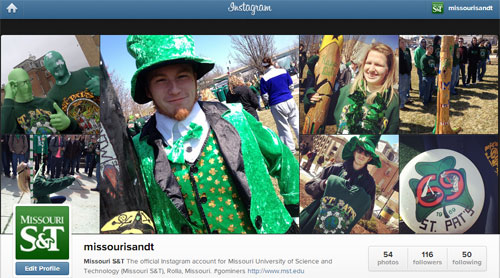
To coincide with St. Pat’s Week (which began this past Monday), we launched our official university Instagram account, and boy has it been fun. The visual nature of the week’s events makes it ideal for smartphone coverage. Four of us attend events and snap pics with our cameraphones, while our real photographer weeps into the viewfinder of his professional-grade digital camera. (I think it’s a Nikon. But I don’t know for sure. All I know is it isn’t an iPhone.)
4. Twitter
Even before we launched the Best Ever Blog back in 2008, we were on Twitter. During St. Pat’s Week, our Twitter account (@MissouriSandT) is packed with St. Pat’s-related tweets and references. This year, thanks to Instagram, we posted many more photos to Twitter than in the past, and that expanded activity and reach. The student organization that puts on the annual event (@StPatsBoard) is also active on Twitter. And our students and alumni talk up the event with a variety of hashtags, including #StPats, #StPats2013, #BestEver, #RollaStPats and #105BestEver.
5. Facebook

Ah, yes. In terms of raw numbers, Facebook still rules. (But in terms of activity among our followers during St. Pat’s, Twitter wins.) During St. Pat’s, our Facebook site becomes more visual than during most other times of the year (as is the case with most of our social media). We change the cover photo to something frivilous. We get a lot of thumbs up and a few shares, even the occasional comment.
Bonus: Vine
This year, for the Wednesday arrival of St. Pat and his court to downtown Rolla, one of our staff members recorded the arrival and part of a walking stick presentation using the iPhone video app Vine. We tweeted the arrival Vine video and posted it on Facebook.
* * * * *
St. Pat’s is an unusual celebration that is distinctive to our campus. It’s also an annual event that gives us an opportunity to test and experiment with social media. this year, the experiment extended to Instagram, Vine and, although I didn’t talk about it here, even Pinterest. A year ago, Vine didn’t even exist, but we posted some videos on our YouTube channel. So next March, who knows what new social media toys or tools may be upon us? What will the 106th annual “Best Ever” have in store for social media?
Whatever it is, we’ll be sure to investigate some of them, and see whether they fit with the nature of our annual rite of (almost) spring.
 Andrew Careaga