A long music list project for a long weekend

Yes, it’s the Fourth of July, Independence Day (and Fossil Fuel Independence Day, according to Steve Knight), and I should be getting ready to celebrate. I will, soon. But there’s some important blogging to be done first.

While scanning my RSS feeds last night, this challenge to list a favorite album from every year of your life jumped out at me. I love to waste time compiling lists, so this is the kind of challenge I relish. Feel free to take up the challenge yourself. If you do, let me know where you posted your list.

You’re not required to create your list from memory. If you need help, feel free to consult Wikipedia’s years in music list, or check out Christgau’s list, which goes back to 1971, which unfortunately is not far enough back for me. I gotta admit, it’s tough trying to think about albums from my earliest years. The concept of an LP didn’t really take form until the early 1960s. Fortunately, I grew up in a very musical household.

The years and albums in bold type are those I could remember without any Internet assistance.

1960 – The Ventures, Walk Don’t Run
1961 – West Side Story soundtrack
1962 – Herb Alpert and the Tijuana Brass, The Lonely Bull
1963 – Bob Dylan, The Freewheelin’ Bob Dylan
1964 – The Chipmunks, The Chipmunks Sing the Beatles (very popular among 4-year-olds at the time)
1965 – The Beatles, Rubber Soul
1966 – The Beatles, Revolver
1967 – The Beatles, Sgt. Pepper’s Lonely Hearts Club Band

1968 – Big Brother and the Holding Company, Cheap Thrills
1969 – The Beatles, Abbey Road
1970 – Creedence Clearwater Revival, Cosmo’s Factory
1971 – The Who, Who’s Next
1972 – The Rolling Stones, Exile on Main Street
1973 – Pink Floyd, The Dark Side of the Moon

1974 – Frank Zappa, Apostrophe
1975 – Bruce Springsteen, Born to Run (close to a three-way tie with Patti Smith’s Horses and Kiss Alive!)
1976 – Ramones, Ramones
1977 – Talking Heads, 77
1978 – The Cars, The Cars (runner up: The Rolling Stones, Some Girls)
1979 – The Clash, London Calling (best album ever, btw, and technically it wasn’t available in the U.S. until 1980 but it came out in ’79)
1980 – Pretenders, Pretenders
1981 – The Clash, Sandinista!
1982 – The Clash, Combat Rock
1983 – David Bowie, Let’s Dance

1984 – Cyndi Lauper, She’s So Unusual
1985 – John Mellencamp, Scarecrow
1986 – Paul Simon, Graceland
1987 – U2, The Joshua Tree

1988 – Mekons, Mekons Rock ‘n’ Roll
1989 – Pixies, Doolittle
1990 – Pixies, Bossanova
1991 – REM, Out of Time
1992 – REM, Automatic for the People
1993 – Liz Phair,
Exile in Guyville
1994 – Green Day, Dookie
1995 – Rancid, And Out Come the Wolves
1996 – Cheryl Crow, Cheryl Crow
1997 – Sleater-Kinney, Dig Me Out
1998 – Lauryn Hill, The Miseducation of Lauryn Hill
1999 – Santana, Supernatural
2000 – U2, All That You Can’t Leave Behind
2001 – The Strokes, Is This It
2002 – Wilco, Yankee Hotel Foxtrot
2003 – Joe Strummer and the Mescaleros, Streetcore
2004- Green Day, American Idiot
2005 – Spoon, Gimme Fiction
2006 – Belle and Sebastian, The Life Pursuit (close runner-up: Cat Power, The Greatest)
2007 – Arcade Fire, Neon Bible
2008 (through July 4) – My Morning Jacket, Evil Urges

Some of these albums I didn’t discover until years later. Obviously the 1960 pick, The Ventures’ Walk Don’t Run, didn’t make my list until years later. The great Pixies albums of the late 1980s escaped my notice until Nirvana arrived on the scene a few years later and Kurt Cobain name-checked the Pixies as a strong influence. My most active album-listening years were the decade of the mid-1970s through the mid-1980s, when album rock was at its peak and I was moving from adolescence into young adulthood. I could have listed a dozen influential albums from 1977, for instance, but struggled to remember anything from 1988.

—————-
Now playing: Led Zeppelin – The Song Remains The Same
via FoxyTunes
Friday Five, early (and lite) edition

Friday — Independence Day in the USA — will find this blogger far from his computer keyboard, celebrating the birth of the nation in the fine American tradition of outdoor grilling and pyrotechnics. That means this week’s Friday Five is delivered a day early and with 40 percent less bloggy goodness. Call it the Thursday Three.

Today’s topic is books. Back when my summers were more leisurely, I would read books (novels mostly) for pleasure. These days, if I don’t see some sort of vocational connection to a book, I rarely read it. Maybe you’re the same way. But that felt need to justify my reads by linking them to work doesn’t mean I can’t enjoy a good book along the way. Here are three recent reads that not only taught me something I didn’t know about PR, communication or some other work-relevant aspect, but also gave me good, if not great, pleasure.

Three books that marketing, PR and/or web types may find worth reading

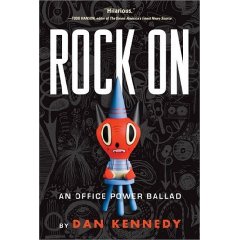
An Office Power Ballad, by Dan KennedyRock On: An Office Power Ballad, by Dan Kennedy. An amusing memoir of the author’s 18-month tour of duty doing marketing for a big record label while the music business was in free fall. (BTW, it’s not getting any better for the recording industry.) Kennedy, a regular contributor to McSweeney’s, is a clever writer whose book offers insight into what happens when an industry flat-out refuses to accept market realities and continues to push product the way it did two decades earlier. A great review of the book from March describes Kennedy as “a Walter Middy in reverse” who “constantly retreats from an absurd corporate environment — equal parts tyranny, vanity and fecklessness — into neurotic internal-reality checks even funnier than the folly all around him. He attends a meeting about Jewel’s song ‘Intuition,’ which she has licensed to a line of women’s razors, also called Intuition. ‘Anyone in the room who knows the irony of a song about not selling out being used to sell razors,’ Kennedy writes, ‘displays a perfect professional poker face. I, on the other hand, am most likely doing the thing where I stifle disbelief and then start getting paranoid that I totally don’t understand what’s going on and that it’s showing on my face, and then I get paranoid that you can get cancer this way.'” Of the three books on this list, Rock On is probably the most suitable for on-the-beach reading.

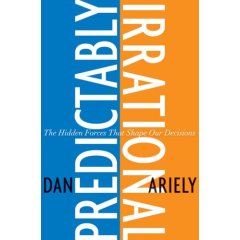
Predictably Irrational, by Dan ArielyPredictably Irrational: The Hidden Forces That Shape Our Decisions, by Dan Ariely. The author, a behavioral economist who until very recently served on the MIT faculty (but now, according to his blog, has joined the faculty at Duke), strings together the results from a string of experiments and research projects that confirms we humans are not as rational as we like to think we are. We fall for gimmicks like Amazon’s “free shipping” for orders of over $25 (who else in the room has ordered an unneeded item just to qualify for the “free” shipping?), we order the second-most-expensive item on the menu thinking we’re getting a deal when actually we’re putting more money in the eating establishment’s pockets (the savvy restaurant deliberately includes a high-priced item to induce us to order the profitable runner-up), and we tend to think a more expensive drug will be more effective than a less expensive alternative. Ariely’s engaging book shows that humans act irrationally in predictable ways. It’s a disturbing insight, but also valuable to anyone interested in human behavior — ergo, any marketer.

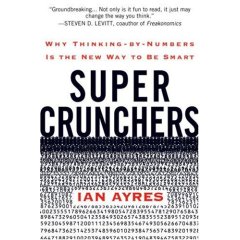
Super Crunchers, by Ian AyresSuper Crunchers: Why Thinking- by-Numbers Is the New Way to Be Smart, by Ian Ayres. This is a book any data-driven blogger (read: Kyle) ought to love. Ayres, a law professor at Yale, looks at all the many ways number-crunchers are going up against the intuitive experts in a variety of fields — from sports (think Bill James and “moneyball”) to entertainment (dataset analysts are working with movie companies to “script” the next blockbuster) to the rarefied pastime of wine collecting (Ayres begins his book by describing how one statistician, crunching weather data, can out-perform the world’s most sophisticated oenophiles in determining the quality of Bordeaux vintages — long before the wine leaves the casks). Like Predictably Irrational, this book is disturbing, especially if, when it comes to man-vs-machine competitions, you favor the experience and intuitive knowledge of humans to the cold calculations of data. But keep in mind that, for the time being at least, humans are still needed to interpret the data. But after reading Ayres’ book, I’m thinking it wouldn’t hurt those “intuitive experts” among us who have gotten this far relying on our “instincts,” “artistic eye,” “experience” or whatever to brush up on statistics.

So, those are my three. Any good reads to recommend? Discuss in the comments.

—————-
Now playing: Talking Heads – The Book I Read
via FoxyTunes