
Twitter Cards: 50-plus ways to not leave your Twitter

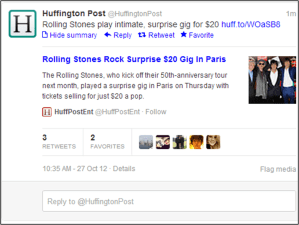
Example of an expanded Tweet (aka “Twitter card”) from @HuffingtonPost

Hop on the Twitter bus, Gus. To get the news, information and deals you want, you may never even have to hop off.

The folks at Twitter recently announced they had expanded their “expanded tweets” function. That function, implemented earlier this year, lets Twitter users preview photos, video and other content within a single Tweet — simply by clicking on the tweet, rather than a hyperlink to another destination. The expanded partnerships now gives users “more than 2,000 ways to bring more interactive and engaging Tweets to your stream,” Twitter said in the recent announcement.

This means that now, in addition to seeing previews of Instagram photos and YouTube videos, or lead paragraphs of news stories, you’ll also get to see product descriptions, ratings, prices and reviews from Amazon.com products, video clips from the presidential debates from CNN tweets, movie previews from Fandango or audio clips from Soundcloud.

With these expanded tweets (also called Twitter Cards), why would anyone ever need to leave Twitter to sample content?

That’s precisely the point, writes Jennifer Van Grove of VentureBeat. If Twitter can become the medium for aggregating content, it becomes the source for all types of information from trusted sources that you, the Twitter user, select.

“[W]e’re all one step closer to that Twitter-centric vision,” Van Grove writes. But it’s a vision that “consumers, publishers, and developers will either love or hate.”

How will this affect higher ed? Colleges and universities could conceivably take advantage of the expanded tweets function to deliver content more directly to their audiences who are on Twitter. But will it change our approach to Twitter? Rather than trying to use Twitter to extend our reach or draw audiences back to our sites, will it mean we think of Twitter as the destination for users interested in our content?

And more important: Will the consumers of our content love it or hate it?

(Thanks to Jeremiah Owyang for drawing my attention to Twitter’s recent announcement — via a tweet, naturally.)

Friday Five: On creativity, social 2.0, ‘Networked,’ higher ed’s future, ‘useless’ degrees

Happy Friday! Enjoy these nuggets of knowledge gathered from some of the brightest people and organizations on Twitter:

  • For all you misunderstood creatives out there, take a couple minutes to watch this video on how creativity works (and if you’re a brave soul, share it with your favorite clients). Via @timsamoff.
  • An introduction to Networked: The New Social Operating System, the new book by Lee Rainie (of the Pew Internet Trust) and sociologist Barry Wellman. According to the Pew Internet Trust, Networked discusses how “the large, loosely knit social circles of networked individuals expand opportunities for learning, problem solving, decision making and personal interaction.” After skimming this excerpt and watching Rainie discuss its premise on video (embedded in the first link), I’m convinced this is an important resource for higher ed marketers. It is now on my ever-expanding to-read list.
  • Welcome to Social 2.0. This infographic (shared by @NealSchaffer) identifies four new market segments “most likely to look to customer communities when making purchasing decisions.” While none of the four groups is directly relevant to purchasing decisions related to higher education, their characteristics could offer insight into some of our more recent graduates or lifelong learners.
  • Five ideas for improving the future of postsecondary education, from Toronto’s Globe and Mail, may address specific challenges facing Canada’s institutions, but some of the ideas could transfer to institutions elsewhere that face similar situations. Thanks to Jake Pringle (@jdp2222) for sharing.
  • Finally, for a refreshing perspective on the oft-maligned liberal arts education, read The Importance of Being Useless, from Times Higher Education. In these days, when we try to measure and quantify every conceivable aspect of higher education in order to demonstrate the value of college to a jaded public, it’s comforting to know that, in Aristotle’s day, “a useless education was the highest and most noble form of education because it represented the genuinely free education of the genuinely free man.” This essay argues that looking at the history of liberal arts “creates the opportunity to consider what a modern liberal arts education might look like in relation to its ancient and medieval counterparts.”