

#highered and Obama: the first four years

266449_web_5-22-12-obama-joplin_willAs President Obama prepares for today’s public swearing in of his second term of office, it’s as good a time as any to look back at how higher education has fared under this president’s first term, and to look forward at what might be in store for higher ed over the next four years.

The first four years of the Obama presidency have been marked by difficulty and turbulence. The economic mess he inherited hit many sectors hard, and higher education was no exception.

Many colleges and universities, perhaps for the first time in their histories, resorted to layoffs, furloughs and program cuts to deal with their financial struggles. The rise of MOOCs threatens to turn the traditional model of higher education on its ear, even as campuses try to survive by raising tuition while more college graduates struggle under the strain of enormous debt loads. The latest punch to higher ed’s gut came last week, when Moody’s Investors Service gave all of higher ed a failing grade. Moody’s pessimistic outlook (which I briefly discussed here last Thursday) could do some major harm to colleges and universities that seek to borrow money for badly needed facilities upgrades or other projects.

No president can wave a magic wand and make these troubles disappear. But a president can set an agenda and cast a vision for a nation’s future — at least for four years at a time.

So, how well did Obama do at setting a higher ed agenda and casting a vision for our sector during his first term? And what does he envision for higher ed in his second term?

First-term promises (mostly) kept

Obama’s first-term vision for higher education seems to connect to the ideals of keeping college affordable and accessible to people of all income levels. He also wants to increase the college graduation rate and get more students to major in STEM disciplines (science, technology, engineering and math) in order to improve our nation’s global competitiveness.

Peter Wood, writing in the Chronicle of Higher Education, sees Obama’s vision as encompassing eight major themes, all of which touch on the issues I mention above. Lumped together, these themes constitute “a large and energetic attempt to recast the role of American colleges and universities.” (For an in-depth treatment of Obama’s higher ed agenda, read Wood’s introductory piece on the topic in the Chronicle of Higher Education. And to get even more in-depth, read each of Wood’s blog posts on the subject.)

Since it’s difficult to view success or failure of broad categories like affordability and accessibility, we’ll need to get more granular and take a look at how well Obama’s main initiatives fared, or didn’t fare, during his first term.

For that, we turn to a recent analysis by Politifact.com. The website says Obama has largely kept or made progress on nearly three-quarters of 508 campaign promises from 2008. He’s made the greatest progress in the areas of health care and education.

On the post-secondary education side of things, Obama has kept most of his promises in terms of trying to keep college affordable and accessible, and in trying to increase the number of college graduates. Those include promises to recruit math and science degree graduates into teaching careers, reduce subsidies to private student lenders, expand Pell grants for low-income students, increase research opportunities for college students and increase funding for land-grant institutions.

But Obama fell short in a few areas, such as his efforts to create a college tax credit program (a compromise that watered down the initiative), simplify the financial aid application process (another compromise), to support college credit initiatives and to create scholarships to recruit new teachers.

The next four years

So, what is in store for higher education during the second term of the Obama presidency? I discussed this in my post-election post, The higher ed agenda and Obama’s second term. But in case you missed it, here’s a recap:

  • Slowing tuition growth. In the Obama campaign’s fall 2012 Blueprint for America’s Future (PDF) is a section titled “Improve Education for Middle-Class Jobs.” It specifically calls for cutting tuition growth in half over the next decade. It also calls for doubling campus-based student aid and incentives for schools that limit tuition growth. So the take-away here is that Obama wants colleges and universities to work on affordability, and maybe somewhere down the line there will be some carrots for those that adhere to the as-yet-unspecified goals.
  • Hope for STEM education. Contained in that same document is Obama’s call for 100,000 more math and science teachers so we can “out-compete China and Germany” (among other nations, presumably) “by out-educating them.” The STEM Master Teacher Corps and investments in research and innovation into the best ways to teach math and science will help improve math and science education nationwide.” That STEM Master Teacher Corps, by the way, has a goal of 10,000, not 100,000. So to reach the blueprint’s 100,000 goal will require more math and science teaching degrees.
  • Job training programs. The blueprint calls for community colleges to train 2 million new workers for “good jobs that actually exist.”
  • Research opportunities to support the blueprint’s goals of expanding jobs in manufacturing and energy. To bolster manufacturing, Obama says he wants to build “a new network of 15 to 20 manufacturing innovation institutes to bring together business and research universities to ensure that the next generation of products are invented and manufactured here.” Meeting his “all of the above” energy goals will also require investment in research universities.

The president’s vision for higher education is hopeful and progressive as well as pragmatic. But he’ll continue to call on colleges and universities to become more accountable and to keep costs down. He will likely continue a theme from his 2012 State of the Union Address, when he told higher ed leaders everywhere: “If you can’t stop tuition from going up, the funding you get from taxpayers will go down. Higher education can’t be a luxury, it is an economic imperative that every family should be able to afford.”

Given the tenor of that statement, you might think Obama is not much of a fan of higher education. But you would be wrong. As Wood notes in his Chronicle piece from last February, shortly after the president’s SotU address:

Despite President Obama’s recent feistiness on student debt and spiraling college costs, he is a man who has generally identified himself with the ethos of contemporary American higher education and has, in turn, been embraced by the faculty, students, and the broader institution. He bridges with ease the differences between the fiscally challenged state university and the financially thriving summit of elite education, and a whole set of related tensions: between going to college to get a job and going to college to get a liberal education; aspiring to financial security and aspiring to be part of the ruling class; and aspiring to be part of America and aspiring to be a “citizen of the world.”

Meanwhile, America’s colleges and universities will continue to struggle to bridge their missions with their economic problems accelerated by the impact of technological advances.

Maybe more important than asking what is the president of the United States’ vision for higher education is the question: What is your vision, Mr. or Ms. President, of your college’s or university’s future?
Friday Five: Immutable branding laws, revisited

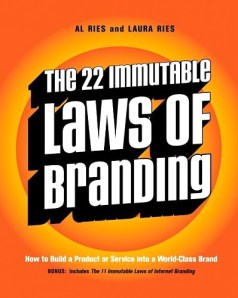
ImmutableLawsAs 2012 drew to a close, I spent some time revisiting some reading material that has informed my life, both personally and professionally. One of those materials was a book by Al and Laura Ries called The 22 Immutable Laws of Branding (affiliate link). Perhaps you’ve heard of it? In my opinion, it is one of the most important books ever written on the subject of branding, and anyone who does any sort of marketing, public relations or brand management for a living should read it. For that matter, anyone who does any sort of communication work who wants his or her message to stand out should read it.

The Rieses present in concise form, chapter by chapter, 22 branding “rules to live by” that organizations ignore at their peril. They cite example after example of big brand names that follow or violate these rules, and provide plenty of evidence of why a brand’s tactic worked or failed, in the context of one of these 22 laws.

Before going forward, it’s important here to distinguish between the ideas of branding and marketing. I find that people, even people in our business, tend to use the terms interchangeably. The 22 Immutable Laws of Branding is not a marketing book, although the laws it contains do matter — greatly — to marketing people. Just bear in mind as you read on that branding is about an institution’s identity and its promise to the customer, while marketing is about delivering the product or service that institution offers to the customer. With any luck and strategic forethought, the products and services being taken to market also embody the promise of the brand that offers those products or services.

As the Rieses point out in chapter after chapter, companies have seen short-term success by violating a branding law or two. (For example, when Bayer introduces its Bayer Select line of “aspirin-free” products, in violation of law No. 10, The Law of Extensions.) But the damage to their brand eventually outweighs those short-term marketing victories. The lesson for marketers and brand managers is that what may look appealing from a marketing standpoint in the short term could do permanent damage to the brand in the long term. As the Rieses write in the very first chapter:

Marketers often confuse the power of a brand with the sales generated by that brand. But sales are not just a function of a brand’s power. Sales are also a function of the strength or weakness of a brand’s competition.

Substitute “gifts” or “students” for “sales,” and you see how this applies to higher education marketing.

My copy of this book was published in 2002, which means that many of the examples cited are outdated. Also, there’s an additional minibook at the end titled The 11 Immutable Laws of Internet Branding which, being published in 2002, doesn’t take into account the changes wrought by social media. So if you pick up this book, I wouldn’t put too much stock in that section.

Like many branding experts, the Rieses talk about big, recognizable brand names. You won’t find any reference to colleges or universities in the book.

But that doesn’t mean these branding laws are irrelevant to higher education. If they’re immutable for the commercial sector, they should be immutable for our organizations, right?

Here are five of those laws that I think are most relevant to higher education. At the least, they serve as a reminder of best practices for our higher ed brands.

1. Law 1: The Law of Expansion.

The power of a brand is inversely proportional to its scope.The tighter a brand’s focus, the greater its success as a brand.

This is the big one and the most important law. No wonder they put it first.

Think about the most focused colleges and universities in the nation. How strong is MIT’s brand? How about Oberlin’s? Fashion Institute of Technology’s?

Now, think about how many “comprehensive universities” there are in the U.S. (There are a lot of them.) How many of them have strong brands for being “comprehensive”?

Certainly, comparing the number of degrees an institution offers to the lines of toothpaste Crest offers (38 at the time Immutable Laws came out) isn’t fair. But there’s an underlying principle that applies in both cases. If a college or university is known for something very specific, as MIT is for engineering, it could do some damage to its brand by extending into areas that are unrelated. (Obviously, MIT has very strong programs in business and other areas, but the connection to the institution’s emphasis on engineering and science is strong.)

The strongest brands are the most focused. (See also: Law 2: The Law of Contraction and Law 10: The Law of Extensions.)

2. Law 5: The Law of the Word.

When people think of your institution, what word or phrase comes to mind? A brand should strive to own a word in the mind of the consumer.

Back in the 1990s, before the university I work for changed its name from the University of Missouri-Rolla to Missouri University of Science and Technology, the University of Missouri System conducted a series of focus groups around the state in an effort to find out how much people of our state knew about each of the system’s four campuses. When focus groups were asked about our institution, the most common response was that we were known for “engineering.” That was the word we owned among the public of Missouri in the 1990s. And it’s the word we own today — even more so, now that we have a name that better reflects the intrinsic nature of our campus.

What about MIT or Oberlin? Does MIT own “great engineering school” on a national scale? Probably. Does Oberlin own “great liberal arts”?

In building a brand, Ries and Ries suggest you “forget about the laundry list of wonderful attributes your product has” and instead focus on owning a word in the customer’s mind. “The mind gives meaning to visual reality by using words,” they write. “To get into a consumer’s mind, you have to sacrifice.” This is hard to do for any organization, but especially for higher ed.

3. Law 7: The Law of Quality.

Quality is important, but brands are not built by quality alone. Here is where the issues of affordability and accessibility come in to play today, and will in the future as The Great Disruption in higher ed continues. (Moody’s negative outlook for the entire U.S. higher education sector, announced on Wednesday, will obviously play in to public perceptions of U.S. higher education as a “quality” product.)

One of my favorite TED Talks, which I’ve written about previously on this blog, is Life lessons from an ad man, by Rory Sutherland of the Ogilvy Group. Sutherland talks about the importance of advertising as a means of adding perceived value to products and services. He even talks a bit about the perceived value of higher education.

“The point is that education doesn’t actually work by teaching you things,” Sutherland says. “It actually works by giving you the impression that you’ve had a very good education, which gives you an insane sense of unwarranted self-confidence, which then makes you very, very successful in later life.”

Sutherland is exaggerating to make a point, and it’s a bit like saying the role of higher education is to be like Wizard of Oz and confer credentials in the form of a diploma to straw men. But the perception of quality is an important component in branding, and as The Great Disruption continues to turn educational products into generic commodities that can be purchased cheaply, or even obtained free of charge, institutions that emphasize quality will have to think about just how well they are selling this intangible to prospective students, as well as how great the demand is for such a, well, quality. And also, whether your brand is really built on quality.

“If you want to build a powerful brand,” write the Rieses, “you have to build a powerful perception of quality in the mind.”

The notion of affordability often flies in the face of quality. Institutions need to decide whether to build on quality or some other factor. You can’t be both cheap and great.

“The customer who wears a Rolex watch doesn’t do so to be more punctual,” write the Rieses. “The customer who wears a Rolex watch does so to let other people know that he or she can afford to buy a Rolex watch.”

4. Law 11: The Law of Fellowship.

Brand managers like to talk a lot about differentiation, about how our brands are distinctive. And this is important (see Law 22: The Law of Singularity). But in reality, you don’t want to be the only one of your kind in the marketplace. Then you wouldn’t have any competition.

Coke needs Pepsi. Staples needs Office Depot and Office Max. Southwest needs American Airlines and United. And so on.

In order to build the category, a brand should welcome other brands.

When the leadership at our university was building the case for changing our name, they developed a classification of 16 technological research universities — institutions that, like us, were heavily focused on the STEM disciplines but also conducted research and had graduate-level programs. (This process allowed us to exclude fine, undergraduate focused engineering schools like Rose Hulman and Harvey Mudd, so that we could further narrow our scope.) By focusing on these 16 institutions, we intentionally limited ourselves to a ‘fellowship” of similar universities. (We compete with others not in this grouping, but we differentiate ourselves from those institutions by our focus. We are one of an elite group of 16 — and the only one in the Midwest.)

5. Law 13: The Law of the Company.

Brands are brands. Companies are companies. There is a difference.

From my perspective, as one who works for one of four campuses that are part of a university system, this law bears great importance when it comes to building a distinctive campus brand apart from the system brand.

Think of a multi-campus university system as the “company” and the individual campus as the “brand.” (For example, the system is like Procter & Gamble and the campus is Tide.) Does the company name need to be part of the brand? Would Tide be a stronger brand if it were marketed as “Tide, by Procter & Gamble” or “Procter & Gamble’s Tide”?

Taking it down to a campus level: Maybe the brand is a school or college and the “company” is the campus itself. Does the S.I. Newhouse School of Public Communications have a stronger brand identity than, say, “Syracuse University’s S.I. Newhouse School of Public Communications”?

Sometimes, this law conflicts with other laws, such as No. 10 (The Law of Extensions). And when the brand managers (and deans) individual schools or colleges of an institution see their organizations as brands that are distinct from the academic institution, then problems arise. (See Law 14: The Law of Subbrands. What branding builds, subbranding can destroy.)

So Law 13 can be a tricky one to navigate, because companies are employee-oriented but brands are, or should be, customer-oriented.

Your turn

Have you read The 22 Immutable Laws of Branding? If so, what are your takeaways from the book? What law or laws that affect higher education have I omitted? Please share your comments.