
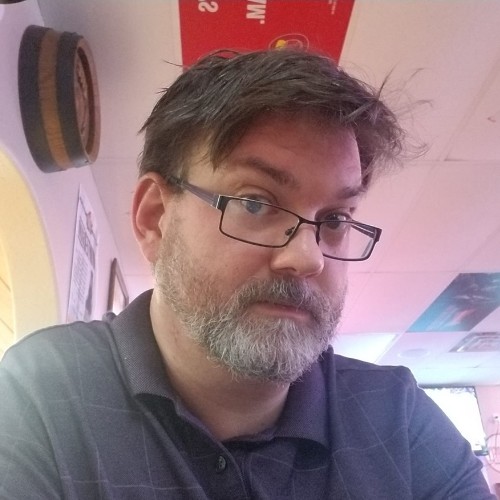
On this, the first Friday of National Poetry Month, I’m pleased to introduce readers to Randal Burd, a fellow Missourian whose second book of poetry, Memoirs of a Witness Tree, was published in 2020 by Kelsay Books. His first book of poetry is a self-published work titled Leaving Home: Discoveries and Reflections of a Once-Sheltered Heart. An educator, freelance editor and writer, and genealogist, he also is the creator of the “journal of poetic observations,” Sparks of Calliope. His poetry appears in numerous print and online journals (partial listing). Learn more about Randal and his writing on his website, The Edge of Memory.
- What inspired you to start writing poetry?
Shel Silverstein was my first inspiration for writing poetry. I was introduced to Silverstein’s Where the Sidewalk Ends in elementary school, and I became rather obsessed with it. I recited his poems for at least one talent show; in the fifth grade, I wrote a poem imitative of his style called “I Have a Hippoturtlephant” and sent it off to be published. A short time later, I believe in 1990, I received my first acceptance notice from Creative Kids magazine. From then on, I was hooked.
- From where do you draw your inspiration for your poems?
I find the poems I write that are most successful are in some way inspired by either personal experience or first-hand observations. When I try to move beyond first-hand knowledge, I am often less satisfied with the finished product, and the reception for such poems seems diminished as well. Personal observations and reflections from diverse viewpoints are far more valuable poetically in my opinion than one-person virtue-signaling on a variety of predictable topics for positive attention, so I’ve tried not to stray too far from what I’ve known, observed, or experienced. That’s not to say that every successful poem I write is autobiographical or confessional in some way, but many times, the initial inspiration comes from being truly invested in a subject.
Now, there are times when I feel I have something of value to contribute to the discussion about a subject outside of my experience, but I really try to avoid creating “talking-points that rhyme.” Speaking of rhyme, I respect what good free verse poetry has to offer, but I prefer creating my poems with at least some constraints of traditional form. Rhyme and meter have been red-headed stepchildren in literary publishing circles during my time, but I’ve always loved the sounds of language, and I believe you lose something when it is no longer in vogue to consider the musicality of words in your creative processes.
- What is the greatest challenge you face as a writer?
I have discovered there are two pitfalls when writing poetry that can be hard to avoid. The first is being too didactic. This happens when you are not really making personal observations, but instead schooling your readers on what you think is right. When my poetry becomes didactic and preachy, it’s almost always not my best work. Nobody likes to be schooled in anything, and I’m not in a position to pass judgment or be the know-it-all on any subject. So when your writing is less concrete, when you are telling instead of showing, when you are drawing the conclusions instead of allowing your reader to do so, I think there is potential for improvement.
The second pitfall is being too confessional. Even when you are pulling from personal experience — especially when you are pulling from personal experience — you must always ask why anyone else should care. In life, we are the star of our own production. But what is really important to me might be irrelevant to you — some things might irrelevant to everyone else. I try to make poetic observations that tie in to our common humanity; I try to write about things that matter to me that should in some way strike a chord with you as well.
- Tell us about your latest writing project?
Kelsay Books published my collection, Memoirs of a Witness Tree, in the summer of 2020. They also nominated my work for a Pushcart Prize. These poems have appeared over 150 times and in over 30 publications. In 2019, I started an online poetry magazine called Sparks of Calliope. Sparks of Calliope has featured one or two poems selected from submitting poets about every three days ever since. Submissions come from all over the English-speaking world. It will have been operating for five years this coming July. While I have intentionally refrained from including my own work in Sparks of Calliope, I hope to have enough new poems of my own for another collection some time in the near future.
- What one piece of advice would you give to an aspiring poet or new writer who is just starting out?
There is no money in poetry. There’s really no fame. If you’re writing to please anyone but yourself, that road is going to end, for one reason or another, in disappointment. But if you are compelled to creatively express yourself with words, if you want to metaphorically touch fingers with the divine, if you want to share your observations on the common threads of humanity with fellow humans and know you are not alone, then write poetry. Read, read, read. Write, write, write. And then get it out there, get it published. But understand that if you’re doing it right: the most important member of your audience, the one who receives the most edification, healing, whatever else from your poetry, will be yourself. And this a good thing.

 Andrew Careaga
2 thoughts on “Friday Five: Q&A with poet and ‘Sparks of Calliope’ editor Randal Burd”