

Today’s Friday Five is with Sally Bayless, a novelist who writes in the “cozy” mystery genre. Sally and I met many years ago when I was a reporter for a now-defunct daily newspaper and Sally was a summer intern. Since that time, she graduated from journalism school, worked as a newspaper copy editor (remember those?), and ended up in corporate communications, where “I edited everything from an article on gastrointestinal scopes to a report on the use of depleted uranium in armor-piercing weapons, all of it (honestly) fascinating.” These days, she’s working on book seven of her Dogwood Springs Cozy Mystery Series. All of the book titles are alliterative and set in the mythical Ozarks town of Dogwood Springs.
1. How would you describe the “cozy” mystery genre?
Cozy mysteries feature an amateur sleuth and are gentle reads with very little gore, profanity, or sex on the page. They often take place in small towns. Classic examples are books by Agatha Christie and the TV show Murder, She Wrote.
2. What inspired you to pursue this particular writing genre?
My goal as a writer is to provide clean, wholesome entertainment. Cozy mysteries fit this goal and fit my puzzle-loving brain. In addition, I’ve loved mysteries since I read my first Nancy Drew.
3. Please tell us a bit about your newest mystery?
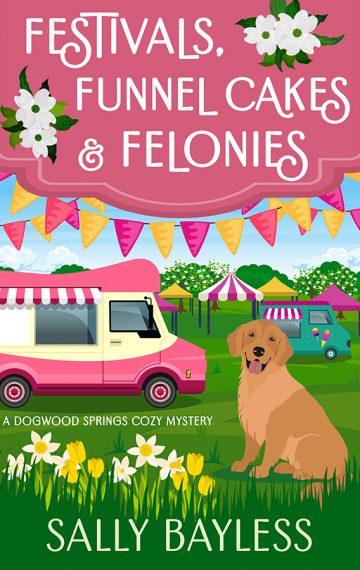
Festivals, Funnel Cakes & Felonies is the fifth book in the Dogwood Springs cozy mystery series. Here’s (an excerpt from) the back cover copy:
In the heart of a celebration, a dark secret festers.
The Dogwood Festival, held each year in the small town of Dogwood Springs, Missouri, is more than just a special event. It’s a cozy haven of springtime charm, live music, and handmade crafts that draws tourists from all around. Libby Ballard, the dedicated director of the local history museum, is thrilled to be a first-time member of the festival steering committee.
As the festival approaches, the air buzzes with excitement.
But secrets simmer beneath the surface, and tragedy strikes when a fellow member of the steering committee is found murdered at the festival grounds.
When the police zero in on the wrong suspect and dismiss any connection to the festival, Libby realizes she must step in. With her loyal golden retriever by her side, Libby dives headfirst into a sea of suspects, each with their own motives, each a piece in a puzzle waiting to be solved.
Can Libby and Bella find their way through the labyrinth of lies and unmask the villain before another life is lost?
4. In your online bio, you write, “Not realizing that real people were allowed to write fiction, I went into journalism.” (Same here.) How (if at all) did your studies in journalism and your work in corporate communications prepare you to become a novelist?
I think the biggest lesson I learned from my work in journalism and corporate communications was the ability to produce words when I needed to. After all, you never see someone sitting in a newsroom, staring at the wall and complaining about writer’s block. If I don’t know what to write, I back up a bit, think about what would happen next, and keep going. Also, my books are well-plotted ahead of time, so most of the thinking about what happens next has already been done.
5. What advice would you give to someone who wants to write novels (in general, or cozy fiction in particular — either/or)?
If someone wants to write fiction, they should find the type of book they want to write and read piles and piles and piles of them. And, when they get tired of reading, they should watch the same type of story on TV or in movies. The goal is to get to the point where whether you’re reading or watching, you can say (without looking at the clock or how far you are into the book) “Okay, I can tell it’s the middle of Act 2. It’s time for x to happen.” Reading about plot and structure is helpful, but being able to feel that plot really helps.
Then, sit down every day at the same time in the same place and write. I started out doing a challenge to write 100 words a day on a story for 100 consecutive days.
Finally, for a first project I’d consider writing a novella instead of a novel. I had to iterate the process a few times before I knew what I was doing. Those iterations go a lot faster when your goal is 20,000 words instead of 80,000.
* * *
Sign up for Sally’s newsletter for curated updates on all things mystery-related, and get a free cozy mystery from Sally herself.

 Andrew Careaga
Thanks for having me on your blog, Andy!