
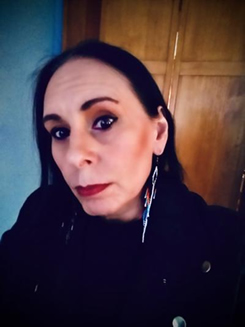
I first encountered the writings of Sage Ravenwood via one of her poems, “Lit Cigarette Summer.” It was published in Scavengers, a literary magazine of Querencia Press, and the opening lines — I wanted a clove cigarette so bad/I could taste it like a dying wish — hooked me immediately, like a nicotine habit. I knew right away that I had to read more from this writer.
Recently, her collection of poems, Everything That Hurt Us Becomes A Ghost, celebrated its one-year anniversary. In this week’s Friday Five, Sage discusses that collection, her philosophy on writing, and more. She also shares the poem, in its entirety, that inspired the book’s title.
1 – Congratulations on the one-year anniversary of Everything That Hurt Us Becomes A Ghost. Such an intriguing title! Please share a bit about this book, and how you came up with the title.
Everything That Hurt Us Becomes a Ghost is a collection of poetry dealing with lingering, resurgent trauma of familial violence from the viewpoint of an Indigenous and deaf woman. It’s meant to take you on an exploration of grief, anger, tenderness, and defiance. An invitation to spend time in someone’s else skin. To see life through my eyes yet making space for the natural world and my reverence for it.
Everything That Hurt Us Becomes a Ghost is my attempt to shed a light on Indigenous issues outside my own life such as the Native American boarding schools which are currently making headlines with Biden’s presidential apology and MMIW (Murdered Missing Indigenous Woman) movement. Using rage and pain as driving emotions yet striving for understanding as a way forward. This book is what I call a painful carrying. The subject matter
can be at times raw and sensitive.
As for the title of my book, you can find it in the last verse of my poem, “How to Outlive a Rapist,” originally appearing in Native Skin Lit. I’m including the poem here for your readers.
The title conveyed an overall feeling of what we’re left with on the other side of survival, grief, or pain, loss in any form. We keep these things with us whether it be a memory or a lesson. Reminders of moments in our lives that stay with us. Ghosts of our emotional discordance following us wherever we go.
How to Outlive a Rapist
His living haunted like the dead.
Even after his actual death.
The carefree girl I was,
the woman I become, side by side
staring down at his gravestone.
All three of us no longer
wearing the same face.
Death cheated. We can’t
get his stain off our skin.
Every breath we take trembles,
leaves wind surfing an open grave.
We stopped screaming for daddy,
long after our throats gave out.
She stayed with him; I grew older.
Today, both of us are wearing
phantom black and blue
neckties in his dishonor.
The girl loosens her grip on me
and fades back in memory,
back to when she skipped along
railroad tracks, arms outstretched.
I miss her, that part of me
who never had a chance
to test her wings.
I want the pieces of her
buried with him,
to sing to him in his grave.
Everything that hurt us
becomes a ghost.
2 – On your website, you write, “In 2019 I took a leap of faith and submitted my first poem ‘Bullet Tithe’ to Glass Poetry – Poets Resist.” Why do you describe that act as a leap of faith?
To me as I’m sure it is for others, a leap of faith is believing in oneself enough to attempt something you’ve never done before. In my case that entailed writing poetry. I didn’t have an MFA or have a clue about poetic nuances or format. Writing poetry enabled me to write about my trauma in as few words as possible, which held its own appeal. ‘Bullet Tithe’ became my first published poem in 2019, that leap of faith I spoke about.
3 – When did you first begin writing poetry, and what first got you interested in writing?
This one is self-explanatory in the above question but I’ll go into a little more detail here. I’ve been open about the fact, I’ve been in and out of therapy since the onset of my deafness. In many cases a therapist will advise you to write out your feelings or to give depth and details to your memories on the page to help you empty out your emotions. For years I found this an impossible task. Eventually I came across poets using free verse in protest, trauma laced poems. Instead of long soliloquys which opened wounds wider in the reliving. In this way I could say more with less.
Even now, I still find it daunting. For the more traumatic, deeper pieces, I’ll often write it out in third person as if I’m writing about someone else. By the second or third draft, I simply go in and change it up to first person, having gotten the meat of the painful details out on the page already.
4 – How do you feel your deafness and your Cherokee heritage influences your writing?
This one will probably throw some people off. I don’t. Those two aspects are a part of who I am as a person. They describe my heritage and my disability. Who I am as a person is more about lived experience. I would say the latter has more to do with my writing than those two. Which is to say since I am Cherokee and deaf those two issues resurface abundantly in my writing. I think a majority of writers out there write from a place of familiarity. As for being outspoken about
Indigenous or disability issues, that’s a natural progression from where I stand in life.
Do these things influence my writing? Life, the everyday living, influences my writing. Writers throughout history have served as a witness to their times. Unfortunately in my lifetime, little progress has been made in either Indigenous causes or disability inclusion. Yes, some progress has been made, but too little, too late. So perhaps in some ways, I am encouraged to write from those perspectives as a bullhorn.
5 – What advice would you offer to someone who is interested in writing poetry for publication?
Write the book or poem you want to read. Write your truth as you understand it. If this is something you want to do, do it. It’s not an easy route to take. At the end of the day, not everyone is going to like what you write or what you have to say. That’s okay. Write for yourself.
Don’t write for popularity or to fill some empty salvos, find what’s genuine, what speaks to you. I’m not going to sit here and say everyone can do this or that it’s easy. I’m not going to discourage you either. If this is what you want, the only person stopping you is you.
Writing poetry is probably the most difficult journey I have ever undertaken, and that’s saying a lot if you’ve read about any of the number of things I’ve survived. I’m still writing, despite. Be your own champion. There are a lot of us out there, but that doesn’t mean you can’t or shouldn’t leave your own mark on the world.
I’m going to add one more addendum here: You don’t need an MFA or specialized course to call yourself a poet. There are plenty of online offerings of poetry. Take a look at what others are writing to grasp the basics and do you. Perseverance is key.
*
- Find more of Sage Ravenwood’s work from her publications page.
- Follow her on X/Twitter at @SageRavenwood.

 Andrew Careaga