
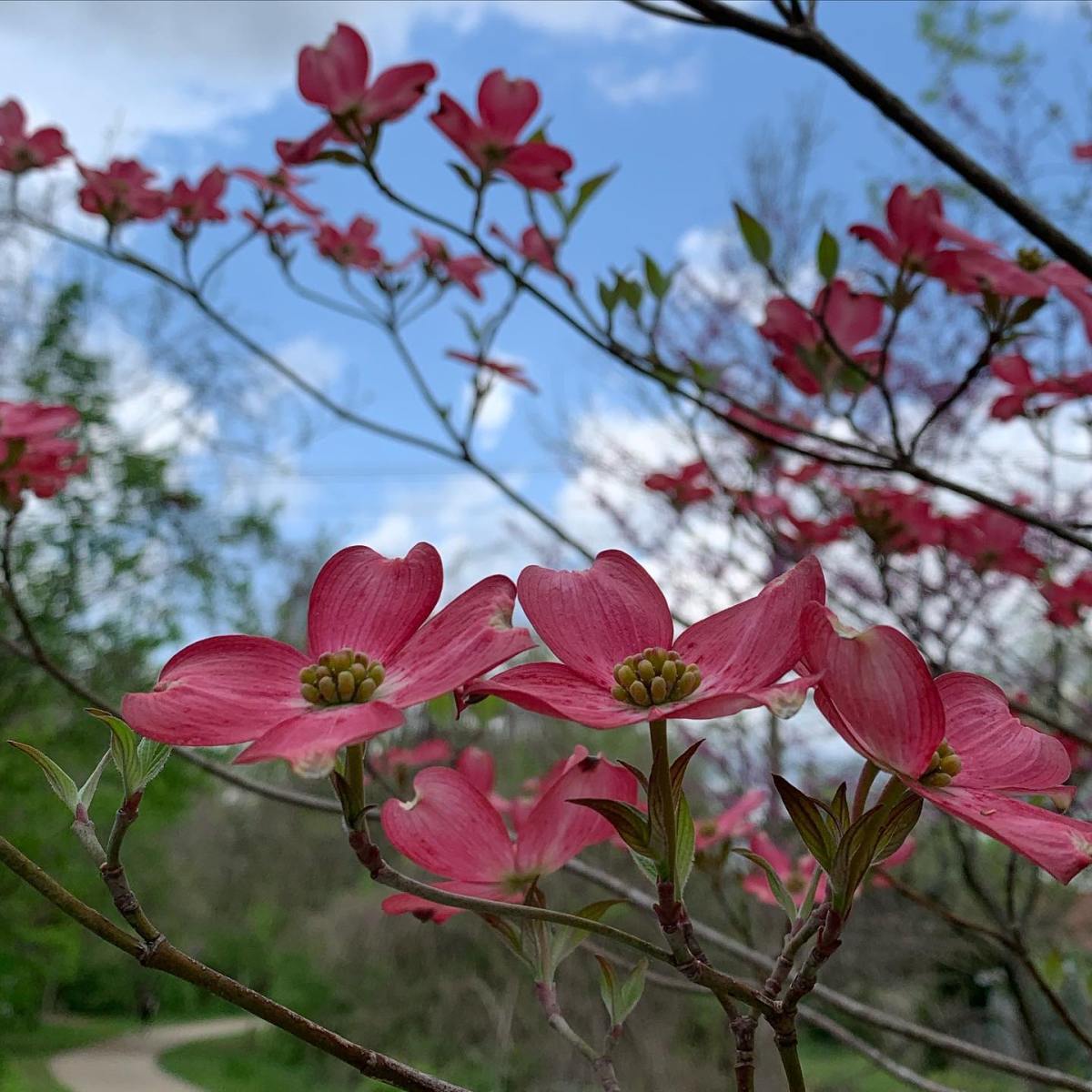
Here we are in the middle of April, and all around me in this part of the world I see dogwoods are in full bloom, the brilliant purple flowers of redbuds giving way to the new, tender sprouts of leaves, and the dreary, dirty browns of winter erased by lush greenery, from lawns to trees to fertile undergrowth. My unevenly green yard is bursting with the yellow flowers of dandelions, which contrast with the canvas of lawn like the radiant stars of Vincent Van Gogh’s The Starry Night.
All around me, life is flourishing, as it should be in mid-April. But my writing life feels like it is dying on the vine.
In my writing life, I am failing to flourish.
Even my daily journaling practice has fallen by the wayside. I finally picked up the journal this morning and wrote a couple of pages. It was the first entry in over a week. With luck and a bit of purpose and motivation, I’ll try it again tomorrow.
A new role
Why the stagnation? Some of it has to do with a new role I’ve taken on as a caregiver for a family member. The tasks associated with that role has taken over some of the time I once dedicated to writing. This new and unfamiliar role is also sapping a lot of my writing energy, and my motivation is waning.
I know I’m not the first human to take on the role of caring for another. But this is relatively new ground for me, and it’s taking some adjustment. It’s also helping me appreciate the selflessness of those who have come before me in this role.
I also take comfort in knowing I’m not the only writer who struggles with finding the time and energy to write for whatever reason. And some writers have taken their caregiving situations as opportunities to write beautifully and vulnerably about their experiences in that role. (Esmé Weijun Wang is one such writer worth reading. Check out her Reasons for Living posts on Substack.)
A recent National Public Radio story about caregiving is also helping me gain a different perspective on the role, and helping me think about how to balance that with my other roles. It’s also introduced me to an area of research called caregiver identity theory, which is helping me also understand how the practice of caregiving can begin to affect individual identity.
Time for a break?
And yet, I still identify as a writer more than a caregiver. A recent article from Lit Mag News, “The Benefits of Taking a Writing Break,” also offers some comfort — and grants me permission to step away from the writing life for a season, even if it is during the time of year when everything seems to be flourishing. The author of that essay, René Ostberg, is a self-described late bloomer who has now reached the age where writers start to feel they’ve missed the boat and need to make up for lost time. (I can relate.)
“Writers so often hear advice that leans toward productivity. Write every day. Discipline your flow. Submit strategically but often,” Ostberg writes. “These bits of advice are undoubtedly time-tested and get results. But are they always realistic or even healthy? Life, after all, very often ‘gets in the way.’ And as important as it is to practice self-discipline and self-advocacy, to establish a daily writing practice and insist on your right to write without distractions, isn’t it just as important to give yourself, and your work, some breathing room? To just take a break?”
Ostberg also shares some historical precedent for taking a break. Consider Mark Twain, who published The Adventures of Tom Sawyer in 1876 but didn’t finish its sequel and his masterwork, The Adventures of Huckleberry Finn, until 1883. “No, Twain didn’t quit writing altogether during its creation.,” Ostberg writes. “But the significant breaks he took from it should tell us something about the realities of creativity and the writing process. And perhaps make us question the benefits of forced productivity.”
Then, serendipitously it seems, I discovered this YouTube short from the Author Adjacent podcast, in which host Michael Vadney (who is waaaay younger than me) advises writers to take our time.
So I’m choosing to press pause on my writing life right now. I’m giving myself some grace. I’m taking a break from the heavy focus on writing to tend to other important matters.
Perhaps the most writerly thing I’m doing right now is absorbing the works of other writers, mainly through audiobooks I borrow via the Libby app and listen to on the way to and from the family member’s home. This can be escapist as well as therapeutic, as I’m finding it even difficult to read much these days.
Being a writer, I am of course also thinking about how I can parlay elements of this experience into some future story or essay. And then I consider that to write about this would be exploitative, so I tuck those thoughts away and try to shrug off the guilt that creeps in for thinking too much like a writer, not enough like a caregiver. I wonder what caregiver identity theory has to say about that?
Cover image: Pink dogwood in bloom along the Acorn Trail, Rolla, Missouri. Photo by Andrew Careaga.

 Andrew Careaga
I noticed you’ve been MIA (albeit steady with the Friday Five). Thank you for letting your readers know why. We’ll still be here when you return!