
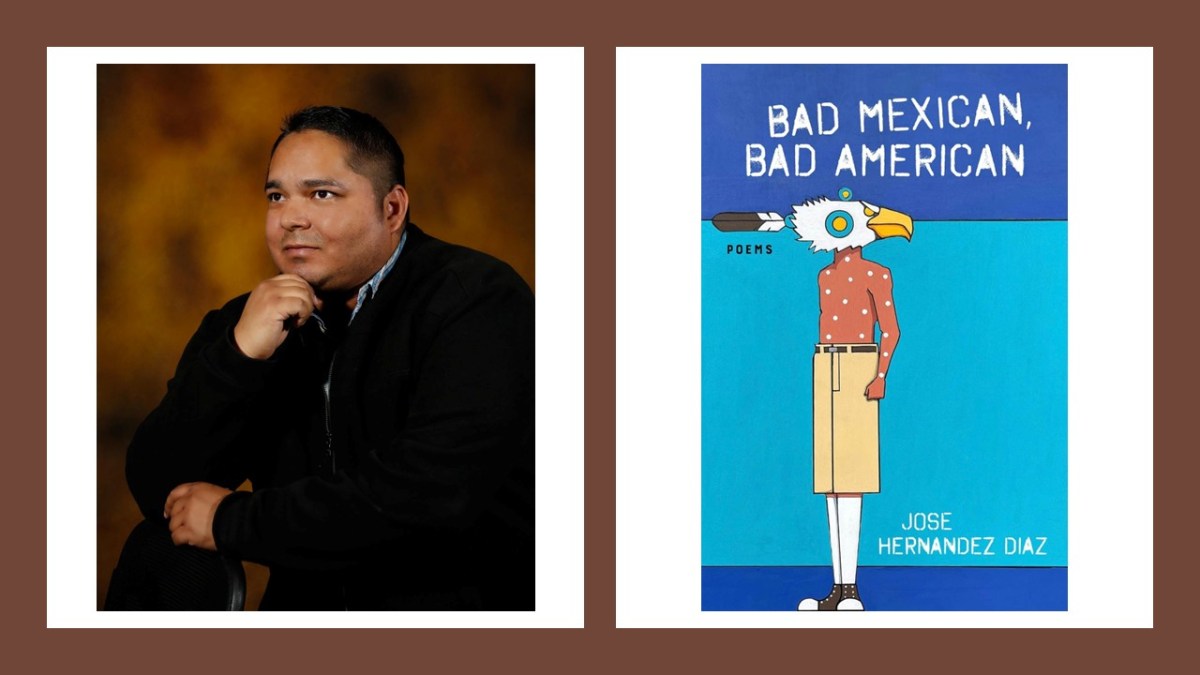
My American friends think I’m too Mexican.
My Mexican friends think I’m too American.
My Mexican American friends are my road dogs.– Jose Hernandez Diaz, “Ballad of the West Coast Mexican American/Chicanx”
These opening lines to the first poem in Jose Hernandez Diaz‘s 2024 collection, Bad Mexican, Bad American capture the essence of Mexican American identity, the feeling of being caught between two cultures and never fully at home in either.
It’s a recurring theme in this writer’s prose poems and free verse, which explore first-generation identity, surrealism, cultural hybridity, among other themes. But his writings encompass broader, universal themes and issues. As one review describes it, Bad Mexican, Bad American “effectively and thankfully eludes simple categorization, refusing both assimilation and accommodation.”
A native of southern California, Jose studied English and creative writing at Cerritos Community College, the University of California Berkeley, and Antioch University Los Angeles. His poetry has appeared in several literary journals, including Yale Review, Southern Review, and Poetry. He also is the author of The Fire Eater (Texas Review Press, 2020) and two new collections, The Parachutist (Sundress Publications, 2025) and Portrait of the Artist as a Brown Man (Red Hen Press, 2025). In 2017, he was named a National Endowment for the Arts Poetry Fellow. As a writer in residence at the University of Tennessee, Knoxville, and a frequent presenter, he shares his writing expertise with other aspiring writers.
- Your work often balances surreal imagery with a grounded, working-class voice. Please share your approach to writing a new poem or prose poem. How do you know when an image or idea has the spark worth pursuing?
It is an organic process. Maybe a word, or a title, or a line stands out to me. I try to expand on said words or images and take it from there. I rely on momentum in the early stages of writing and just go with my instincts and associative leaps trying not to overthink it in the early stages. Later, I can go back and edit in revision and fine tune adding details or making it even leaner. All the while reading it out loud to keep in mind that musicality and sound are just as important.
As far as the surreal and the realist lenses my work can vary: some work is very realist, often linear verse poetry, other work is very surreal, often prose poetry. Still other work is a mixture of both. I try not to limit myself but do try to keep it true to each poem and voice and style considerations as well. Overall, I try to keep it organic and inspired but I do work with prompts as well to keep writing more especially if I am encountering a dry spell.
- You’ve cited surrealism as an important influence, and your work is often compared to that tradition. Which writers, artists, or movements—literary or otherwise—have most shaped your creative voice?
I’m a fan of music first. Rage Against the Machine was an early influence. Classic rock as well: Tom Petty, The Doors, Santana, Hendrix, Jefferson Airplane, Dylan. Underground hip hop in my undergrad years was important: MF Doom, Immortal Technique, Atmosphere, Sole of Anticon, Def Jux, Mr. Lif, Typical Cats. Later, I was into Massive Attack, The Mars Volta, Ramon Ayala, Manu Chao, Antonio Aguilar, Rachmaninoff later, Vivaldi, Chopin… free jazz, experimental jazz as well. I think I always wanted to be a rockstar or musician growing up. Poetry was a way for me to be like a one-man band lol.
Early poets were the Beat Poets. Kerouac, Ginsburg. Bukowski. Lorca. Then later the Chicano Renaissance poets: Alurista, Alarcon, Lorna Dee Cervantes, Cisneros.
Then I discovered James Tate and started writing prose poetry. Discovered prose poets like Marosa di Giorgio, Russell Edson, Richard Garcia, Ray Gonzalez, Harryette Mullen, Sabrina Orah Mark, Shivani Mehta. I am also a fan of the relatively linear poets: Ada Limón, Alberto Rioos, Eduardo C. Corral, Victoria Chang, Diane Seuss.
- I’ve been absorbing Bad Mexican, Bad American, and really love how so many of your poems address the conflicts and tensions of straddling multiple cultures—in family, in society, and simply in navigating daily life. How does your Mexican-American background shape the stories you tell and the way you tell them?
Being Mexican American is who I am, my identity, my everyday reality, I am a Brown Man in a world where it is legal to pull me over and ask why am I driving while Brown? Am I legal? Do I speak Spanish? I can be thrown into a cage if I only speak Spanish. These realities have been accelerated in the Trumpian Fascist regime…
I choose to celebrate my culture in the face of such ignorance and hate. I often write odes to everyday Mexican American images and places like “Ode to Agua de Jamaica,” “Ode to the Piñata,” “Odes to the Pollo Asado Burritos from Albertos…” My goal is to promote the culture as vibrant instead of a nuisance as is promoted by right wing racists and bigots.
- You’ve become known for your prose poetry. How do you define prose poetry, and what possibilities does that form open up for you that more traditional verse forms might not?
I would say it is a hybrid form of writing, written in paragraph form, no line break, to the end of the page, interested in condensed writing, working with brief space to tell a story or muse on a topic. But it is a loose form. That’s what I like about it. There are grey areas. Prose poems that lean more prose. Prose poems that lean more poetry. Prose poems that are absurd. Prose poems that are realist. Prose poems that are subversive. Prose poems that are language based. Prose poems that use dialogue. Prose poems that use a lot of word play. I think the sense of freedom and exploration associated with prose poetry is what appeals to me. It is less restrictive or pretentious in the sense of looser, freer, more humorous, satirical, irreverent, edgy. Keeping in mind my early interest in rock and roll, counterculture music, we can see the natural fit with the subversive prose poetry.
- What excites you most about the state of contemporary poetry and literature right now, and what challenges or gaps do you think still need more attention?
The diversity of voices excites me. The passion younger or newer writers have for it. Sometimes it can be scary to see every now and then that there are still racist or homophobic or bigoted poets out there, but they are in the minority. I would say that society’s indifference to poetry in general kind of scares me but doesn’t surprise me considering they elected trump. Other than that I would say what worries me is I wish all poets could make a more decent living with words, or teaching or editing and didn’t have to sell out to a more corporate job, unless that’s what they just prefer which is fine of course, not trying to be judgmental.
Follow Jose Hernandez Diaz on X/Twitter at @JoseHernandezDz and on Instagram at @jose_hdz_dz.

 Andrew Careaga