
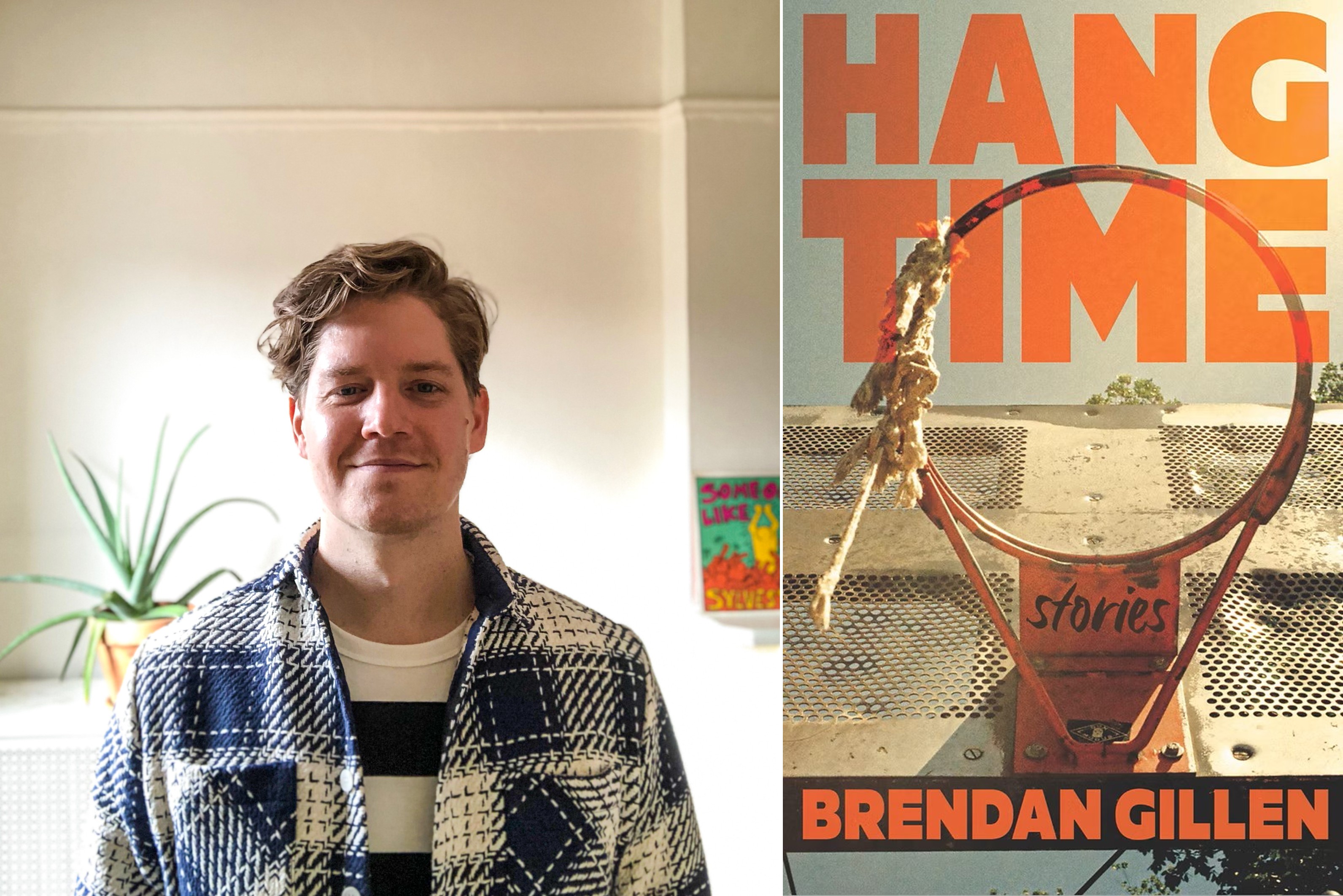
As the Winter Olympics get into full swing, it’s as good a time as any to share this interview with Brendan Gillen, whose collection of short stories, Hang Time. The wide world of sports–from Little League and golf to college basketball, monster truck rallies, and more–serves as a backdrop for many of these yarns, but as author John Brandon notes in his blurb, “there’s LSD in the Gatorade.” Because the stories in this collection, published in December 2025, are about much more than sports. They reveal what Brendan calls “the in-between moments” that turn relatable, everyday experiences into surreal yet believable and very enjoyable tales of love, life, and heartbreak.
Based in Brooklyn, New York, Brendan’s work has been nominated for the Pushcart Prize and Best Small Fictions, and appears in Electric Lit, Write or Die, Sundog, the Florida Review, Wigleaf, X-R-A-Y, and elsewhere. He is also the author of a novel, Static, which came out in 2024, and an award-winning creative director who has developed, written, and created content for a broad range of brands, including ESPN, NASCAR, and Anheuser-Busch.
1. Obviously, sports plays a part in every story of this collection, either directly or tangentially. What is it about sports that most attracts you as a storyteller?
Sports can be very cut and dry. Victory and defeat. Winners and losers. Who scored the most points, recorded the most assists. Which coach has the record for career wins. But what really interests me in sports, and in life in general, really, is the in-between moments. The moment before or after something momentous occurs. Because I think we learn a lot about ourselves and others in those moments. The title of the collection, Hang Time, alludes to those little pockets of time before we take the big shot, before the buzzer sounds. Before we break up with our partner, or before we decide to commit to a certain way of life. Those small moments are rich for storytelling, and sports provides plenty of them.
Sports are also a natural prism to explore themes of masculinity: who is the biggest, the strongest, the Alpha dog? But the characters I often empathize with are those who never quite made it, or maybe never believed in themselves enough to try. Does that make them any less of a man? I’m hopeful that some of the pieces in this collection approach that question in a worthy way.
2. What is your personal relationship with sports? Were you an athlete in school, or more of a fan, or a mix of both?
I grew up in a sports family. In some ways, I was the sports version of an Army brat. My dad coached Division I college basketball for thirty years, so our family moved where his job took him: Xavier University in Cincinnati, Providence College, and the University of Virginia. The team I rooted for was always his team, so it ran much deeper than fandom. And I’ve seen how tough that life can be. It’s a grind, 24/7/365. At the end of the game or the end of the season, your performance is laid bare in the win and loss column. It can be brutal. And fans can be vicious! But I love sports, especially basketball. I played growing up. I suppose it’s in my blood. And in that way, I guess I can’t really shake it. I don’t exclusively write sports fiction, but it’s only natural that sports will bleed into my fiction in some form or fashion. Sports are some of the only true unpredictable stores we have in life, and what a gift that is. Unless you’re a Cincinnati Bengals fan like me.
3. What two or three writers have most influenced you, and why?
Two of my favorite authors are Tobias Wolff and Fernanda Melchor. Wolff’s “Bullet in the Brain” was one of the first stories I read that really knocked my socks off. It was like a magic trick. How did he do that? And not just on a craft level, though of course that’s part of it, and Tobias Wolff is a master. But on an emotional level. Reading that story turned the light on for me that that was what I wanted to do. Evoke in a reader the kind of emotional response that story evoked in me. And maybe that reader is inspired to craft a story that inspires someone else, and so on. I’m not a particularly religious person, but this idea of connection through art, gets close to a sort of spirituality. Or hopefulness at the very least.
I also love Fernanda Melchor’s work, especially her novel Paradais. That novel grabs you by the throat from page one and never lets you go. The voice is utterly lived-in, authentic, and terrifying. It inspires me to want to get better, to write with more urgency, more truth. That book isn’t for the faint of heart, but I highly recommend it. She’s one of the best writers doing it, in my opinion.
4. What advice would you offer someone just getting started in writing fiction?
This question assumes that I know what the hell I’m doing! But I’ll do my
best.
I would say that yes, you need to put your butt in the chair and do the work. Of course you do. But I think you also need to get to know what kind of writer you are and learn to embrace it. For example, I’ve come to understand that I can’t write for much longer than 60 or 90 minutes every morning before I start to get antsy and restless. Anything beyond that has a diminishing return. Do I still guilt myself for not writing more/longer? Of course.
Which leads me to another piece of advice, which is to try not to put too much pressure on the work. Try to get out of your own way and trust the subconscious/the gut/the soul—that mysterious force—to have your back. Like many of us, I freak out about how fast time goes and often catch myself hunched in my chair like I’m trying to squeeze the words out of the pencil (I do write longhand…the perceived impermanence of it helps me). Ethan Hawke said something in an interview recently about how, if you can learn to relax while you’re doing something hard, the work will come more freely. That’s as good advice as anything.
5. What’s next for Brendan Gillen? Any writing projects in the works?
I’m working on what I hope becomes a novel-length version of “Man Up,” the novella at the end of Hang Time. It’s about a star player at a major Division I college basketball program, and the personal traumas he endures under the spotlight and scrutiny of big-time college athletics. It’s about manhood and insomnia and gambling and I hope I can pull it off! I’m also working on a scripted version of my debut novel, Static, about a band of twenty-something musicians in downtown NYC trying to make their dreams come true and screwing up royally along the way. Autobiographical? Not really. Relatable? Definitely.

 Andrew Careaga