
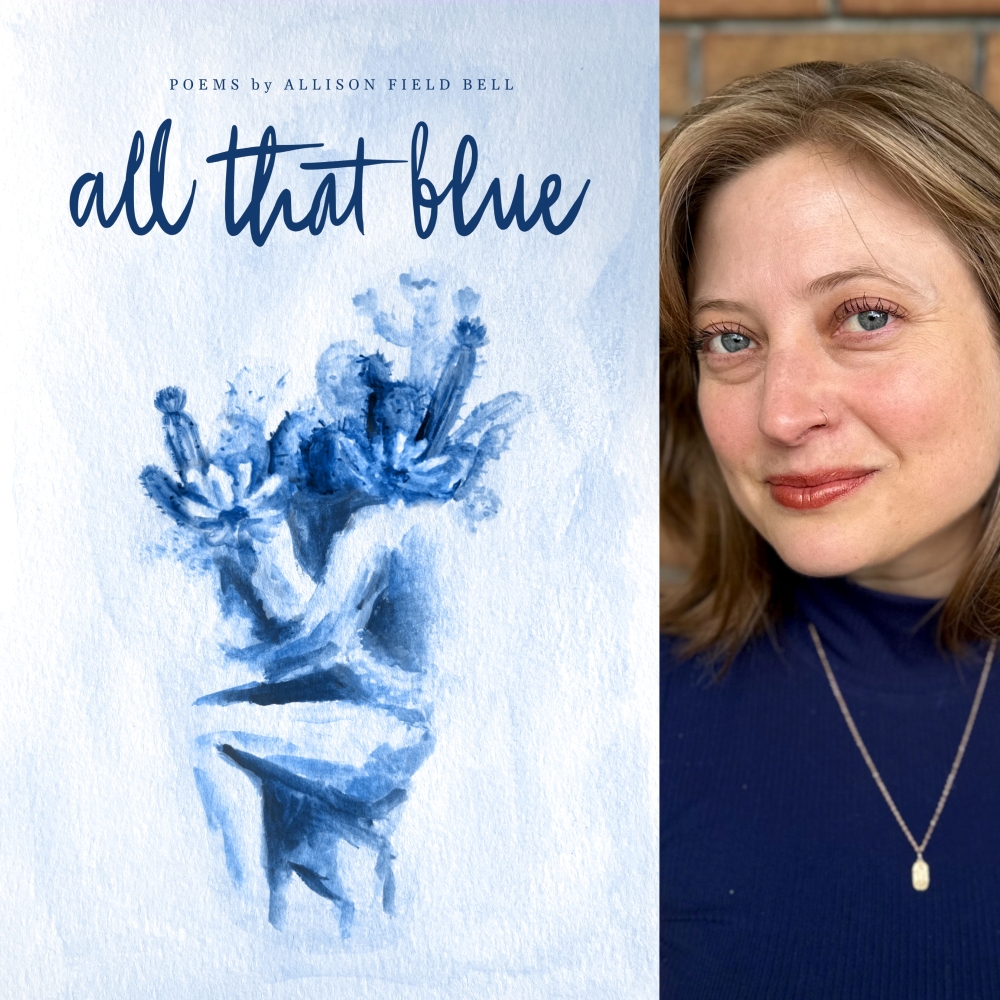
There’s something beautifully expansive about multi-genre writer Allison Field Bell‘s new poetry collection, All That Blue (now available from Finishing Line Press). The title itself evokes images of expansiveness: an unending dome of blue sky above, the glimmering cobalt of the ocean, the pristine turquoise of a county pond.
Juxtaposing these visions of expansiveness, though, are raw, intimate, and up-close expressions of life in all its messiness and unpredictability–the teeming life bubbling up from beneath. The 43 free-verse poems of All That Blue, Allison’s first collection of poetry, present this juxtaposition brilliantly.
I’ve been a fan of Allison’s writing for some time now, especially her short fiction and creative non-fiction pieces. Her narrative style often feels poetic to me, so it’s no surprise she would branch out to create wonderful free-verse pieces and prose poems that also contain strong narrative elements. The term “multi-genre writer” seems to have been created with writers like Allison in mind.
The poems in All That Blue provide touch on a range of emotionally riveting subjects and situations, from complicated family relationships (mainly between a daughter and mother) to gender roles, sexuality, love, running, drinking, worrying, and mental illness. Woven throughout the poems are elements of geography, both of place and of the body–“yes, yes, I am always writing about the body,” Allison tells me in an email exchange–and how we can become dislocated or alienated from both or either.
From Body to Blue
The body is such a recurring theme in Allison’s work that at one point she’d considered calling this collection Some Other Body. But she “landed on All That Blue for a few reasons,” she says.
“First, it is the last line of the poem ‘O’Keeffe Country’ (about the artist Georgia O’Keeffe), which I think says a lot about making poems and art (a kind of ars poetica), and also includes some hope for the future in my opinion. A hope that many other poems lack.”
That poem, as well as another homage to O’Keeffe (“Skeleton”), are among the pieces that paint a picture of expansiveness. In “O’Keeffe Country” describes “…Landscape so vague/it’s uninhabitable. Just lines and/color. So much that doesn’t belong/to me. Just passing through. …”
Not all of the poems in All That Blue convey the sense of big-sky optimism of “O’Keeffe Country,” however.
“There’s a lot of tough material in this book,” Allison writes, “but I don’t want it to be without hope. So I wanted to foreground that. Also, when I started thinking more about the word blue, I realized that it really holds so much: there is the sea and the sky, and the idea of blue as in depression. So the word blue encompasses both the mental and physical spaces we inhabit. Deeply relevant to the content of the book as a whole. There’s a quote I love from my grandmother’s journal–a woman I never met–that is currently the working title of my novel-in-progress (though I’m sure it will change): ‘There is the day filled with too much.’ Something about the phrase ‘all that blue’ strikes me as in line with that quote. And both resonate with me as a complex reflection on what it is to be bipolar moving through the world. Which is a part of my experience.”
As I read this collection, I also connected the sense of blue with images of music–the blues, rhythm and blues, and the improvisational nature of jazz, a la Miles Davis’ Kind of Blue. I felt that most while reading and rereading the poem “Oysters,” which appears in the fourth and final section of this collection (more about sections in a bit). In “Oysters,” the narrator, at a bar somewhere in the Midwest, is eating oysters and contemplating “where to go next,” and the tenor and rhythm of the words strike me as having a jazzlike quality.
“… West coast or east coast or
a combination of the two. Like deciding
where to go next. This way, that way,
a combination of the two. Living outside of my
surroundings, of my means: oysters in the Midwest.”
The book is divided into four sections that correspond roughly to Allison’s “the trajectory of my life: childhood, early adulthood, late 20s to early 30s, and most recent.” She credits “several poet friends I admire”–Matty Layne Glasgow, Jamie Smith, Jessica Tanck, Tara Westmor, Jasmine Khaliq–“to really parse out what I wanted to do with the sections.”
Eventually, they helped me recognize that the poems themselves were doing so much already, and maybe embracing chronology wasn’t such a bad thing. … Of course, it’s not all autobiographical, but much is at least inspired by material from my life.”
Read two poems from All That Blue
Horse Girl
As a child, I raised guppies. Bright scaled creatures that fluttered through freshwater. They multiplied overnight, filling the tank with color. I netted the babies to separate them, so they wouldn’t be consumed. When they were big enough, I sold them for a few dollars to a local pet store. I was saving to buy a horse. A useless enterprise. I wanted something to carry me across the earth. All that muscle. Large liquid eyes. The smell of alfalfa and hay. Instead, I had cages. Tanks. Green anoles, hermit crabs, a teddy bear hamster, the guppies. My room a menagerie of what I could afford. The horse I dreamed up was a proud unbroken mare. And I wouldn’t be the one to break her—no one would—but she would only respond to me. My touch. My voice. A way of being something other than myself. Maybe every little girl’s fantasy. I didn’t know how to be otherwise. Makeup, shaved legs, boys. But I wasn’t a horse girl either. I was guppy girl. I saved the boldest most beautiful males for breeding. Their tails a spectacle. Watching them shimmer. Running the numbers in my head. Heart in a gallop.

Originally published in Passages North.
Garden
I haven’t been honest with myself. The peony in my front
yard had just one bloom last year. Fleeting, fuchsia.

I watched it unfurl one petal at a time, breaking through the bud.
Couldn’t leave the house for fear of it happening without me.

Stared through the window in pajamas. Days lost to waiting.
My doctor wants to increase my medication—he suggests we double it,

my brain needs more than it already has. I think about the quartet of tulips
in the backyard—every winter I fear they must have died down there

but every spring they shoot through the ground in a great miracle—
green stalks and deep wine-red blossoms. I tell my doctor this. A metaphor.

Really, I wonder how long any of us can last. Winters changing: rain in February in Utah. The whole of the Salt Lake Valley under threat.

Beneath the lake’s liquid skin: poison. The last medication I tried flooded
my heart in a ruthless double-beat. I couldn’t do anything right:

drink coffee, pour wine. I yelled at my doctor on the phone. He agreed that it was wrong. Told me I shouldn’t be drinking. Too much

for my liver to hold. There’s also a bed of irises that bloom
later than the rest: early summer and their pale pink flesh opens

to the mountain heat. Doctor doesn’t understand why I’m talking
about bulbs, about flowers. Why I can’t just say I want to get better.

I tell him, I wish I could just live outside. Plant me in the yard, let me
disappear in winter and return come spring. Let me be brief and full of light.

Originally published in Sugar House Review.
About Allison Field Bell
Originally from Northern California and now living in Utah, Allison is a PhD candidate in Creative Writing and English Literature at the University of Utah, and she holds an MFA in Creative Writing from New Mexico State University. Allison is a Fiction Editor for Waxwing and the Social Media Editor & Assistant Prose Poetry Editor for Pithead Chapel. Her debut short story collection, Bodies of Other Women, is the 2025 Winner of the Red Hen Press Women’s Prose Prize, judged by Alyssa Graybeal. The book is forthcoming in 2028. She is also the author of two otherchapbooks out in the world now–Edge of the Sea (creative nonfiction, CutBank Books) and Without Woman or Body (poetry, Finishing Line Press)–and flash fiction chapbook, Stitch, forthcoming this year with Chestnut Review Books. Her current projects-in-progress include a book of flash fiction, a collection of nonfiction, and a novel.
Related links
- Read my Friday Five interview with Allison from January 24, 2025
- Follow Allison on X/Twitter at @afb16

 Andrew Careaga
Thank you, as always, for shining the spotlight on great writing!