Friday Five: The 5 Ws (and one S) of good communication

If you’ve taken a high school journalism course, you’ve heard of the 5 Ws of journalism. The 5 Ws are the five questions a journalist must answer when writing a news account — especially when using the inverted pyramid approach to news reporting:

  1. Who?
  2. What?
  3. When?
  4. Where?
  5. Why?

But the 5 Ws matter to other communicators, too — not just journalists. It’s important for the marketer to be able to answer these 5Ws when preparing their materials. It’s also important to think about these 5 Ws (and 1 S, which I’ll get to in a minute) before you start working on any marketing project. These questions should be answered in strategy sessions — long before you sit down to write your copy, set up your video shoot or design your website.

Strong marketing copy should address the 5 Ws for the same reasons as a news story: To get to the point quickly and make it easy on your reader (customer). (This post provides more insight into why the 5 Ws are more important to business than to journalism.)

Answering these questions before you start writing your copy, creating your video or designing your marketing materials will save you a lot of time up front:

  1. Who is my customer? (In other words, who am I trying to reach with my message?) Also, Who am I to the customer? This can be an important distinction, and your relationship with the customer makes a difference in how you answer the other questions.
  2. What do I want the customer to do as a result of my communication?
  3. When do I want the action (the “what”) to take place? Enroll today!
  4. Where do I want it to occur? Apply online or Come visit our campus!
  5. Why should they take action?

But there’s a sixth question we need to ask before we start our production. And it’s more important than any of the 5 Ws. That question is:

So what? Who cares?

Who cares about your offering? Is your communication even worth sharing?

That’s the toughest question of all. Which is why it often goes unasked.

And that’s probably why we see so much “careless” marketing. And by “careless,” I mean marketing that makes the audience “care less” about what we have to offer.

Happy weekend.

(Image courtesy of Julian Gough.)

P.S. – Technically, that “one S” question is two questions. I include this caveat because I know some of you care about those details.
 

Global #highered and the 99%

During the past year — since the Occupy Wall Street protest movement gained traction last fall — we here in the United States have heard a lot about the 99 percent.

But recently I’ve learned about another 99 percent — one that exists in the realm of higher education on a global scale. And it has more to do with meritocracy than privilege.

In the hyper-competitive higher education systems of India and China, the very best and brightest students — the 1 percenters in terms of academic ability — are “the ‘chosen ones'” who “get their choice of university, putting them on a path to fast-track careers, higher incomes and all the benefits of an upper-middle-class life.” This comes from a recent report from The Wall Street Journal titled, Can U.S. Universities Stay On Top? (Yes, yet another story about the decline of higher education in America. It seems we just can’t escape them.)

The 1 percent in India and China are the smartest and most academically equipped, and for them, their academic acumen is a ticket to the good life, according to this WSJ report.

Then there are the 99 percent. “The system doesn’t work so well” for them, the WSJ reports.

There are nearly 40 million university students in China and India. Most attend institutions that churn out students at low cost. Students complain that their education is “factory style” and “uninspired.” Employers complain that many graduates need remedial training before they are fully employable.

All of which alludes to an answer to the question in the headline. Yes, U.S. universities can stay on top, perhaps for now. The authors of this WSJ piece, both affiliated with the Boston Consulting Group, briefly discuss their “E4” formula determining global competitiveness of national higher ed systems. The U.S. and U.K. are first and second, respectively, followed by China, Germany and India.

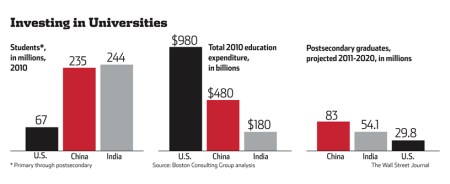
But the formula isn’t perfect. The four Es are expenditure (investment by government and private households, presumably in the form of tuition and gifts); enrollment; engineers; and number of “elite” institutions.

Comparisons of U.S., China and India based on data from BCG's "E4" rating system
Comparisons of U.S., China and India based on data from BCG’s “E4” rating system

The U.S. and U.K. sit atop the rankings thanks to three of the four metrics: “raw spending, their dominance in globally ranked universities and engineering graduation rates.” China and India make the top five due mainly to enrollment.

But I wonder about the validity of that first E, expenditure. For many public institutions, anyway, tuition costs have offset public investment from the states. Rather than raw numbers, it would be interesting to look at public investment as a percentage of GDP or perhaps a per-institution number.

As one of the comments in that WSJ article points out, U.S. education is becoming more stratified. While elite universities may be faring well, others are struggling. In a recent post, I referenced a National Science Board report showing that state per-student funding for public research universities has declined by an average of 20 percent between 2002 and 2010. As states invest less in public universities, our system could look more like those in China and India — where the 99 percent receive “factory-style” and “uninspired” education.

But there will be one difference: The 1 percent of U.S. students may not necessarily be the best and brightest, but the ones who can best afford an “elite” education.