
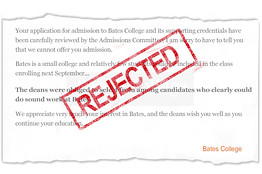
All-American rejection letters

In the world of college admissions, rejection is just part of life. (That’s also true in the world of trying to get a book published, as experience has taught me.)

But these days, in an era of college-bound American teens reared on self-esteem, rejection is a foreign concept, and can be a bitter pill. So, if you’re a high schooler applying for college and you might be on the bubble in terms of academics, or if you’re the parent of such a person, you might want to think about the possible tone of rejection letters that may come your way.

Sue Shellenbarger of the Wall Street Journal offers some guidance in her article Rejection: Some Colleges Do It Better Than Others (hat tip to Julie Wight, aka @socialjulie, who pointed this out in a retweet).

According to Shellenbarger’s “highly unscientific survey of actual letters, student interviews and message boards,” Harvard College offers the kindest rejections. “Despite an estimated admission rate of about 7% this year, this hotly sought-after school sends a humble rejection letter. ‘Past experience suggests that the particular college a student attends is far less important than what the student does to develop his or her strengths and talents over the next four years.'”

Duke also goes easy on those who can’t make the cut. “Undergraduate admissions dean Christoph Guttentag won particular praise from students and parents for the line, ‘I know you will find an institution at which you will be happy; I know, too, that the school you choose will benefit from your presence.’ Says Mr. [Daniel] Beresford, who was one of the 18,000 recipients: “It made me feel like I was a good applicant, not just another rejection.”

The toughest rejection letters came from Bates College in Lewiston, Maine. “The deans were obliged to select from among candidates who clearly could do sound work at Bates,” the letter says. Ouch.

The article includes other categories of rejections, including best spin, most confusing and most discouraging. Then there’s the best student response: “Living well.” Shellenbarger notes that one student, rejected by Harvard and Yale, “posted these words of advice for other rejected candidates on CollegeConfidential.com: ‘When you’re in the dough,” he wrote, “fax the colleges that denied you a copy of your rejection letter every day — letting them know just how badly they screwed up.'”

Tradition as a tool for student recruitment

Blogger’s note: There appears to be a problem with the ocmmenting form on this post. I hope the prblogs.org folks are working on it. Thanks for your patience. – AC

* * *

And how do we keep our balance? That I can tell you in one word: Tradition!

— Tevye, “Fiddler on the Roof”

The 2008 St. Pat, Paul Voss, watches St. Pat's Follies last March along with a throng of S&T students. (How'd that guy with the Michigan cap get in there?)
Every college and university has its share of traditions. Starting today, Missouri S&T kicks off one of its oldest and most celebrated traditions: St. Pat’s Week.

Last year, we celebrated the centennial of St. Pat’s, which began on our campus in 1908. (Full disclosure: We stole the idea from our sister campus in Columbia, where engineering students a few years earlier designated St. Pat the patron saint of engineers. But here in Rolla, where we had a much higher proportion of engineering students, we appropriated the celebration and rechristened it as our very own.)

This particular celebration is an important part of our history as a university. It probably means nothing to you, unless you happen to live in Missouri. (Research among Missourians in the 1990s revealed that our campus was known for two things: “excellent engineering programs” and “St. Pat’s.”) But it means a lot to alumni of many generations, who fondly recall it as a one-of-a-kind rite of spring and an important part of their college days. It means a lot to a segment of our student body, too.

But how important are such traditions to prospective students? Where does tradition fit into a recruitment strategy?

I haven’t read or heard much about this. It seems most colleges and universities neglect the power of their traditions as a marketing tool for prospective students. This seems to be a mistake, because traditions usually come with great stories. I know ours does.

We talk about our St. Pat’s tradition in our recruitment materials, but it is never front and center. We prefer to talk more about how our campus is the ideal place for a certain type of student. We talk about our range of majors, the availability of financial aid, and all the other stuff every other college or university talks about, only we try to do it in a way that sets us apart from everybody else.

But one of the things that really sets us apart is this tradition thing. Every institution has them. Maybe we should be using them more to distinguish us from the competition.

Although, to be honest, our St. Pat’s Celebration doesn’t have the greatest history. Like many things associated with St. Patrick’s Day, it has a lot of connections to drinking, and more than its fair share of debauchery. There have also been a couple of student deaths connected to a former student group that used to run the event. So maybe it isn’t the kind of thing you want to draw too much attention to.

Still, it’s part of what we are. Traditions, like family, stick with you, whether you want them to or not.

There ought to be some way to incorporate the best of our traditions into student recruitment. Don’t you agree?

Or maybe you’re already doing that. If so, please share.

P.S. – As part of last year’s 100th celebration, we started a blog to help promote the event and keep our far-flung alumni connected. We’ve resurrected that blog again, perhaps beginning a tradition of our own.