
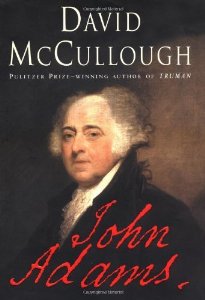
 Heading into the Independence Day holiday here in the U.S., I’ve been reading David McCullough’s biography John Adams. (I know; very late to the party, as usual. It’s been languishing on my bookshelf for a couple of years, right next to 1776, which I’ve now read twice. Why it’s taken me so long to read John Adams, I don’t know.)
I’m not quite 150 pages into the tome (that’s less than 25 percent of the pages), but I’ve already gotten to the good stuff that I wanted to read about before July 4 arrived. I’ve already read about Adams’ early days in Braintree, in Harvard, as a schoolmaster in Worcester and a lawyer in Boston’ about his rise to prominence in the Continental Congress; about his statesmanship and leadership in guiding others to support the move to break from Great Britain; about his political cunning in nominating George Washington as general of the continental army; about his love and commitment to Abigail, herself a very strong personality; and about the role he played in support of Thomas Jefferson as the young Virginian drafted the Declaration of Independence, which we celebrate on Thursday.
But what strikes me most about McCullough’s history — other than his ability to tie together extensive research to tell a great story — is the sheer fortitude, stamina, resilience and sense of purpose Adams and many of his fellow delegates possessed to shepherd the colonies through those perilous times. I’ve been thinking about some of the themes that resonate most with me, given my admittedly shallow dive into the book, and how they could apply to my work and life.
1. Compromise can win wars. Adams championed George Washington, a Virginian, to lead the continental army over fellow New Englander John Hancock. This was undoubtedly a political compromise, but Adams knew what he was doing. Virginia was the richest and most prominent of the colonies, and the proponents of independence from Britain needed to solidify that state’s support. Otherwise the cause of Adams and others would be dead in the water. The selection of Washington to lead the army was a shrewd political compromise.
The takeaway? Don’t be afraid to compromise when it supports a larger cause.
2. Oh, you’ve been appointment to a committee? Quit complaining. At one point, Adams served on 23 committees of the Continental Congress. Twenty-three committees. His days typically began at 6 a.m. and committee meetings would last well into the night. He also chaired something called the War Board, which was responsible for consulting with Washington’s army and presenting the fledgling military’s needs to Congress. Kind of puts your appointment to the Parking Committee into perspective, doesn’t it?
3. The pen is mighty. Mightier than the sword, as the cliche goes. In early 1776, while support for independence was split in Congress, the publication of a little pamphlet called Common Sense greatly raised public support for Adams’s cause. It became “a clarion call,” McCullough writes, “rousing spirits within Congress and without as nothing else had” by its attack on “the very idea of hereditary monarchy as absurd and evil.” The pamphlet boldly urged readers to take up the cause for independence. “The sun never shined on a cause of greater worth … for God’s sake, let us come to a final separation [from Great Britain]. … The birthday of a new world is at hand.”
It’s heartening for me, as a writer and pamphleteer of sorts (for what is a blog but a more modern version of the pamphlet?), to see McCullough acknowledge the power of this piece of writing to stir a movement. Of course, Jefferson’s writing of the Declaration of Independence (aided substantially by Adams, Ben Franklin and others) also proved that the written word can stir great passion for a cause.
4. Sometimes an outsider can make a big difference. Thomas Paine, the author of Common Sense, was not part of the inner circle discussing independence and rebellion. McCullough describes him as “a down-at-the-heels English immigrant.” Yet his little pamphlet did much to advance Adams’s cause. The lesson here: Don’t discount the impact outsiders can have in supporting your cause. Listen to their voices. Seek them out, even. They may not have all the answers — Adams disagreed with much of Paine’s ideas — but they could provide unknown advantage.
Just a few things to think about as we head into what I hope for many of us will be a long weekend and a time to reflect on the many blessings life affords us.
And one final thought — certainly not original:
When in the Course of human events, it becomes necessary for one people to dissolve the political bands which have connected them with another, and to assume among the powers of the earth, the separate and equal station to which the Laws of Nature and of Nature’s God entitle them, a decent respect to the opinions of mankind requires that they should declare the causes which impel them to the separation.
We hold these truths to be self-evident, that all men are created equal, that they are endowed by their Creator with certain unalienable Rights, that among these are Life, Liberty and the pursuit of Happiness.–That to secure these rights, Governments are instituted among Men, deriving their just powers from the consent of the governed, –That whenever any Form of Government becomes destructive of these ends, it is the Right of the People to alter or to abolish it, and to institute new Government, laying its foundation on such principles and organizing its powers in such form, as to them shall seem most likely to effect their Safety and Happiness. Prudence, indeed, will dictate that Governments long established should not be changed for light and transient causes; and accordingly all experience hath shewn, that mankind are more disposed to suffer, while evils are sufferable, than to right themselves by abolishing the forms to which they are accustomed. But when a long train of abuses and usurpations, pursuing invariably the same Object evinces a design to reduce them under absolute Despotism, it is their right, it is their duty, to throw off such Government, and to provide new Guards for their future security.
Read the Declaration of Independence in its entirety.
Happy Independence Day to you and yours! (And to you Canadians, a belated Canada Day!)
 Andrew Careaga