Book review: Happy Customers Everywhere

It seems like a no-brainer to me that businesses and other organizations would like to keep their customers happy. If someone buys your product or service and likes it, that person is more likely to return and buy more of your stuff, right? (For colleges and universities, the assumption is that a graduate satisfied with his or her experience with your institution is more likely to donate or provide some other form of support, whether it involves voluntarism, attending sporting events or just speaking well of your institution to others.)
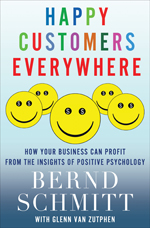
Happy Customers Everywhere, by Berndt Schmitt

So as I cracked open Bernt Schmitt‘s new book, Happy Customers Everywhere: How Your Business Can Profit from the Insights of Positive Psychology, I wondered why anyone would need to read this book. Don’t we already know all there is to know about customer service and satisfaction?

As I soon learned, Schmitt’s premise extends far beyond the notion of customer service and satisfaction. Building on findings from the  field of positive psychology, which asserts that helping people find meaning and fulfillment in their lives is just as important (if not more so) than diagnosing mental illness, Schmitt applies what he calls the PME Happiness Model (the letter stand for pleasure, meaning and engagement) to the world of business. He presents his insights using case studies from a number of businesses that work at delighting their customers in order to build stronger loyalty and what he calls “promotion,” but what for higher ed purposes might better be termed “advocacy.”

This book is a quick, enjoyable read. Schmitt has a lively and conversational writing style, and although this is a business book, it isn’t full of many of the buzzwords we’ve come to expect from such efforts. As with most pragmatic business books, he also includes plenty of case studies illustrating how companies are building these positive psychology principles into their business processes and marketing efforts. Schmitt also includes a section addressing the importance of a happy workforce, which in turn leads to happier customers.

Happy Customers Everywhere contains some sound marketing ideas that should translate well to our higher ed marketing roles as  we work to build a greater commitment to loyalty and advocacy for our institutions among our customers, from prospective and current students to alumni and legislators. Many of the concepts discussed in Happy Customers Everywhere are rooted in the ideas behind experience-based marketing. Which comes as no surprise, since Schmitt, a professor of international business at the Columbia Business School, also wrote a book called Experiential Marketing.

So, if you’re interested in putting a positive-psychology spin on your higher ed marketing efforts, you might want to take a look at Happy Customers Everywhere.

From my perspective, the most important takeaway from this book — one that is more implied by Schmitt that explicitly stated — is embodied in the “everywhere” part of the title. In this global economy, where more and more people have more money to spend in their pursuit of happiness, more and more customers are expecting to be satisfied. The idea that consumers from developing nations should just “take what they get” from (U.S.-based) multinational corporations and be thankful will soon be out of fashion, if it isn’t already. Gone, too, is that image in my mind of the bread lines of Soviet-era Moscow, where the women in babushkas would stand for hours in hopes of getting a stale loaf, and not having much say about whether they do or not.

As I learned from this book by Schmitt (a pretty sharp guy; he’s ), the concept of happiness is a relatively new idea that’s only been around from a few hundred years or so. And the notion that we can pursue happiness is mostly a Western idea (and Jeffersonian). So it was a foreign concept to those Soviet-era Russians. But as with many of our cultural values, the pursuit of happiness has been exported to the global marketplace. Now everyone, everywhere, can pursue happiness. This is a good thing.

So, how does this affect those of us who work in higher ed in the U.S. as we consider the globalization of higher education? For years, as our nation’s global market share in various sectors began to shrink, scores of educators, pundits and public figures have continued to proclaim that our system of higher education is still the greatest in the world. There’s probably some truth to that assertion. In his 2008 book The Post-American World, Fareed Zakaria described how the U.S. higher education system is “much better [than other nations’ systems] at developing the critical faculties of the mind, which is what you need to succeed in life. Other educational systems teach you to take tests; the American system teaches you to think.”

Still, that was four years ago. Today, even as many international students continue to view the U.S. educational experience as the best in the world, they have more options than ever before. Because if we aren’t serious about delighting this burgeoning market of students, they’ll take their business elsewhere.

That, too, seems like a no-brainer.

Cover image courtesy of www.stockfreeimages.com

Friday Five: ‘Likeonomics’ takeaways

Likeonomics author Rohit Bhargava

What’s not to like about Rohit Bhargava‘s new book Likeonomics: The Unexpected Truth Behind Earning Trust, Influencing Behavior, and Inspiring Action? It’s a quick, enjoyable read — perfect for a lazy day at the beach or a business flight. It’s loaded with real-world examples, many of them familiar to most marketing people. It includes quick case studies from a variety of fields (including one for education). It features a complementary website — likeonomics.com — where readers can access bonus material (PDF workbooks and “action guides” as well as links to many of the articles and other resources Bhargava incorporated into his book). And if you’re really pressed for time or just totally ADHD, Bhargava hits the highlights in 60-second recaps of each chapter at the end of each one.

OK, so there were a couple of things I didn’t really like. But they’re minor, nitpicky sorts of things — the stuff copy editors are more likely to obsess over than regular readers, like a typo on a chart in the introduction; but maybe the publisher sent me an advance copy, and that error was corrected before the book shipped). So I won’t go there. Because, well, Bhargava seems like such a genuinely good fellow and it would look like I’m taking cheap shots. And nobody wants to look like a chap shot-taking jerk who points out a few stylistic issues in a book with a title and theme as uplifting as Likeonomics. Besides, there’s more than enough positive and useful information in this book to make up for those trifling errors.

Likeonomics is the second book by Bhargava. He’s a marketing guy at the global PR firm Ogilvy and an adjunct marketing professor at Georgetown, so he comes with strong credentials for writing this book. The premise of Likeonomics (which is pretty obvious from the title) is that even in business, nice guys and gals can finish first.

The point is that you don’t have to be a ruthless, money-grubbing jerk to come out ahead in the world of business or, more to the point for this audience, the world of marketing. This should be obvious to us in the days of social media, when customers can and do use social media to complain about lousy customer service or shoddy products, and their networks can quickly amplify those complaints to a worldwide audience. (United Breaks Guitars, anyone?) But apparently the idea that being likeable is a winning business strategy hasn’t reached everybody in the business and marketing world. Here’s hoping that Bhargava’s book will help spread a virus of likability.

So, on to my top five takeaways from and about Likeonomics:

1. It’s not all about social media. Thanks to Facebook, “liking” someone or something has taken on a new meaning these past five or six years. Bhargava is quick to point out in the preface (“Warning: Unexpected Honesty…”) that “the idea of likeability goes far beyond getting people to like you on a superficial level.” And what is the Facebook “like” if not the ultimate symbol of social media superficiality?

2. Marketing and PR have caused a “believability crisis.” One reason people distrust corporate and government institutions is because of the way they’ve tried to push their products and ideas, or tried to manipulate and spin us into seeing things their way. The now-glamorized Mad Men mass-marketing era that gave us the Marlboro Man “played a central role in creating a culture where people are afraid to trust the media around them,” Bhargava writes (pp. 13-14). This escalating distrust has blossomed into “a full-blown crisis” (p. 14).

3. T-R-U-S-T is the answer. Bhargava believes that the remedy for this believability crisis is TRUST, a handy acronym for what he calls the five principles of likeonomics: Truth, Relevance, Unselfishness, Simplicity and Timing. (OK, I said I wouldn’t nitpick; but Bhargava’s reference to this acronym on p. 55 calls to the first principle “Trust,” not “Truth,” although he got it right in the first reference, back on page xxxvii. I would think Wiley’s copy editing would have caught that. Error-free books go a long way toward inspiring trust among certain obsessive-compulsive copy editor types who review books on their blogs.)

4. Examples abound. It’s obvious from reading Likeonomics that Bhargava is an excellent researcher. He cites numerous examples to support his TRUST principles — from the success of Costco’s ethical business practice model (Unselfishness) and Avis’s classic “We Try Harder” ad campaign (Truth) to the popularity of TED Talks and and the rise of the plain language movement (Simplicity). These examples show the practical nature of Bhargava’s ideas. And he was surprised at “just how easy it was to find examples of Likeonomics in action. It is all around us” (p. 146). I do wish he had found a couple of examples from the world of higher education, but I guess I’m just being selfish.

5. It’s good to be liked. Throughout my reading and re-reading of Likeonomics, my mind’s VCR (yes, I’m that old) kept replaying that portion of Sally Field’s 1985 Academy Award acceptance speech, the one where she exclaims, through tears of joy: “You like me!”

It’s good to be liked. And as Likeonomics and Sally Field both show, being likeable can also be good business.