
Repost: Marketing (and life) lessons from Martin Luther King Jr.

This post originally appeared on this blog on Martin Luther King Jr. Day 2009, under the title Media relations, taking the long view and other lessons from Martin Luther King Jr.. MLK Jr. Day 2009 also coincided with the eve of President Obama’s inauguration, so references to that event have been deleted in an attempt to keep this post relevant. I hope it gives you pause to reflect on how you live your life and approach your most meaningful work. – AC
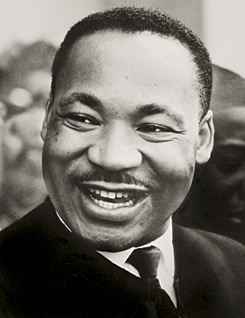
As our nation honors the Rev. Martin Luther King Jr. today with a national holiday, I pause to consider a bit how King’s worldview and moral stance against evil has influenced my own life.

I’m in no way attempting to compare my life with King’s, for I’m no civil rights leader, no martyr, no leader of any consequence by comparison. But I’ve long admired King not only for his leadership in civil rights, but more for his clarity of vision in the sense of moral and spiritual matters, as well as his PR savvy. The fact that he understood and used mass media to his advantage should not be separated from King’s quest for justice and equality, but it does point to the man’s ability to use the tools and systems of the temporal world to further more idealistic goals, and that’s something any of us who work with the media ought to understand.

One of the most poignant (brief) commentaries on King’s life that I’ve read comes from Philip Yancey’s book Soul Survivor: How My Faith Survived the Church. Yancey was a good ol’ Georgia boy when the civil rights movement started gaining traction in the early 1960s.

“When I was in high school,” he writes, “the same students who cheered the news of President Kenedy’s assassination also cheered King’s televised encounters with Southern sheriffs, police dogs, and water cannons. Little did we know that by doing so we were playing directly into King’s strategy.”

That strategy, from a media relations standpoint, was brilliant, for it opened the nation’s eyes to the tragedy and brutality of racism. “He deliberately sought out individuals like Sheriff Bull Connor and stage-managed scenes of confrontation, accepting jail, beatings, and other brutalities, because he believed a complacent nation would rally around his cause only when they saw the evil of racism manifest in its ugliest extreme.

“In that goal,” Yancey writes, “King succeeded spectacularly.”

But separated from what Yancey calls King’s “long view of faith,” that media relations success would have rung hollow.

“Already convinced of the justness of their cause,” Yancey writes, the civil rights workers “wanted someone to lift their sights beyond the long string of disheartening failures.” King, with his long view that justice will triumph, was the man to do just that.

We now look back on the civil rights movement as a steady tidal surge toward victory. At the time, facing daily confrontations with the power structure and under constant intimidation from policemen, judges, and even the FBI, civil rights workers had no assurance of victory. We forget how many nights they spent in rank southern jails. Most of the time the present looked impossibly bleak, the future even bleaker. …

For King, the long view meant remembering that, no matter how things appear at any given moment, God reigns. Later, when the famous march from Selma finally made it to the state capitol, the building which once served as the capitol of the Confederacy and from which the rebel flag still flew, King addressed those scarred and weary marchers from the steps:

I know that you are asking today, “How long will it take?” I come to say to you this afternoon, however difficult the moment, however frustrating the hour, it will not be long, because truth pressed to earth will rise again. …

* * *

It seems the long view has been in short supply in our culture for many years. Witness what has happened on Wall Street, in our banking industry, and just about everywhere else you look in our culture, and you see the fruits of short-term, get-what-you-can-while-you-can thinking. Even in our educational system, sadly, the short view too often reigns. We live from fiscal year to fiscal year, from project to project. Even our long-range plans extend no further than five years out, and the goals are largely based on numbers, rather than the essentials King spoke of — the essentials of peace, justice and love.

What about us? Do we connect our day-to-day actions, our work? Our lives, to a greater, nobler cause? Those of us in higher education ought to. It’s pretty easy, really. We’re in one of the most noble pursuits there is. I’m fond of quoting William Butler Yeats, who supposedly said that “education is not the filling of a bucket, but the lighting of a fire.” On my better days, I like to think that what I do helps to fan those flames of knowledge.

I can’t say I’ve always done the best job of taking the long view, or for contributing to King’s ideal of a world in which peace, justice and love reign. But re-reading Yancey’s chapter on MLK has reinvigorated me and encouraged me to think more about the long view — in my job, in my life, in my other pursuits. I hope this post encourages you to do the same.


Introverts and the ‘new groupthink’

Disclosure: I am a raging introvert. I’m here, I’m not particularly loud, get used to it. I can come off as aloof, uncaring and anti-social. Whenever I run or work out, I like to do so alone. It gives me time to think and clear my head after days that are all too often full of meetings, interactions and interruptions. I like to think about stuff. Sometimes I like to think about stuff more than I actually like doing stuff. Which drives my wife crazy on weekends, especially when I’m blogging instead of being, you know, productive.

I also digress.

Brainstorm-NYTimesAnyway. I tell you all of that so you will know why I come off as such a fanboy of this article, The Rise of the New Groupthink, which was published in this weekend’s New York Times Sunday Review. I can’t convey with enough enthusiasm my praise for this article. (Of course I can’t. I’m a pensive, analytical introvert. But if you would, please imagine this animated little guy inside my brain doing handsprings and screaming Squee! about this essay. Are you with me?)

(I have a feeling that most extroverts have checked out by now. Here goes Andy, all up inside his head again, with ideas and stuff, so no thank you. Next? So this may be preaching to the choir. But those extroverts in charge of things will need to know this stuff, too. So I hope you’ll pass these ideas along to them. You can bet that I will, in the same way that, back in 2003, I passed along photocopies of Jonathan Rauch’s great essay Caring for Your Introvert to every co-worker and supervisor who would receive it.)

quite-bookThe author of this article is Susan Cain, who is also the author of a forthcoming book Quiet: The Power of Introverts in a World That Can’t Stop Talking. She too is an introvert and proud of it, perhaps even over-zealously so. (She advocates a “quiet revolution,” which comes complete with manifesto. To arms, comrades! In the solitude of your studies, that is.) Her essay resonates with my introverted self in many ways. But there are so many good ideas presented in that piece that anyone, introvert or extrovert, in higher ed culture — where meetings and face-to-face time can suck the energy from even the hardiest of marketing and PR minds — ought to heed.

What Cain calls the “new groupthink” is this idea, so prevalent in higher ed, as well as in many other types of organizations, that “creativity and achievement come from an oddly gregarious place.”

“Most of us,” she writes, “now work in teams, in offices without walls, for managers who prize people skills above all. … The New Groupthink has overtaken our workplaces, our schools and our religious institutions.”

Here are some ideas and takeaways from this piece that piqued my interest:

Privacy can aid creativity. In our higher ed marketing culture, where brainstorming sessions have become routine, we might think the opposite is true. But as Cain writes, “Research strongly suggests that people are more creative when they enjoy privacy and freedom from interruption. And the most spectacularly creative people in many fields are often introverted. … They’re extroverted enough to exchange and advance ideas, but see themselves as independent and individualistic. They’re not joiners by nature.”

Cain points to the success of Apple, and the quieter half of the fabled pioneering partnership, Steve Wozniak. Woz “who toiled alone on a beloved invention, the personal computer,” long before Steve Jobs entered the picture. True, Jobs deserves much credit for Apple’s success. But if not for the work of the lone engineer Wozniak, who knows what might have happened?

Takeaway: Don’t assume the most gregarious “team players” in your group are the most creative. Give people time to work in solitude.

Solitude can aid productivity. It isn’t just the creative types — designers, writers, etc. — who benefit from privacy, according to Cain. She cites one study of programmers at top-performing companies which revealed that the best weren’t necessarily the most experience or highest-paid. Instead, what distinguished the best from the rest “was how much privacy, personal workspace and freedom from interruption they enjoyed.”

In our workspace, the “front office” staff have little opportunity for solitude, and they probably suffer more than any of us from interruptions, office chit-chat, etc. Even though they aren’t designing websites or writing for the alumni magazine, they are engaged in projects and work — accounting, scheduling, organizing — that could benefit from some peace and quiet every once in a while.

Takeaway: Give all members of your team a chance for some solitude.

Solitude helps you learn. Often, “the best way to master a field is to work on the task that’s most demanding for you personally. And often the best way to do this is alone.” On the other hand, “brainstorming sessions are one of the worst possible ways to stimulate creativity.”

Takeaway: Brainstorming is great for generating ideas, but don’t expect the “great” ideas to come from those activities. And don’t rely on brainstorming as your only way to get new ideas or solve problems.

Not all group activity is bad. “Some teamwork is fine and offers a fun, stimulating, useful way to exchange ideas, manage information and build trust,” Cain writes. “But it’s one thing to associate with a group in which each member works autonomously on his piece of the puzzle; it’s another to be corralled into endless meetings or conference calls conducted in offices that afford no respite from the noise and gaze of co-workers.”

Takeaway: Don’t abandon team-building activities, but realize that sometimes we all need some time to ourselves.

In conclusion: We all should heed the immortal words of Billy Idol and, at the end of a long day, “sink another drink, ‘cuz it’ll give me time to think.”

I have pre-ordered Quiet, which releases Jan. 24, and plan to devour it as soon as I get a moment’s peace. Maybe I can even talk Susan Cain into share some insight in a Friday Five interview.

What do you think? Is Cain on to something here? Comments are open.