
Friday — Independence Day in the USA — will find this blogger far from his computer keyboard, celebrating the birth of the nation in the fine American tradition of outdoor grilling and pyrotechnics. That means this week’s Friday Five is delivered a day early and with 40 percent less bloggy goodness. Call it the Thursday Three.
Today’s topic is books. Back when my summers were more leisurely, I would read books (novels mostly) for pleasure. These days, if I don’t see some sort of vocational connection to a book, I rarely read it. Maybe you’re the same way. But that felt need to justify my reads by linking them to work doesn’t mean I can’t enjoy a good book along the way. Here are three recent reads that not only taught me something I didn’t know about PR, communication or some other work-relevant aspect, but also gave me good, if not great, pleasure.
Three books that marketing, PR and/or web types may find worth reading
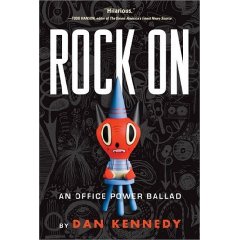 Rock On: An Office Power Ballad, by Dan Kennedy. An amusing memoir of the author’s 18-month tour of duty doing marketing for a big record label while the music business was in free fall. (BTW, it’s not getting any better for the recording industry.) Kennedy, a regular contributor to McSweeney’s, is a clever writer whose book offers insight into what happens when an industry flat-out refuses to accept market realities and continues to push product the way it did two decades earlier. A great review of the book from March describes Kennedy as “a Walter Middy in reverse” who “constantly retreats from an absurd corporate environment — equal parts tyranny, vanity and fecklessness — into neurotic internal-reality checks even funnier than the folly all around him. He attends a meeting about Jewel’s song ‘Intuition,’ which she has licensed to a line of women’s razors, also called Intuition. ‘Anyone in the room who knows the irony of a song about not selling out being used to sell razors,’ Kennedy writes, ‘displays a perfect professional poker face. I, on the other hand, am most likely doing the thing where I stifle disbelief and then start getting paranoid that I totally don’t understand what’s going on and that it’s showing on my face, and then I get paranoid that you can get cancer this way.'” Of the three books on this list, Rock On is probably the most suitable for on-the-beach reading.
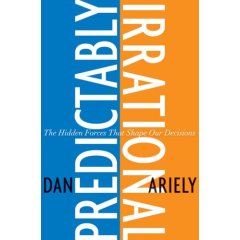 Predictably Irrational: The Hidden Forces That Shape Our Decisions, by Dan Ariely. The author, a behavioral economist who until very recently served on the MIT faculty (but now, according to his blog, has joined the faculty at Duke), strings together the results from a string of experiments and research projects that confirms we humans are not as rational as we like to think we are. We fall for gimmicks like Amazon’s “free shipping” for orders of over $25 (who else in the room has ordered an unneeded item just to qualify for the “free” shipping?), we order the second-most-expensive item on the menu thinking we’re getting a deal when actually we’re putting more money in the eating establishment’s pockets (the savvy restaurant deliberately includes a high-priced item to induce us to order the profitable runner-up), and we tend to think a more expensive drug will be more effective than a less expensive alternative. Ariely’s engaging book shows that humans act irrationally in predictable ways. It’s a disturbing insight, but also valuable to anyone interested in human behavior — ergo, any marketer.
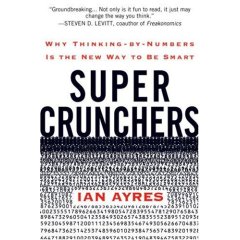 Super Crunchers: Why Thinking- by-Numbers Is the New Way to Be Smart, by Ian Ayres. This is a book any data-driven blogger (read: Kyle) ought to love. Ayres, a law professor at Yale, looks at all the many ways number-crunchers are going up against the intuitive experts in a variety of fields — from sports (think Bill James and “moneyball”) to entertainment (dataset analysts are working with movie companies to “script” the next blockbuster) to the rarefied pastime of wine collecting (Ayres begins his book by describing how one statistician, crunching weather data, can out-perform the world’s most sophisticated oenophiles in determining the quality of Bordeaux vintages — long before the wine leaves the casks). Like Predictably Irrational, this book is disturbing, especially if, when it comes to man-vs-machine competitions, you favor the experience and intuitive knowledge of humans to the cold calculations of data. But keep in mind that, for the time being at least, humans are still needed to interpret the data. But after reading Ayres’ book, I’m thinking it wouldn’t hurt those “intuitive experts” among us who have gotten this far relying on our “instincts,” “artistic eye,” “experience” or whatever to brush up on statistics.
So, those are my three. Any good reads to recommend? Discuss in the comments.
—————-
Now playing: Talking Heads – The Book I Read
via FoxyTunes

 Andrew Careaga