
Apple’s branding breakthrough and what it means for #highered

Earlier this week, Interbrand unveiled its ranking of best global brands for 2013. And for the first time since Interbrand began keeping score (way back in 2000), Coca-Cola has been dethroned. The new king of the global brands is Apple. Google takes the No. 2 spot, and Coke tumbles to third place.
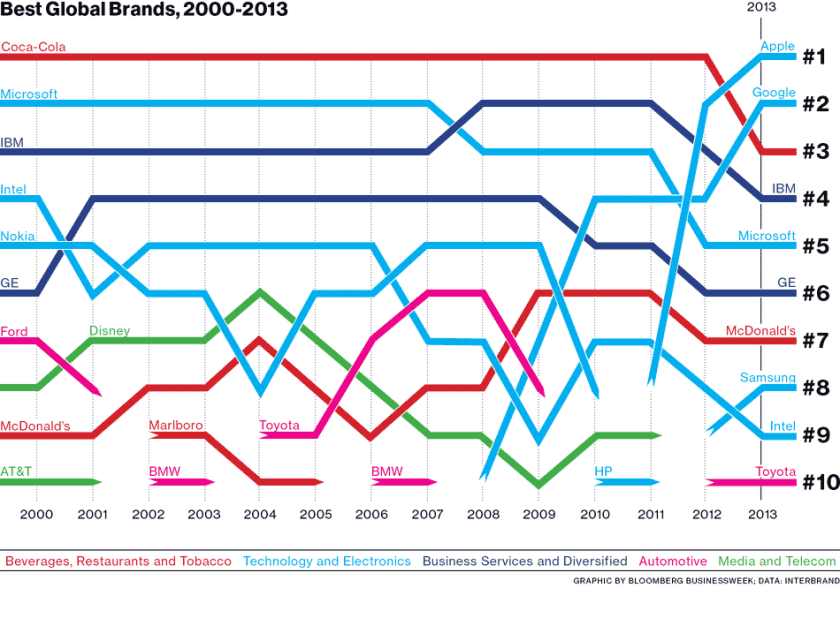
A BloombergBusinessweek  timeline of Interbrand's top 10 global brands since 2000. (Click image for larger view.)
A BloombergBusinessweek timeline of Interbrand’s top 10 global brands since 2000. (Click image for larger view.)

Interbrand’s methodology for determining brand value is about as arcane as U.S. News & World Report‘s approach to the annual college rankings. (For example, Interbrand relies on something it calls the “Brand Strength framework,” which is some sort of “diagnostic tool that delivers actionable insights.” Um, okay. That certainly clarifies things.)

But people in the branding world pay attention to Interbrand’s scorecard, just as higher education administrators do the U.S. News rankings. And both sectors love to brag about their organization’s rating when the scores look good and to loathe the rankings when the scores look bad, it gets people talking.

So let’s talk about brand rankings.

How did Apple dethrone Coca-Cola? And what could higher ed brand managers learn from it?

Getting emotional. Apple’s stock price has tumbled from $700 a share in September 2012 to the neighborhood of $478 per share recently, according to this analysis of the Interbrand rankings. So, considering stock value alone, one might conclude that Apple has even less value today than a year ago. But that would leave out one important component of the brand’s value. “Less tangible strengths like emotional intelligence and psychological insight are proving to be just as vital to leading a brand today as the ability to generate high ROIs and increased shareholder value,” says Interbrand CEO Jez Frampton in a statement. It is “a sign of the times,” Frampton says, that Apple, “a company that has changed our lives, not just with its products but also with its ethos,” has risen to the top of the brand hierarchy. For higher education, the takeaway is about the emotional value our institutions provide students, alumni and others.

Global and the new normal. Frampton also points out that “in a world that is increasingly globalized and interconnected, ‘developing’ countries like China are now poised to become bigger players, and collaboration — across borders, across silos, or co-creating with consumers — is more crucial than ever.” How will colleges and universities in the U.S. — or anywhere else, for that matter — position themselves to compete in this global environment?

Can you be both cheap and good? Apple becomes No. 1 on the heels of its recent announcement of a new, less expensive line of iPhones, a move that some see as risky. It actually bends one of the so-called “immutable” laws of branding (see this post), which says, in essence, that your brand should stand for something simple and narrow (more about this here). Apple has been known for high-end, well designed products. Are they now lessening their worth by offering a $99 iPhone? It’s a risk that may pay off. Consider what Stanford and others are doing with MOOCs, or Georgia Tech’s gambit of offering the $7,000 computer science degree. Will expanding access and dropping prices help build these brands or will it ultimately hurt? Time will tell. But time is not on the side of being both cheap and good.

Then again, Apple is known to “think different.” I wouldn’t bet against them, and look for them to stay on top of the charts for a while.

Disclaimer: I am not an Apple fanboy. 

University pages: New life for LinkedIn?

LinkedIn-University-Pages-600x247By now, you’ve heard about LinkedIn’s announcement that it was inviting colleges and universities to create official university pages in that space.

The social network known for helping prospective employees find the right job now wants to get in the business of helping prospective students find the right college.

Will it work?

Is this move a smart expansion of the LinkedIn brand or will it lead to a possible dilution or lack of focus for one of the more distinctive social networks out there?

Christina Allen, LinkedIn’s director of product management, writes in the university pages announcement that these sites “will be especially valuable for students making their first, big decision about where to attend college” and added that in September, LinkedIn will open up to high school students “who can use LinkedIn to explore schools worldwide, greatly expand their understanding of the careers available, and get a head start on building a network of family and friends to help guide them at every milestone.”

I guess soon we’ll see adolescents posting their resumes on LinkedIn, right alongside job-seekers. Maybe even competing for positions.

But some on the business side — which is LinkedIn’s niche — think the move could lead to a loss in credibility for the service. They like LinkedIn’s focus on talent recruitment, not student recruitment.

“When thinking about LinkedIn, numerous adjectives come to mind: professional, business-oriented, networking,” writes Victoria Derrick in a recent Business2Community article. ‘A few of the top reasons businesses use LinkedIn are: to gain exposure to professionals and consumers, recruit new talent, and increase credibility.”

But maybe those same adjectives come to mind when describing certain students looking for a college degree. As we’ve read in countless reports over the past few years, the demographics of college-bound students are changing. From my own experience, working at a university where the vast majority of students are engineering and science majors, I know that many of them are focused, serious-minded students who are looking at the college experience as a pathway to great careers. Many of these students also had this mindset while in high school. We also must consider older students who are re-entering college after losing jobs to downsizing, or military veterans returning to campus, and many other non-traditional audiences for whom LinkedIn may hold more appeal than other social media venues.

That’s more or less how the Wall Street Journal sees the move. “Focusing more on higher education is a natural extension for LinkedIn, and one that opens up the company to a whole new territory of users–young people,” writes the WSJ’s Brian L. Fitzgerald. “LinkedIn says ‘smart, ambitious students are already thinking about their futures when they step foot into high school.'”

But Fitzgerald adds something that gives me pause:

For LinkedIn, it’s less about trying to grab a group of savvy social-media kids allegedly growing bored with Facebook, and more about plying that old General Motors concept: Start out the customers young and stay with them through different stages of their lives. A college prospect with a LinkedIn account is likely to become a professional employee with a LinkedIn account a few years later. (Crossing fingers for a good economy.)

It’s that “plying that old General Motors concept” that bugs me. GM became known for extending its brand too far, trying to build all kinds of cars for all kinds of customers. And we saw the outcome of that brand extension in the form of a bailout.

“Reinvention,” Business2Community’s Derrick notes, “is sometimes a necessary aspect of business that can result in success and increased brand awareness. For other companies, it spells disaster.”

Let’s hope LinkedIn is making the right move — for its core business and for higher education.

P.S. – If you want to jump on the LinkedIn bandwagon and apply for one of the university pages, Karine Joly’s recent blog post provides a good step-by-step approach. (I’ve already submitted a request on behalf of my university. Might as well join the herd, right?)

Also, just for fun, view LinkedIn’s video targeting thecollege crowd: