
 With the concepts of authenticity and transparency now solidly ingrained in the minds (or at least the lingo) of most higher ed marketers and administrators, it’s amazing that so many of us insist on doing our marketing the old-fashioned way. We tend to continue the pushy, intrusive approaches that we assumed worked well in the past. We tout generic attributes about small class sizes, caring faculty and cutting-edge research, focusing on puffing ourselves up instead of considering the needs of our audiences. We also tend to invest little time or money in thinking about approaches that would tell the real — and distinctive — stories about our institutions.
But as the title of a new book for higher ed marketers suggests, it’s time for campus marketers and leaders to embrace their schools’ true identities and create brands that reflect those identities.
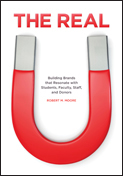
The Real U, by Robert M. Moore, is a quick, insightful read that could serve as a template for just about any campus in search of a brand identity. Subtitled Building Brands That Resonate with Students, Faculty, Staff, and Donors, Moore’s book offers some pretty good counsel for a brand manager seeking to involve those constituents in creating a brand identity.
The Real U‘s mission is outlined at the end of the brief introduction. “In this book,” Moore writes, “you’ll learn how to understand your brand story; shape it to meet the interests, values, and needs of your stakeholders; and project it into the marketplace in powerful, compelling, and effective ways.”
Moore, a managing partner for the higher ed consulting firm Lipman Hearne (which has a very slick website), has more than 25 years of experience in higher ed and non-profit marketing. So he knows the business. But 25 years of experience can lead to some bad habits, such as peppering one’s prose with standard-order marketing adjectives like “powerful,” “compelling” and “effective.” That’s not so bad, I guess. Our minds tend to skip over that sort of writing anyway, right? That’s why ads no longer command our attention. Fortunately, there isn’t much of that BS lingo in the book. And what there is of it, most of us can easily brush aside to uncover some worthwhile information.
Moore also counterbalances those sins with some clever verbal zingers, like this one attributed to Bo Diddley, which captures the essence of authenticity: “Don’t let your mouth write no checks that your a** can’t cash.”
In The Real U, Moore casts branding — rightly, I think — as the embodiment of an organization’s story. Every institution has a story, even if it isn’t very well articulated. (The goal of this book is to help brand managers articulate it.) Whatever that story is, Moore maintains that it must be anchored in authenticity — “the guarantee that the institution is actually able to deliver on the promise that it makes.” From there, Moore makes that case for grounding your brand identity not in logos or taglines, but in crafting the stories that convey your institution’s true identity.
There’s nothing new in The Real U, but Moore does a nice job of weaving the ideas of other marketers into his story to present a cohesive approach for higher ed. He cites marketing legends like Harry Beckwith and Jack Trout but also includes sidebar commentaries from other higher ed practitioners (way to keep it real for the audience, Robert!).
Even if there’s nothing new here, The Real U is an expertly and concisely packaged narrative, and I suspect most higher ed marketers, regardless of their experience, will find some take-aways in this book. The section on building a brand platform contains valuable illustrations for a variety of archetype campuses, which should prove helpful for marketers who are just getting started (or those who are revisiting their brand identity). From a personal and work perspective, I found the section on brainstorming and the Brand Basics chapter’s sidebar about creating an integrated marketing committee (contributed by Sharon Jones Schweitzer of Trinity University) to be particularly helpful. And although at times Moore seems to try too hard to be clever with his words (don’t all copywriters?), the final product is a worthwhile how-to resource for higher ed marketers. I plan to share it widely with members of our branding and marketing team, and maybe even with some administrators.
 You may have heard some of the uproar among higher ed types caused by U.S. News‘ decision to sell universities the right to post the magazine’s rankings “seal of approval” badge on institutions’ websites.
 Andrew Careaga