
 Update #5 (7:08 a.m. Friday, Oct. 22): PayPal and FundRazr have also donated to Sydney’s cause. Very cool.
Update #4 (11:44 a.m. CDT Friday, Oct. 15): Sharing this news for fellow tweeters, Facebookers and bloggers: “For every tweet, FB status + blog entry that includes #beatcancer, SWAGG & PayPal will donate $.05 to #beatcancer.”
Update #3 (8:05 a.m. CDT Friday, Oct. 15): Thanks to your generosity, nearly $1,700 has been raised to help the Stoltz family. Thank you. If you still would like to donate, here’s the Facebook link: http://bit.ly/dAomEP.
Update #2 (1:10 p.m. CDT Tuesday, Oct. 5): At this moment, $1,500 has been raised online for Sydney. (And I know of a few of you who are also sending checks, so the amount will be even higher.) Thank you all! Special thanks to Karine Joly, who mentioned it this morning in her Higher Ed Experts e-newsletter. To donate via PayPal, here’s the Facebook link: http://bit.ly/dAomEP.
Update (noon CDT, Monday, Oct. 4): Thank you for reading, retweeting and being so generous in support of Sydney Stoltz and her family. As I write this, $760 has been raised, much of it through contributions from you. I’m overwhelmed and so grateful for your support. If you haven’t yet donated and would like to do so, please read on. Thank you. – AC
In exactly one month from today, I will turn 50. But that fact isn’t the reason I’m issuing this plea for help. Frankly, given many of the life-threatening circumstances my friends and co-workers and their children have faced lately, I feel damned blessed to be approaching 50.
I’m using blog as a bully pulpit today because a dear friend and co-worker, Mary Helen Stoltz, and her husband, Bill Stoltz, are struggling due to medical bills and other costs associated with the cancer operation and post-op treatment for their second daughter, Sydney, who is not yet 3 years old. (That’s her, pictured on the left making that fishy-lipped kissy face.)
I believe that by leveraging the power of our collective online networks, together we can help the Stoltz family. At the least, we can relieve some of the anguish and burden Bill and Mary Helen are dealing with.
Many of you probably follow Mary Helen on Twitter (@mhstoltz is her handle), so you know about the cancer that was detected in Sydney’s body over the summer and the many trips in and out of a St. Louis hospital and to and from St. Louis physicians. Thank goodness, the cancerous growth was removed, but Sydney still must undergo weeks of treatment.
It isn’t yet certain how long the treatments will take. What is certain is that it will involve several more drives to St. Louis, which is a 200-mile-plus round trip from Rolla, as well as several overnight stays and a lot of time away from the office. Meanwhile, the medical bills and associated costs pile up.
Fortunately, Bill and Mary Helen have some very good friends who have set up an account through which others of us may donate to help the Stoltzes with their expenses. And so, I’m writing to ask you to join me in helping them. There’s an app through Facebook that should work if you go to my Facebook profile. (If we’re not yet friends, you won’t be able to see it. If that’s the case, please submit a friend request and I’ll grant it. You can always unfriend me later. I promise I won’t be upset.)
I’m sure many of you know other people who have a significant financial needs right now. Chances are you may also have a friend or loved one dealing with a form of cancer right now. Cancer sucks, and treatment is expensive, no matter who you are, how old you are, and how good your medical coverage is. If that’s the case, then please, do all you can to help those close to you who are struggling right now. Charity begins at home, right?
If you want to help, here are five ways you can do so.
1. Donate to the cause. This link should work. If it doesn’t, visit my Facebook profile to access it.
2. Help spread the word. Retweet this blog post, or link to it from yours. Forward the link to your friends. Share the Facebook link with your contacts. The more people who know about the situation, perhaps the greater the chance Bill and Mary Helen will receive the donations they need.
3. Help someone else who is in need. As I said above, if you know someone who is struggling, reach out to them. If nothing else, you could do what Chris Brogan suggested on Twitter the other day: Buy lunch for a homeless person.
4. Pray. If you are a praying person, please pray for the Stoltz family. I know they do appreciate it.
5. Make my (birth)day. You know that gift you were going to buy me for my 50th birthday? Nothing would make me happier than for you to donate to this cause instead.
And so begins the final month of my 49th year on this planet. I do not plan to post another blog entry here until I turn 50. But over the month, I will continue to remind people — through Twitter and Facebook — about Bill and Mary Helen’s need for support. I think you understand why, and I think you would do the same.
Have a wonderful weekend. God willing, I’ll blog at you in November.
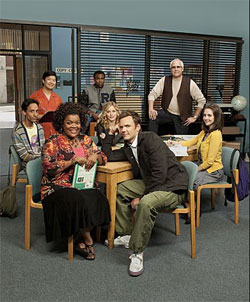 There is one other sitcom, which also survived its first season — along with Glee and Modern Family — to re-emerge for season two. And it’s a show anyone in higher ed should watch, at least occasionally.
 Andrew Careaga