
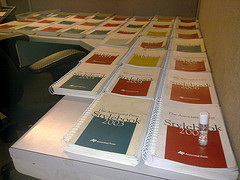
 What has gotten into those crusty curmudgeons who edit the Associated Press Stylebook?
For those of you whose own in-house editorial style leans heavily on the AP Stylebook — the self-proclaimed “journalist’s bible” — you may have heard about a couple of big changes to the rules. AP announced them earlier this spring.
They are:
More than vs. over
In March, the editors ruled that the use of over to define quantity is acceptable as a synonym for more than. This change, as Poynter noted, “rock[ed] copy editors to their very cores.”
Prior to the change, over was acceptable only when describing physical proximity. Our plane flew over Kansas on the way to Colorado. Now, over may be used to describe quantity. We have over hundreds in stock.
Nitpicky? Sure. But for those of us reared (not “raised”) on the rules of AP style, this is a significant change. We’ve been replacing “over” with “more than” for years, and some of us took a certain sort of perverse joy by explaining to the edited why “over” was unacceptable. As a colleague told me the other day: “How am I supposed to feel superior to others now?” It’s a dilemma for sure.
As for me, I’m not bothered by this change. “Over” is more economical than “more than,” so it saves space. Five spaces, to be precise. And it saves me the hassle of trying to explain why I took such pains to change a simple word in copy. So, I’m OK with over, even though some aren’t. As for the debate, I’m more than over it.
Spelling out state names
While some of us were still reeling over the AP’s acceptance of over as a synonym for more than, the stylebook editors throw another curve ball just a month later.
In April, AP announced that starting May 1, state names should be spelled out in body copy. Even when following a city. So instead of writing “Rolla, Mo.” (using the antiquated, pre-postal code abbreviation for the state) we’re supposed to write “Rolla, Missouri.”
What the…?
Another arcane AP style rule bites the dust.
As Poynter reported, AP made the change “to be consistent in our style for domestic and international stories. International stories have long spelled out state names in the body of stories.”
I can buy that. We live in and communicate with global audiences. Consistency is good.
But the AP’s historic tendency to favor economy (i.e., shorter is better) falls by the wayside here.
I can live with this style change, too. But I have compassion for those of you in Mississippi and Massachusetts.
* * *
It boils down to this: Language and our use of it evolves. It’s good to see the AP — often considered a dinosaur of journalism and writing — evolving along with it.
Photo: “The old school rules, spiral bound” – by AllaboutGeorge on Flickr

 Andy writes!