
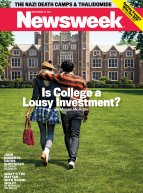
 I wasn’t sure just how much hand-wringing would be required of me when I saw the cover of the latest is of Newsweek magazine. The title of the cover story — Is College A Lousy Investment? — would suggest that a higher ed marketing person like me should worry.
Then again, I thought, this is Newsweek, and editor-in-chief Tina Brown loves to play the role of provocateur, especially with dramatic cover imagery and headlines that lean toward the sensational. Recall just a few weeks ago that the magazine shocked conservatives and liberals alike with its Hit the Road, Barack cover story. And a few weeks before then, for its cover story about the world’s great restaurants, used a photo of “phallic asparagus dangling suggestively above a woman’s open mouth, lips parted just so.” Rather strange, too, that the “asparagus issue” also carried Newsweek‘s college rankings, including a listing of those deemed most affordable in terms of cost, debt load and ROI. And now the story’s all about a “lousy investment.”) And of course, who can forget Annie Leibovitz’s infamous nude and pregnant Demi Moore cover shot for Vanity Fair back when Tina Brown ran that magazine?
Plus, we’ve all heard this song before, haven’t we? The chorus of woe about college becoming less and less valuable to Americans. Even the Newsweek piece itself notes: “A lot of ink has been spilled over the terrifying plight of students with $100,000 in loans and a job that will not cover their $900-a-month payment.” Some of that ink came in the form of an article carried by (Newsweek‘s chief competitor, TIME, published more than 3 years ago: Is College A Bad Investment? Only the adjectives have changed.
So I figured that the cover title was yet another ploy by a magazine desperate to remain relevant. And I didn’t worry much about paying attention to this latest in a series of cries about the higher ed bubble.
But I should pay attention. And so should you. Because the bubble is real, folks. Technology is leveling the playing field. In another recent news report — this one about massive open online courses (or MOOCs, as they are clumsily labeled) — Mary Beth Marklein, the higher ed beat writer for USA Today, refers to a recent report from Moody’s Investor Service “calls MOOCs a ‘pivotal development’ that has the potential to revolutionize higher education.”
Yes, we’ve heard this song before, right? Dylan Wilbanks makes that point quite well in his “death wish” blog post from June.
But read on, please. This, from Marklein’s article:
MOOCs also have the potential to radically alter a centuries-old business model, one that for most institutions has depended on increasingly higher tuition. …
Moody’s sees several likely revenue opportunities, including advertising and licensing. Eventually, it expects that students will have to pay some costs. …
As for colleges and universities, the big financial winners will be brand-name universities who seize the opportunity, the Moody’s report says. It also says their elite reputations will allow their residential campuses to flourish. In contrast, less selective schools will likely see a decline in student demand, and colleges with small endowments will be particularly at risk, unless they find a way to participate. The embrace of online education by elite institutions also will help “reduce the stigma” of distance education, and put new competitive pressure on for-profit colleges, which have dominated the distance-education sector, Moody’s says.
Yet another recent piece on this topic, The Siege of Academe, in Washington Monthly, puts our situation in some historical context, but confirms the Moody’s report that we are at a pivotal moment:
This hype has happened before, of course. Back in the 1990s, when [Netscape creator Marc] Andreessen made his first millions, many people confidently predicted that the Internet would render brick-and-mortar universities obsolete. It hasn’t happened yet, in part because colleges are a lot more complicated than retail bookstores. Higher education is a publicly subsidized, heavily regulated, culturally entrenched sector that has stubbornly resisted digital rationalization. But the defenders of the ivy-covered walls have never been more nervous about the Internet threat. In June, a panicked board of directors at the University of Virginia fired (and, after widespread outcry, rehired) their president, in part because they worried she was too slow to move Thomas Jefferson’s university into the digital world.
The ongoing carnage in the newspaper industry provides an object lesson of what can happen when a long-established, information-focused industry’s business model is challenged by low-price competitors online. The disruptive power of information technology may be our best hope for curing the chronic college cost disease that is driving a growing number of students into ruinous debt or out of higher education altogether. It may also be an existential threat to institutions that have long played a crucial role in American life.
So as I read these pieces — reported in mainly traditionally print-and-paper-based media that are struggling to adjust to a new world — I wonder how well we in higher ed are doing in our adjustment. Worse, I suspect, than the news business or even the recording industry. Back to Dylan Wilbanks’ question: “Do we [in the higher ed business] hate higher ed? Do we want it to die a horrid death? I’m starting to wonder if we do.”
And the band plays on, as we wring our hands.
 Andrew Careaga