
On achieving liftoff

Adapted from a post I originally wrote in January 2010.

Up is not an easy direction. It defies gravity, both cultural and magnetic.

— Capt. D. Michael AbrashoffIt’s Your Ship

It takes a lot of power to escape the gravitational pull of all the stuff that tries to hold us back.

It takes a lot to break free of the urgent issues that suck all the time and energy from our days and lives.

For marketing types, it takes a lot of effort to push beyond those traditional tactical roles our organizations want us to play in order to move into a position of strategic importance.

It takes velocity to escape the bonds of the urgent and soar to the lofty heights of the important.

It’s hard to help clients rethink their conventional approaches to marketing — to think beyond brochures and websites and press releases, to think in terms of audience and message and outcomes.

It’s tough to say no to people who are used to getting their way.

It’s tough to be both a service provider and a strategic partner within an institution.

It’s hard to set priorities.

These are just a few of the things I think about when I think about the role of a university communications and marketing operation.

These are lessons I thought I’d learned before. But in the busyness of day-to-day work, I sometimes forget them.

So I’m re-learning them. Some days, I re-learn them several times.

If we’re going to move ourselves, our operations and our organizations beyond the tactical to the strategic, then we must learn how to escape the bonds of organizational gravity. We must figure out how to pull away from the inertia that tries to hold us back. We must do the hard stuff, positioning ourselves and our operations into strategic roles, in order to reach that escape velocity needed to soar.

Photo via NASA’s Image of the Day Gallery.
Twitter Cards: 50-plus ways to not leave your Twitter

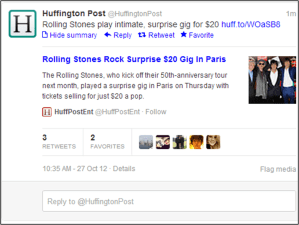
Example of an expanded Tweet (aka “Twitter card”) from @HuffingtonPost

Hop on the Twitter bus, Gus. To get the news, information and deals you want, you may never even have to hop off.

The folks at Twitter recently announced they had expanded their “expanded tweets” function. That function, implemented earlier this year, lets Twitter users preview photos, video and other content within a single Tweet — simply by clicking on the tweet, rather than a hyperlink to another destination. The expanded partnerships now gives users “more than 2,000 ways to bring more interactive and engaging Tweets to your stream,” Twitter said in the recent announcement.

This means that now, in addition to seeing previews of Instagram photos and YouTube videos, or lead paragraphs of news stories, you’ll also get to see product descriptions, ratings, prices and reviews from Amazon.com products, video clips from the presidential debates from CNN tweets, movie previews from Fandango or audio clips from Soundcloud.

With these expanded tweets (also called Twitter Cards), why would anyone ever need to leave Twitter to sample content?

That’s precisely the point, writes Jennifer Van Grove of VentureBeat. If Twitter can become the medium for aggregating content, it becomes the source for all types of information from trusted sources that you, the Twitter user, select.

“[W]e’re all one step closer to that Twitter-centric vision,” Van Grove writes. But it’s a vision that “consumers, publishers, and developers will either love or hate.”

How will this affect higher ed? Colleges and universities could conceivably take advantage of the expanded tweets function to deliver content more directly to their audiences who are on Twitter. But will it change our approach to Twitter? Rather than trying to use Twitter to extend our reach or draw audiences back to our sites, will it mean we think of Twitter as the destination for users interested in our content?

And more important: Will the consumers of our content love it or hate it?

(Thanks to Jeremiah Owyang for drawing my attention to Twitter’s recent announcement — via a tweet, naturally.)