

It seems like a no-brainer to me that businesses and other organizations would like to keep their customers happy. If someone buys your product or service and likes it, that person is more likely to return and buy more of your stuff, right? (For colleges and universities, the assumption is that a graduate satisfied with his or her experience with your institution is more likely to donate or provide some other form of support, whether it involves voluntarism, attending sporting events or just speaking well of your institution to others.)
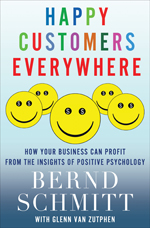
So as I cracked open Bernt Schmitt‘s new book, Happy Customers Everywhere: How Your Business Can Profit from the Insights of Positive Psychology, I wondered why anyone would need to read this book. Don’t we already know all there is to know about customer service and satisfaction?
As I soon learned, Schmitt’s premise extends far beyond the notion of customer service and satisfaction. Building on findings from the field of positive psychology, which asserts that helping people find meaning and fulfillment in their lives is just as important (if not more so) than diagnosing mental illness, Schmitt applies what he calls the PME Happiness Model (the letter stand for pleasure, meaning and engagement) to the world of business. He presents his insights using case studies from a number of businesses that work at delighting their customers in order to build stronger loyalty and what he calls “promotion,” but what for higher ed purposes might better be termed “advocacy.”
This book is a quick, enjoyable read. Schmitt has a lively and conversational writing style, and although this is a business book, it isn’t full of many of the buzzwords we’ve come to expect from such efforts. As with most pragmatic business books, he also includes plenty of case studies illustrating how companies are building these positive psychology principles into their business processes and marketing efforts. Schmitt also includes a section addressing the importance of a happy workforce, which in turn leads to happier customers.
Happy Customers Everywhere contains some sound marketing ideas that should translate well to our higher ed marketing roles as we work to build a greater commitment to loyalty and advocacy for our institutions among our customers, from prospective and current students to alumni and legislators. Many of the concepts discussed in Happy Customers Everywhere are rooted in the ideas behind experience-based marketing. Which comes as no surprise, since Schmitt, a professor of international business at the Columbia Business School, also wrote a book called Experiential Marketing.
So, if you’re interested in putting a positive-psychology spin on your higher ed marketing efforts, you might want to take a look at Happy Customers Everywhere.
From my perspective, the most important takeaway from this book — one that is more implied by Schmitt that explicitly stated — is embodied in the “everywhere” part of the title. In this global economy, where more and more people have more money to spend in their pursuit of happiness, more and more customers are expecting to be satisfied. The idea that consumers from developing nations should just “take what they get” from (U.S.-based) multinational corporations and be thankful will soon be out of fashion, if it isn’t already. Gone, too, is that image in my mind of the bread lines of Soviet-era Moscow, where the women in babushkas would stand for hours in hopes of getting a stale loaf, and not having much say about whether they do or not.
As I learned from this book by Schmitt (a pretty sharp guy; he’s ), the concept of happiness is a relatively new idea that’s only been around from a few hundred years or so. And the notion that we can pursue happiness is mostly a Western idea (and Jeffersonian). So it was a foreign concept to those Soviet-era Russians. But as with many of our cultural values, the pursuit of happiness has been exported to the global marketplace. Now everyone, everywhere, can pursue happiness. This is a good thing.
So, how does this affect those of us who work in higher ed in the U.S. as we consider the globalization of higher education? For years, as our nation’s global market share in various sectors began to shrink, scores of educators, pundits and public figures have continued to proclaim that our system of higher education is still the greatest in the world. There’s probably some truth to that assertion. In his 2008 book The Post-American World, Fareed Zakaria described how the U.S. higher education system is “much better [than other nations’ systems] at developing the critical faculties of the mind, which is what you need to succeed in life. Other educational systems teach you to take tests; the American system teaches you to think.”
Still, that was four years ago. Today, even as many international students continue to view the U.S. educational experience as the best in the world, they have more options than ever before. Because if we aren’t serious about delighting this burgeoning market of students, they’ll take their business elsewhere.
That, too, seems like a no-brainer.
Cover image courtesy of www.stockfreeimages.com


 Andrew Careaga