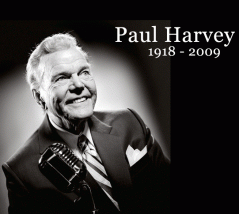
 Hello, Americans!
There was only one man who could deliver that simple phrase is such a distinctive way, and that man was Paul Harvey.
Millions of Americans could tell you a story or two about how Paul Harvey, the legendary radio newscaster, touched their lives. His daily newscasts and “Rest of the Story” vignettes defined radio news for many of us.
When I first learned (via Twitter) that Paul Harvey died Saturday (Feb. 23, 2009) at age 90, my thoughts traveled back in time some 35 years, to the early 1970s, when I would listen to his newscasts over breakfast in my grandmother’s kitchen. Paul Harvey came on either just before or just Earl Nightingale. I can’t remember which aired first. But over breakfast, I would listen to them both: Nightingale, the forerunner for today’s motivational speakers, and Harvey, the plainspoken Midwesterner whose folksy, staccato delivery of news item after news item — page 3 after page 2 after page 1 — brought the day’s happenings into focus. It was a deadpan delivery, void of any hype, drama or sensationalism. The only emotion Harvey’s voiced evoked was a kind of self-effacing humor, an occasional wry chuckle to accentuate a particularly ironic or weird man-bites-dog twist to a news story.
There were news giants in those days. Paul Harvey was one of them. I would put him right up there with Cronkite, Murrow, Huntley, Brinkley, Kuralt. His was a voice of authority. But it was also a voice of reassurance and approachability. He was a regular guy, and could be trusted. His plainspoken delivery also evoked an earlier time — even back in the ’70s. I can imagine him addressing the nation during the pre-television era, when families would gather around their behemoth living room radios for Fibber McGee and Molly, George and Gracie Burns, The Lone Ranger, and FDR’s Fireside Chats. He had a voice you could warm up to. And I did.
His signature feature, “The Rest of the Story,” was terrific radio, excellent human interest. Harvey’s surprise endings were part O. Henry, part Horatio Alger and yes, almost always 100 percent corn. But it could hook you and reel you in, as all good stories do. “The Rest of the Story” was also a marketer’s dream, at least for those pre-Internet days. Harvey kept us hanging as we endured the word from our sponsor; we didn’t dare switching the channel for fear of missing the rest of the story. And it was rarely a letdown.
Today, Harvey’s style is anachronistic. But what a great storyteller he was. He has influenced many lesser storytellers, like me, in many ways.
To Mr. Paul Harvey, I say one final time, “Good day!”

 Andrew Careaga