
Earlier this week, Interbrand unveiled its ranking of best global brands for 2013. And for the first time since Interbrand began keeping score (way back in 2000), Coca-Cola has been dethroned. The new king of the global brands is Apple. Google takes the No. 2 spot, and Coke tumbles to third place.
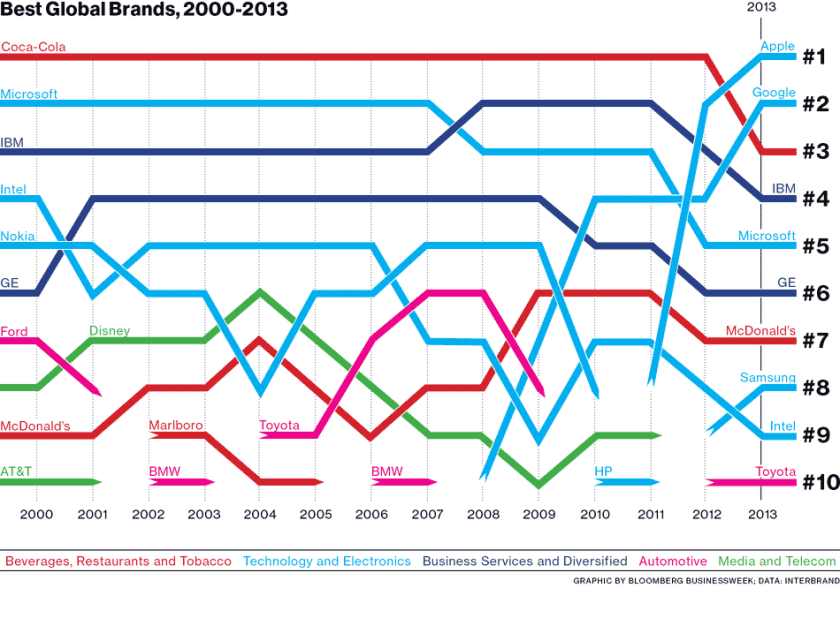
Interbrand’s methodology for determining brand value is about as arcane as U.S. News & World Report‘s approach to the annual college rankings. (For example, Interbrand relies on something it calls the “Brand Strength framework,” which is some sort of “diagnostic tool that delivers actionable insights.” Um, okay. That certainly clarifies things.)
But people in the branding world pay attention to Interbrand’s scorecard, just as higher education administrators do the U.S. News rankings. And both sectors love to brag about their organization’s rating when the scores look good and to loathe the rankings when the scores look bad, it gets people talking.
So let’s talk about brand rankings.
How did Apple dethrone Coca-Cola? And what could higher ed brand managers learn from it?
Getting emotional. Apple’s stock price has tumbled from $700 a share in September 2012 to the neighborhood of $478 per share recently, according to this analysis of the Interbrand rankings. So, considering stock value alone, one might conclude that Apple has even less value today than a year ago. But that would leave out one important component of the brand’s value. “Less tangible strengths like emotional intelligence and psychological insight are proving to be just as vital to leading a brand today as the ability to generate high ROIs and increased shareholder value,” says Interbrand CEO Jez Frampton in a statement. It is “a sign of the times,” Frampton says, that Apple, “a company that has changed our lives, not just with its products but also with its ethos,” has risen to the top of the brand hierarchy. For higher education, the takeaway is about the emotional value our institutions provide students, alumni and others.
Global and the new normal. Frampton also points out that “in a world that is increasingly globalized and interconnected, ‘developing’ countries like China are now poised to become bigger players, and collaboration — across borders, across silos, or co-creating with consumers — is more crucial than ever.” How will colleges and universities in the U.S. — or anywhere else, for that matter — position themselves to compete in this global environment?
Can you be both cheap and good? Apple becomes No. 1 on the heels of its recent announcement of a new, less expensive line of iPhones, a move that some see as risky. It actually bends one of the so-called “immutable” laws of branding (see this post), which says, in essence, that your brand should stand for something simple and narrow (more about this here). Apple has been known for high-end, well designed products. Are they now lessening their worth by offering a $99 iPhone? It’s a risk that may pay off. Consider what Stanford and others are doing with MOOCs, or Georgia Tech’s gambit of offering the $7,000 computer science degree. Will expanding access and dropping prices help build these brands or will it ultimately hurt? Time will tell. But time is not on the side of being both cheap and good.
Then again, Apple is known to “think different.” I wouldn’t bet against them, and look for them to stay on top of the charts for a while.
Disclaimer: I am not an Apple fanboy.
 Andrew Careaga