
Social media and #highered: Where’s the ROI?

A recent “social media ROI” report from the University of Massachusetts Dartmouth talks about how college and university admissions offices view and use social media. The report summary trumpets the findings as an indication that social media is significantly altering the way colleges and universities recruit students. The report (or at least the headline) even goes so far as to trumpet social media tools as “a Game Changer.” The headline and report also tout the return on investment (ROI) social media tools bring to higher education.

The report is filled with some good information, but I couldn’t really pinpoint any actual ROI indicators.

I’m no ROI expert, but it seems to me that the authors of this report have confused cost reductions with ROI. For instance, the report points out that institutions surveyed “report 33% less spent on printing, 24% less spent on newspaper ads and 17% less spent on radio and TV ads.”

But reducing costs, or reducing your media spend, isn’t the same thing as investing. Cutting costs does not equal increased investment.

One uncritical report about this research (posted on businessgrow.com) attracted the interest of several higher ed folks, including three very bright guys: Andrew Gossen of Cornell (@agossen), higher ed consultant Michael Stoner (@mStonerblog) and Mike Petroff, a digital strategist at Harvard (@mikepetroff). Gossen and Stoner took to Twitter to chat about the findings with a more skeptical view. But of course, there’s only so much you can discuss 140 characters at a time.

So Stoner visited businessgrow.com to share his thoughts on the subject, then expanded them in this blog post on his own site. (Tracy Playle of Pickle Jar Communications — @picklejar — also does a fine job of dissecting the Massachusetts Dartmouth study.) Both Stoner’s comment and his blog post are worth reading, as he eloquently discusses the nuances of higher education that the Massachusetts Dartmouth study seems to overlook.

The money quote, however, comes from Stoner’s comment on businessgrow.com blog:

[T]he story is more complicated than The University of Massachusetts Dartmouth Center for Marketing Research data indicate.

For example, Noel-Levitz, an enrollment and admissions consulting firm, does a yearly study of prospective students to see what they say about various channels (in 2012, 2000 students, 51% high school seniors). This year, 72% said they used “brochures/mail” to research colleges. When asked the best ways to learn about academic programs (the most important content to them), 71% said brochures were best; 38% cited social media as the best source. Only 10% said that social media was the best source of info for financial aid and 35% for information about the campus location and community. So while they do use Facebook (and other social channels), these aren’t the only, or even the primary, sources of information.

Indeed, this confirms my observation that adults continuously over-estimate the appetite of teens for whatever it is adults we think they should be interested in. We’ve seen from our own experience that teens love printed pieces — they just aren’t impressed with the kind of glossy viewbooks that most admission offices send out.

Interestingly, just a week after that Massachusetts Dartmouth report came out, businessgrow.com’s report about another study — the Social Habit Research Project — provided the perfect definition of ROI for businesses. It’ comes from social media marketer Rhonda Hurwitz, and it’s a definition that can be modified to fit the realm of higher education:

For me, it always comes down to figuring out how to connect social media usage or activity to revenue. I would ask “have you ever bought a product or service due to a social media interaction” … “have you ever recommended a product or service to others via social media?”

So, for higher education, perhaps the ROI questions should be:

  • Has a prospective student ever decided to attend a college due to a social media interaction?
  • Has a prospective donor ever given to his or her alma mater due to a social media interaction?
  • Has a current student ever recommended a college or university to a prospect via social media?

And perhaps we should be asking them of our customers (students, alumni, etc.) rather than those in charge of delivering the services, recruiting students or raising money. Maybe then we would gain a better sense of the true ROI of our social media activities.

* Disclaimer: I am no ROI guru. Far from it. But I agree with Stoner when he says, in his recent blog post on this topic, that “Measuring ROI is complicated, especially in higher ed.” It’s messy, and it’s a hassle. And that’s probably why we don’t do much of it.

Image: Clara Peller as the “Where’s the Beef?” lady from Wendy’s classic early 1980s ad campaign.

Book review: Happy Customers Everywhere

It seems like a no-brainer to me that businesses and other organizations would like to keep their customers happy. If someone buys your product or service and likes it, that person is more likely to return and buy more of your stuff, right? (For colleges and universities, the assumption is that a graduate satisfied with his or her experience with your institution is more likely to donate or provide some other form of support, whether it involves voluntarism, attending sporting events or just speaking well of your institution to others.)

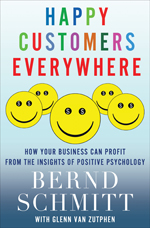
Happy Customers Everywhere, by Berndt Schmitt

So as I cracked open Bernt Schmitt‘s new book, Happy Customers Everywhere: How Your Business Can Profit from the Insights of Positive Psychology, I wondered why anyone would need to read this book. Don’t we already know all there is to know about customer service and satisfaction?

As I soon learned, Schmitt’s premise extends far beyond the notion of customer service and satisfaction. Building on findings from the  field of positive psychology, which asserts that helping people find meaning and fulfillment in their lives is just as important (if not more so) than diagnosing mental illness, Schmitt applies what he calls the PME Happiness Model (the letter stand for pleasure, meaning and engagement) to the world of business. He presents his insights using case studies from a number of businesses that work at delighting their customers in order to build stronger loyalty and what he calls “promotion,” but what for higher ed purposes might better be termed “advocacy.”

This book is a quick, enjoyable read. Schmitt has a lively and conversational writing style, and although this is a business book, it isn’t full of many of the buzzwords we’ve come to expect from such efforts. As with most pragmatic business books, he also includes plenty of case studies illustrating how companies are building these positive psychology principles into their business processes and marketing efforts. Schmitt also includes a section addressing the importance of a happy workforce, which in turn leads to happier customers.

Happy Customers Everywhere contains some sound marketing ideas that should translate well to our higher ed marketing roles as  we work to build a greater commitment to loyalty and advocacy for our institutions among our customers, from prospective and current students to alumni and legislators. Many of the concepts discussed in Happy Customers Everywhere are rooted in the ideas behind experience-based marketing. Which comes as no surprise, since Schmitt, a professor of international business at the Columbia Business School, also wrote a book called Experiential Marketing.

So, if you’re interested in putting a positive-psychology spin on your higher ed marketing efforts, you might want to take a look at Happy Customers Everywhere.

From my perspective, the most important takeaway from this book — one that is more implied by Schmitt that explicitly stated — is embodied in the “everywhere” part of the title. In this global economy, where more and more people have more money to spend in their pursuit of happiness, more and more customers are expecting to be satisfied. The idea that consumers from developing nations should just “take what they get” from (U.S.-based) multinational corporations and be thankful will soon be out of fashion, if it isn’t already. Gone, too, is that image in my mind of the bread lines of Soviet-era Moscow, where the women in babushkas would stand for hours in hopes of getting a stale loaf, and not having much say about whether they do or not.

As I learned from this book by Schmitt (a pretty sharp guy; he’s ), the concept of happiness is a relatively new idea that’s only been around from a few hundred years or so. And the notion that we can pursue happiness is mostly a Western idea (and Jeffersonian). So it was a foreign concept to those Soviet-era Russians. But as with many of our cultural values, the pursuit of happiness has been exported to the global marketplace. Now everyone, everywhere, can pursue happiness. This is a good thing.

So, how does this affect those of us who work in higher ed in the U.S. as we consider the globalization of higher education? For years, as our nation’s global market share in various sectors began to shrink, scores of educators, pundits and public figures have continued to proclaim that our system of higher education is still the greatest in the world. There’s probably some truth to that assertion. In his 2008 book The Post-American World, Fareed Zakaria described how the U.S. higher education system is “much better [than other nations’ systems] at developing the critical faculties of the mind, which is what you need to succeed in life. Other educational systems teach you to take tests; the American system teaches you to think.”

Still, that was four years ago. Today, even as many international students continue to view the U.S. educational experience as the best in the world, they have more options than ever before. Because if we aren’t serious about delighting this burgeoning market of students, they’ll take their business elsewhere.

That, too, seems like a no-brainer.

Cover image courtesy of www.stockfreeimages.com