
Repost: Marketing (and life) lessons from Martin Luther King Jr.

This post originally appeared on this blog on Martin Luther King Jr. Day 2009, under the title Media relations, taking the long view and other lessons from Martin Luther King Jr.. MLK Jr. Day 2009 also coincided with the eve of President Obama’s inauguration, so references to that event have been deleted in an attempt to keep this post relevant. I hope it gives you pause to reflect on how you live your life and approach your most meaningful work. – AC
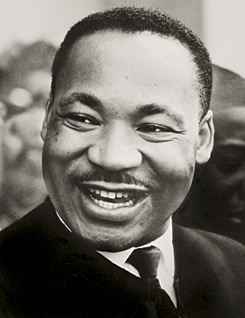
As our nation honors the Rev. Martin Luther King Jr. today with a national holiday, I pause to consider a bit how King’s worldview and moral stance against evil has influenced my own life.

I’m in no way attempting to compare my life with King’s, for I’m no civil rights leader, no martyr, no leader of any consequence by comparison. But I’ve long admired King not only for his leadership in civil rights, but more for his clarity of vision in the sense of moral and spiritual matters, as well as his PR savvy. The fact that he understood and used mass media to his advantage should not be separated from King’s quest for justice and equality, but it does point to the man’s ability to use the tools and systems of the temporal world to further more idealistic goals, and that’s something any of us who work with the media ought to understand.

One of the most poignant (brief) commentaries on King’s life that I’ve read comes from Philip Yancey’s book Soul Survivor: How My Faith Survived the Church. Yancey was a good ol’ Georgia boy when the civil rights movement started gaining traction in the early 1960s.

“When I was in high school,” he writes, “the same students who cheered the news of President Kenedy’s assassination also cheered King’s televised encounters with Southern sheriffs, police dogs, and water cannons. Little did we know that by doing so we were playing directly into King’s strategy.”

That strategy, from a media relations standpoint, was brilliant, for it opened the nation’s eyes to the tragedy and brutality of racism. “He deliberately sought out individuals like Sheriff Bull Connor and stage-managed scenes of confrontation, accepting jail, beatings, and other brutalities, because he believed a complacent nation would rally around his cause only when they saw the evil of racism manifest in its ugliest extreme.

“In that goal,” Yancey writes, “King succeeded spectacularly.”

But separated from what Yancey calls King’s “long view of faith,” that media relations success would have rung hollow.

“Already convinced of the justness of their cause,” Yancey writes, the civil rights workers “wanted someone to lift their sights beyond the long string of disheartening failures.” King, with his long view that justice will triumph, was the man to do just that.

We now look back on the civil rights movement as a steady tidal surge toward victory. At the time, facing daily confrontations with the power structure and under constant intimidation from policemen, judges, and even the FBI, civil rights workers had no assurance of victory. We forget how many nights they spent in rank southern jails. Most of the time the present looked impossibly bleak, the future even bleaker. …

For King, the long view meant remembering that, no matter how things appear at any given moment, God reigns. Later, when the famous march from Selma finally made it to the state capitol, the building which once served as the capitol of the Confederacy and from which the rebel flag still flew, King addressed those scarred and weary marchers from the steps:

I know that you are asking today, “How long will it take?” I come to say to you this afternoon, however difficult the moment, however frustrating the hour, it will not be long, because truth pressed to earth will rise again. …

* * *

It seems the long view has been in short supply in our culture for many years. Witness what has happened on Wall Street, in our banking industry, and just about everywhere else you look in our culture, and you see the fruits of short-term, get-what-you-can-while-you-can thinking. Even in our educational system, sadly, the short view too often reigns. We live from fiscal year to fiscal year, from project to project. Even our long-range plans extend no further than five years out, and the goals are largely based on numbers, rather than the essentials King spoke of — the essentials of peace, justice and love.

What about us? Do we connect our day-to-day actions, our work? Our lives, to a greater, nobler cause? Those of us in higher education ought to. It’s pretty easy, really. We’re in one of the most noble pursuits there is. I’m fond of quoting William Butler Yeats, who supposedly said that “education is not the filling of a bucket, but the lighting of a fire.” On my better days, I like to think that what I do helps to fan those flames of knowledge.

I can’t say I’ve always done the best job of taking the long view, or for contributing to King’s ideal of a world in which peace, justice and love reign. But re-reading Yancey’s chapter on MLK has reinvigorated me and encouraged me to think more about the long view — in my job, in my life, in my other pursuits. I hope this post encourages you to do the same.

Best posts of 2011: What Starbucks can teach #highered

Note: During the final week of 2011, I’m revisiting some of my favorite posts of the year. Here is the third installment in this series. – AC

Friday Five: What Starbucks can teach higher ed

Originally published May 20, 2011

Onward-bookI’ve been reading Starbucks CEO Howard Schultz’s Onward: How Starbucks Fought for Its Life without Losing Its Soul (affiliate link). This book, published a couple of months ago, is Schultz’s account of how he returned to lead the company out of economic doldrums and to renewed prosperity.

In some ways, the book is the typical heroic narrative of the business titan returning to save the company, a la Steve Jobs or Michael Dell. But in reading Schultz’s account about the struggles of one of the world’s strongest brands (No. 72 globally, according to the latest BrandZ report [PDF]), I couldn’t help but take away some lessons that could apply to higher ed branding and marketing.

So what can a highly successful chain of coffee stores teach us higher ed folks about branding and marketing? For starters, we can look at how both entities – Starbucks and (generally speaking) higher ed – got into trouble for some of the same reasons. When Schultz returned as CEO of Starbucks in 2008 after stepping down eight years earlier, the company had stagnated. Obsessed with growth, Starbucks had, in Schultz’s view, abandoned its principles in a quest for greater profits.

“Companies pay a price when their leaders ignore things that may be fracturing their foundation,” Schultz writes (p. 32). “Starbucks was no different.” Likewise, higher ed in the USA has expanded greatly since the 1960s, and perhaps many colleges and universities have also abandoned their core values in their quest for growth, or prestige, etc.

Here are five lessons we in the higher ed business can take away from Starbucks’ turnaround, as described by Schultz in Onward:

1. Don’t dilute your brand. Starbucks became great because it offered something different — both the environment of its stores and its bold coffee — than most Americans could find. A Starbucks store is no truck stop coffee joint, and its product ain’t Nescafe. The company stood for bold brew and a third place environment where people could hang out. But Starbucks got into trouble when they started to overreach and extend the company brand into endeavors that didn’t align with their core. “Confidence,” Schultz writes (p. 40), “became arrogance and, at some point, confusion as some of our people stepped back and began to scratch their heads, wondering what Starbucks stood for. Music? Movies? Comps?” Losing focus leads to confusion and a weaker brand.

2. Growth isn’t always good. Starbucks became too obsessed with constant, continuous growth. In parallel with Starbucks’ forays into entertainment and other fields came the desire for bigger profits from these endeavors. “The business deals looked great on our profit and loss statements,” Schultz writes (p. 21). But that wouldn’t last. While Starbucks was focusing on this expansion, by 2008 the fissures in their foundation turned into major ruptures. That year, when the company announced plans to close hundreds of stores, a Motley Fool newspaper column said Starbucks was being pushed out of the market by a “tag-team of doughnut shops, fast-food joints, and quick-service diners.” When the recession hit shortly thereafter, many consumers decided to forgo a $4 latte, further damaging Starbucks’ balance sheet.

The idea that growth is always sustainable met reality for many college and university endowments during the recession as well. Growth is not always sustainable.

3. It’s the experience that matters. Starbucks is more than a product. It’s an experience. Schultz talks a lot about the Starbucks Experience and references the idea of Starbucks stores as being the “third place” of a community: “A social yet personal environment between one’s house and job, where people can connect with others and reconnect with themselves” (p. 13). Similarly, higher education is an experience. The act of obtaining a college degree or learning a subject is more than an exchange — more than a transfer of knowledge from one entity to another. How well do we in higher ed emphasize the experience — in terms of sense of place (even with online or distance learning) — for those who come to us for betterment?

4. Embrace social media. One of the transformations Schultz realized Starbucks had to make, in addition to the financial and economic one, was a digital transformation. “The times were changing, with or without Starbucks,” he writes (p. 32). “I knew we could no longer tell our story only in our stores. … In addition to tackling mounting problems inside our company, we also had to innovate in the digital domain, to discover new ways to reach out and be relevant to consumers.” Starbucks has succeeded, growing strong followings on Facebook and Twitter as well as initiating sites like MyStarbucksIdea.com to engage with consumers. “For us,” Schultz writes on p. 265, “social networks were proving to be an area where Starbucks could lead instead of using the defensive tactics the company had fallen into employing elsewhere. As long as we did not bombard our followers with coupons, as long as we conversed about issues that were important to both Starbucks and our customers — from coffee to recycling — and as long as we listened as well as talked, people would stick with us and perhaps even become more attached.”

Starbucks may not be doing everything right in social media, but we in higher education should look to what’s working for that company — and other organizations — for inspiration.

5. Innovate, but stay true to your heritage. Colleges and universities are big on talking about heritage and tradition. So is Starbucks. But as Onward points out, the company has learned how to innovate with new products to meet changing consumer tastes. One case in point Schultz recounts is the company’s creation of Pike Place Roast. The product, unveiled in 2008, had “a flavor profile that did not abandon Starbucks’ roasting philosophy but, whether it was served black or with cream and sugar, delighted more people’s palates” (p. 86). Its name also connected with customers, as Pike Place is the location in Seattle where Starbucks began. The product “ushered back in some of what had been missing in our coffee experience. Aroma. Freshness. A little theater.” It connected with Starbucks’ heritage but also demonstrated innovation.

How do we in higher ed connect with our heritage while continuing to innovate?

* * * * *

I’m not a huge fan of the CEO-as-hero genre, and Onward did not change my perspective in that regard. But Schultz’ account contained a few choice morsels about redefining a brand that were worth sharing.

Have you read this book? If so, I’d be interested in hearing your reaction to it.