
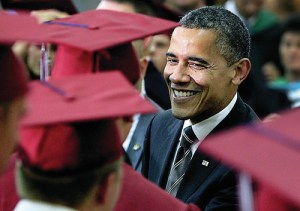
 What’s in store for for higher education in President Obama’s second term?
Christine Messina-Boyer and Dan Kaufman of Widmeyer Communications wasted no time looking into their crystal ball. Their post, The Impact of the Election on Education, arrived in my inbox Wednesday morning. In that post, Messina-Boyer and Kaufman discuss both pre-college and higher education, and tell us not to expect any big pushes from the White House or the Education Department during the second term. After al, the president has a fiscal cliff, a Republican congress and a sputtering economy to worry about, so get in line, higher ed.
Since I don’t have a crystal ball, I decided to just look at the president’s Blueprint for America’s Future (PDF), a 20-page campaign document that was shipped to 3.5 million households in swing states during the campaign’s final days. Higher ed comes in to play in a few areas discussed in this document. So if this blueprint is to be realized, the president will need a strong and thriving post-secondary education system.
(A caveat: This is a campaign document, and we know how quickly campaign dreams can evaporate in the heat of political deal-making. So take these ideas for what they’re worth. But if you believe they’re worth advancing, work to hold the president accountable to these blueprint details. Also, there are no specifics in this document, so it’s more of a preliminary sketch than a true blueprint.)
- Slowing tuition growth. Tied to affordability, this detail within the blueprint’s section titled “Improve Education for Middle-Class Jobs” specifically calls for cutting tuition growth in half over the next decade. It also calls for doubling campus-based student aid and incentives for schools that limit tuition growth. So the take-away here is that Obama wants colleges and universities to work on affordability, and maybe somewhere down the line there will be some carrots for those that adhere to the as-yet-unspecified goals.
- Hope for STEM education. Obama wants 100,000 more math and science teachers so we can “out-compete China and Germany” (among other nations, presumably) “by out-educating them.” The STEM Master Teacher Corps and investments in research and innovation into the best ways to teach math and science will help improve math and science education nationwide.” That STEM Master Teacher Corps, by the way, has a goal of 10,000, not 100,000. So to reach the blueprint’s 100,000 goal will require more math and science teaching degrees.
- Job training programs. The blueprint calls for community colleges to train 2 million new workers for “good jobs that actually exist.”
- Research opportunities to support the blueprint’s goals of expanding jobs in manufacturing and energy. To bolster manufacturing, Obama says he wants to build “a new network of 15 to 20 manufacturing innovation institutes to bring together business and research universities to ensure that the next generation of products are invented and manufactured here.” Meeting his “all of the above” energy goals will also require investment in research universities.
Will any of these goals be realized? Obviously, none of these ideas can be achieved by a single president. It will take hard work and cooperation at the highest levels, among the president, his cabinet and Congress. But also it will require all of higher education pulling together — public and private institutions, research universities and community colleges — as well as the business sector.
Still, if the Widmeyer folks are correct in their assessment that the Obama Administration is unlikely to aggressively push an education agenda, then we not see much in the way of progress.
My personal prediction is that we’ll continue to hear calls to keep higher education affordable (or to make it affordable once again) and to increase the number of college graduates — not only from the Obama administration, but from politicians of all stripes, on both sides.
It promises to be an interesting four years.
 Andrew Careaga