
Repost: Marketing (and life) lessons from Martin Luther King Jr.

This post originally appeared on this blog on Martin Luther King Jr. Day 2009, under the title Media relations, taking the long view and other lessons from Martin Luther King Jr.. MLK Jr. Day 2009 also coincided with the eve of President Obama’s inauguration, so references to that event have been deleted in an attempt to keep this post relevant. I hope it gives you pause to reflect on how you live your life and approach your most meaningful work. – AC
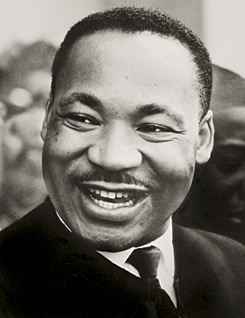
As our nation honors the Rev. Martin Luther King Jr. today with a national holiday, I pause to consider a bit how King’s worldview and moral stance against evil has influenced my own life.

I’m in no way attempting to compare my life with King’s, for I’m no civil rights leader, no martyr, no leader of any consequence by comparison. But I’ve long admired King not only for his leadership in civil rights, but more for his clarity of vision in the sense of moral and spiritual matters, as well as his PR savvy. The fact that he understood and used mass media to his advantage should not be separated from King’s quest for justice and equality, but it does point to the man’s ability to use the tools and systems of the temporal world to further more idealistic goals, and that’s something any of us who work with the media ought to understand.

One of the most poignant (brief) commentaries on King’s life that I’ve read comes from Philip Yancey’s book Soul Survivor: How My Faith Survived the Church. Yancey was a good ol’ Georgia boy when the civil rights movement started gaining traction in the early 1960s.

“When I was in high school,” he writes, “the same students who cheered the news of President Kenedy’s assassination also cheered King’s televised encounters with Southern sheriffs, police dogs, and water cannons. Little did we know that by doing so we were playing directly into King’s strategy.”

That strategy, from a media relations standpoint, was brilliant, for it opened the nation’s eyes to the tragedy and brutality of racism. “He deliberately sought out individuals like Sheriff Bull Connor and stage-managed scenes of confrontation, accepting jail, beatings, and other brutalities, because he believed a complacent nation would rally around his cause only when they saw the evil of racism manifest in its ugliest extreme.

“In that goal,” Yancey writes, “King succeeded spectacularly.”

But separated from what Yancey calls King’s “long view of faith,” that media relations success would have rung hollow.

“Already convinced of the justness of their cause,” Yancey writes, the civil rights workers “wanted someone to lift their sights beyond the long string of disheartening failures.” King, with his long view that justice will triumph, was the man to do just that.

We now look back on the civil rights movement as a steady tidal surge toward victory. At the time, facing daily confrontations with the power structure and under constant intimidation from policemen, judges, and even the FBI, civil rights workers had no assurance of victory. We forget how many nights they spent in rank southern jails. Most of the time the present looked impossibly bleak, the future even bleaker. …

For King, the long view meant remembering that, no matter how things appear at any given moment, God reigns. Later, when the famous march from Selma finally made it to the state capitol, the building which once served as the capitol of the Confederacy and from which the rebel flag still flew, King addressed those scarred and weary marchers from the steps:

I know that you are asking today, “How long will it take?” I come to say to you this afternoon, however difficult the moment, however frustrating the hour, it will not be long, because truth pressed to earth will rise again. …

* * *

It seems the long view has been in short supply in our culture for many years. Witness what has happened on Wall Street, in our banking industry, and just about everywhere else you look in our culture, and you see the fruits of short-term, get-what-you-can-while-you-can thinking. Even in our educational system, sadly, the short view too often reigns. We live from fiscal year to fiscal year, from project to project. Even our long-range plans extend no further than five years out, and the goals are largely based on numbers, rather than the essentials King spoke of — the essentials of peace, justice and love.

What about us? Do we connect our day-to-day actions, our work? Our lives, to a greater, nobler cause? Those of us in higher education ought to. It’s pretty easy, really. We’re in one of the most noble pursuits there is. I’m fond of quoting William Butler Yeats, who supposedly said that “education is not the filling of a bucket, but the lighting of a fire.” On my better days, I like to think that what I do helps to fan those flames of knowledge.

I can’t say I’ve always done the best job of taking the long view, or for contributing to King’s ideal of a world in which peace, justice and love reign. But re-reading Yancey’s chapter on MLK has reinvigorated me and encouraged me to think more about the long view — in my job, in my life, in my other pursuits. I hope this post encourages you to do the same.

On thanksgiving and humility

He who has a thing to sell
And goes and whispers in a well
Is not so apt to get the dollars
As he who climbs a tree and hollers.

(Author unknown)

I first discovered that aphoristic little rhyme long ago, back in my high school days. It was printed on the back of a sugar packet at some restaurant. I don’t remember the name of the restaurant or anything else about that packet of sugar, but that saying has stuck with me, as apparently it has with a lot of other people.

And why wouldn’t it? For someone interested in sales and marketing, the saying is worth tucking away. It succinctly captures the virtue of “shout” marketing: Get your light out from under that bushel, young man. If you want to get ahead in life, you’ve got to shove your way through the teeming masses and draw attention to whatever goods you have to sell.

Being in this marketing/PR line of work, where I try to draw attention to the goods and services my employer offers, and doing my share of sideline marketing/PR stuff, via this blog, speaking and writing engagements, and the like, I think about that quote from time to time. And in the 25 or so years since I started to think more seriously about spiritual matters, I have thought more and more about how the nature of much of my work comes into conflict with nobler, less worldly attributes that get drowned out by the noise of our world.

Humility is one of those attributes. It’s a virtue that doesn’t get much play these days. I’m not sure it ever did. Since biblical times, humility’s opposite — pride, which tops the all-time list of deadly sins — has taken the leading role. The Old Testament Book of Proverbs warns that pride is a precursor to disaster: “Pride goes before destruction, and a haughty spirit before the fall.” Even on the list of seven heavenly virtues, humility ranks dead last. Which is, I guess, fitting.

In marketing, pride is a supreme virtue, and a couple of recent blog posts on how to apply the seven deadly sins to online marketing drive home that point.

“On the web, this sin will help you sell your product,” says Smashing Magazine. For higher education, Michael Fienen of .eduGuru suggests in his post that web managers “[p]romote what makes you special.”

I don’t disagree with the points those two bloggers make about the importance of pride, but they’re not talking about the biblical, “haughty spirit” kind of pride. They’re not talking about undue high-mindedness or hubris. Both Fienen and the Smashing writer are talking about pride in another, less selfish sense — the same sense of pride parents might take in the accomplishments of their children, for instance. There’s nothing wrong with that, in my book. As long as it isn’t taken to extremes and at the expense of others (i.e., “It’s nice that your son finally got to play in today’s ball game, but wasn’t it wonderful how my little Johnny hit that game-winning home run?!”)

Pride, in that seven deadly sin sense — that sense of smugness, haughtiness and selfish, me-first thinking — is in great supply in the world of marketing and PR these days. Just look at your Twitter stream. Look at all of us in the virtual crowd, elbowing our way through, chirping incessantly for you to visit our website, read our latest blog post, buy what we’re selling.

It isn’t just marketing, though. Look at the world of politics and the latest nasty round of national elections. Did you see any humility on either side? Look at sports. Randy Moss, anyone? Entertainment, of course. Kanye West‘s latest album is a masterpiece, but even the title — My Beautiful Dark Twisted Fantasy — tells you that the guy has a bit of an ego thing. Look at the state of journalism today. A recent post on The Daily Beast laments how Twitter is turning journalists into insta-critics who constantly strive to one-up each other with acerbic tweets. Those in turn are retweeted by other tweeters too lazy to create their own 140-character snipes (sloth is also a deadly sin) and hoping to bask in some reflected glory for a moment, thereby fueling their own prideful desires. In higher ed? Sure. Witness the recent dust-up over a Harvard comedy group’s parody of Yale’s Glee-esque admissions video. It happens in the #highered twittersphere, too, where many of us attempt to engage in witty banter, some more successfully than others. It’s fun, but it can give you a sometimes unhealthy sense of self-satisfaction when you score a snappy comeback or a retweetable bon mot. I’m not above that, but as I said earlier, I’m conflicted about this whole pride-humility thing.

The snarkosphere rewards the quick-witted tweet. That’s the best way for a common tweeter to make a name in this rapid-fire world and get a shot at the big time (i.e., mention by @TopTweets). And the online world has flattened and disintermediated one-to-many communications so efficiently that nowadays anyone can plug in, climb their virtual tree, and holler (i.e. blog, tweet, Facebook, YouTube, etc.).

The Internet not only accelerates shout marketing, it amplifies it.

The problem with amplification, though, is that when you have millions of amps plugged in and cranked to 11, all you get is noise.

By now, some of you are smelling the B.S. You know that as soon as I finish this post, I’ll fire up Twitter to proclaim this post’s presence. He who has a thing to sell…

Guilty. I’m not immune to the desire to get my share of the fleeting limelight. The truth is, growing up as a quiet, introverted sort, I found my first calling in journalism, and one of the allures of writing for a newspaper was getting to see my byline. I got a real charge out of seeing my name at the top of a story I wrote. It gave me a smug sense of pride. I’ll show those loud extroverts that I have something to say, too! I still get that cheap thrill with this blog and the notice it gets from time to time. That’s one of the main reasons I continue to do this.

You’ve also probably noticed that handy “retweet” widget at the top of this and every other post on this blog. Ostensibly this makes it easy for readers to share blog content on Twitter, but I and every other blogger who uses this widget swells with pride when a post’s retweet count climbs.

And yet, I attempt to write about the virtues of humility.

See what I mean? Conflicted.

* * *

Since this is Thanksgiving Eve, many of us turn our thoughts toward giving thanks for our “blessings.” Pausing from our busyness of marketing and promotion to ponder the good things in our lives ought to also make us feel a sense of humility.

Unfortunately, we don’t really understand what humility is all about. Its true meaning has been squished by our shout-down culture. And now we’ve developed a sort of puritanical sense of humility, a get-on-your-knees-and-grovel, sackcloth-and-ashes notion of the word. Given the holiday, that’s understandable. But that doesn’t make it right.

Humility is not the same as humiliation. Humiliation is the butt-kicking the Democrats got in November — what President Obama called a “shellacking.” One outcome from that shellacking, ideally, would be a sense of humility — not just among Democrats, but among politicians of all stripes. Indeed, among all of us. I’m not optimistic that will happen. But I digress.

To my way of thinking, humility boils down to a couple of phrases. To the modern ear, they sound old-fashioned, but that’s probably fitting, since humility hasn’t been in fashion for some time:

  1. Anyone can fall from grace; and
  2. There, but for the grace of God, go I.

Both phrases include another out-of-fashion, biblical term, grace, which is best described as “a gift.” It’s something you receive not because it’s your due, not because you’ve earned it, but because it’s a gift.

In the first phrase, grace is a state of existence implying a good life. My take on that is that bad stuff happens to all sorts of people, so don’t assume that just because you’re doing all the right things you’re safe. My favorite Old Testament book, Ecclesiastes, points out this universal truth (somewhat paraphrased): The race is not always to the swift, nor the battle to the strong, nor bread to the wise, nor wealth to the understanding, nor favor to the skillful, but time and chance happen to them all. In other words, you may not win that promotion you think you deserve, your child may get cancer, you could be fired tomorrow, or worse. Life is not fair. So be grateful for the gift of life you have today, because truly, it could be worse.

The second phrase is one my mother used to utter at times whenever she was talking about a person who had fallen on hard times, and we knew a few of those growing up. That utterance is, again, a reminder that sometimes our good fortune in life is not so much due to our own efforts or abilities, but because we are simply more fortunate than some. But it may not always be so. Therefore, count your blessings and be thankful.

While composing this post, I discovered another definition of humility that is most apt. It comes from the Wikipedia description of those seven heavenly virtues I mentioned earlier, and it’s short enough to fit on the back of a packet of sugar:

Humility is not thinking less of yourself, it’s thinking of yourself less.

Thanksgiving is as good a time as any to think of ourselves a little less than usual, don’t you think?

Happy Thanksgiving, all.