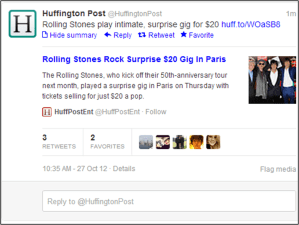
Example of an expanded Tweet (aka “Twitter card”) from @HuffingtonPost
Hop on the Twitter bus, Gus. To get the news, information and deals you want, you may never even have to hop off.
The folks at Twitter recently announced they had expanded their “expanded tweets” function. That function, implemented earlier this year, lets Twitter users preview photos, video and other content within a single Tweet — simply by clicking on the tweet, rather than a hyperlink to another destination. The expanded partnerships now gives users “more than 2,000 ways to bring more interactive and engaging Tweets to your stream,” Twitter said in the recent announcement.
This means that now, in addition to seeing previews of Instagram photos and YouTube videos, or lead paragraphs of news stories, you’ll also get to see product descriptions, ratings, prices and reviews from Amazon.com products, video clips from the presidential debates from CNN tweets, movie previews from Fandango or audio clips from Soundcloud.
With these expanded tweets (also called Twitter Cards), why would anyone ever need to leave Twitter to sample content?
That’s precisely the point, writes Jennifer Van Grove of VentureBeat. If Twitter can become the medium for aggregating content, it becomes the source for all types of information from trusted sources that you, the Twitter user, select.
“[W]e’re all one step closer to that Twitter-centric vision,” Van Grove writes. But it’s a vision that “consumers, publishers, and developers will either love or hate.”
How will this affect higher ed? Colleges and universities could conceivably take advantage of the expanded tweets function to deliver content more directly to their audiences who are on Twitter. But will it change our approach to Twitter? Rather than trying to use Twitter to extend our reach or draw audiences back to our sites, will it mean we think of Twitter as the destination for users interested in our content?
And more important: Will the consumers of our content love it or hate it?
(Thanks to Jeremiah Owyang for drawing my attention to Twitter’s recent announcement — via a tweet, naturally.)
We all know how important it is to incorporate storytelling into our marketing efforts. We also know how, in the social media realm, storytelling and authenticity should complement one another to achieve marketing goals.
Authenticity hasn’t always been that important in traditional marketing. When we see an ad on TV or in a magazine, we’re not all that surprised when a brand incorporates a bit of fiction to sell their products.
But we do appreciate verisimilitude in those stories, right? When the fiction seems to be plausible and connects with us on some visceral level, that’s a winner. That’s why certain types of ad fiction work better than others. The ones that work best resonate with us because the story line is plausible. It’s a vignette that you could imagine actually happening to someone, somewhere. Or you can place yourself in the shoes of the protagonist. The story somehow feels right.
An example of a brand fiction that resonates with me is the Apple “rock god” commercial (video) that plays up the value of the iPhone 4’s voice-recognition assistant Siri. (Thanks to Siri, boy buys guitar, boy learns how to play “London Calling,” boy forms garage band and boy gets called “rock god” by Siri.) My inner teenager can relate to that dorky kid. I watch that clip and in my mind I ponder: Ah, if only the iPhone and Siri had been around when I was a teenage rock god wannabe. Where would I be today?
But sometimes storytelling can lead us down the slippery slope of “truthiness,” a term coined by Stephen Colbert way back in 2005 (video). This, I think, is more of a danger for brands that do much of their marketing in the realm of social media, where authenticity is seen as a virtue, if not a necessity.
The idea behind social media marketing is that it’s somehow more real than the dreck we get from all the other channels — that it’s more true.
Everybody knows the marketing piped to us via TV, radio, direct mail, and print advertising and that bastard child “advertorial” is fake. But social media is a way to shed ourselves of that disingenuous marketing fakery. In social media, we consumers are empowered to talk one-on-one with ourselves about the brands we love, and those we love to hate. And we can talk with the brands themselves.
I thought about these things — about authenticity, transparency and truthiness — after viewing a video by Hootsuite that is designed to help business people (especially bosses) learn about the value of social media in business. Different cuts of the video were posted on the Hootsuite blog under the title “Teaching Your Newbie Colleagues About Social Media.” It’s a well-produced video centered around a cafe that uses social media — and Hootsuite in particular — to connect with customers. Other characters include a cupcake-loving student who promotes the cafe’s product and a lending institution that helps the business owner with financing. It’s a nice story that may have been inspired by the work of another social media dashboard company.
After watching the video, I wanted to learn more about this cupcake cafe and its social media success. Seeing the company’s Twitter handle so prominently displayed in the video, I decided to click on over to @BreadNCoffee‘s Twitter profile, perhaps read some tweets.
There’s was just one problem. The Twitter feed was inactive.
Not only was @BreadNCoffee not following anyone (not even @Hootsuite), but the account also had <s>no</s> only 6 followers and had not yet tweeted. There was no contact information, either. No website, even.
No posts, 6 followers, none following: @BreadNCoffee’s Twitter account, as of Saturday, Oct. 6, 2012
Clearly, @BreadNCoffee is doing it wrong.*
Which means @Hootsuite is doing it wrong. It’s faked authenticity.
Hootsuite developed a nice story line, and I figured they apparently had the presence of mind to grab the @BreadNCoffee Twitter account early on in the process of fleshing out video concept (according to TwBirthday, @BreadNCoffee was born on May 23, 2012) but, judging merely from the presence of the Twitter account, the company appears to be a mere vehicle for Hootsuite’s marketing, just like Apple’s iPhone-wielding teenage rock god. The Hootsuite social media video is truthy. Too truthy for my tastes.
I would expect a company interested in promoting its services as a social media platform to have thought this through a bit more.
But maybe I’m overreacting. It seems many corporate brands don’t view authenticity as much more than a means to an end. This 2011 Forbes piece, “The Battle for Social Media Authenticity,” by Jennifer Leggio, puts the idea of authenticity from a corporate point of view in some perspective.
“Consider a corporate social media strategy meeting,” Leggio writes (deftly weaving some truthiness into her description of the corporate setting). “The team designated to determine social media strategies has a directive to use the tools and develop ideas that drive. The question then becomes, is it wrong for companies to want to build their businesses, market to their customers and use every trick of the social media trade to meet their corporate objectives? Easy answer is no but it’s more complex than that.”
The problem with this contrived approach is that customers are not connecting with brands merely to get deals. Most of the time they generally despise having marketing shoved in their faces. They connect because they want to see the human side of the business and feel like they are a true part of the brand, and that people behind the brand truly care about them. (Emphasis mine.)
I guess that’s what bugs me the most about how Hootsuite developed this ad campaign. I use Hootsuite for personal and professional social media management. Even though I know nothing about the people behind the company, I’ve always considered the service I use to be a product of a social media culture that values authenticity (even if they do tout the “scheduled tweets” function more than I prefer). I somehow feel hoodwinked by Hootsuite’s approach, which feels more truthy than authentic.
* Even though @BreadNCoffee is inactive on Twitter, the company does have a Facebook presence (with 10 fans at this writing) and is on Google Plus. The company is authentic, too. It is located in Nantucket, Mass.


 Andrew Careaga