
There’s a strong contingent of Glee fans among the higher ed marketing community. Just scan the #glee hashtag on Twitter any given Tuesday night, and you’re likely to see many familiar names commenting about the show and its characters.
Modern Family also has a strong following among higher ed marketers. On Twitter, the most visible and adamant of those fans has to be Todd Sanders, who once credited the show and its Twitter-savvy cast for making the Internet cool again.
Me? I’m a fan of both shows, even though I think the canceled Better Off Ted was smarter and funnier than both Glee and Modern Family combined. (Check the promo video from last year to see what you missed.) But that show is toast, and life, and television, goes on.
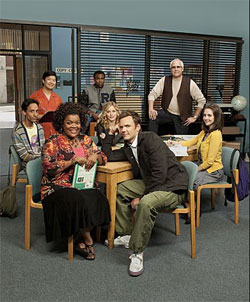 There is one other sitcom, which also survived its first season — along with Glee and Modern Family — to re-emerge for season two. And it’s a show anyone in higher ed should watch, at least occasionally.
That show is Community. It’s pretty funny but also insightful in the way satires should be.
Community made its season debut last night with Betty White as the guest star. (I’ll never listen to Toto’s “Africa” the same way again.) The show is centered on the antics of an ensemble cast of archetypal Breakfast Club-style losers who attend Greendale Community College (yes, the school has its own faux website). In many episodes, the college is more of a backdrop for the characters than an integral part of the overall story lines. But as far as I know, it’s the only prime-time show right now that includes higher education as a major element.
It isn’t the most flattering portrayal of our business. The dean is a wimpy bureaucrat afraid to make a decision. The main professor — Senor Chang, the Spanish instructor — is the nastiest stereotype since Professor Kingsfield of The Paper Chase, only funnier. One of the minor characters has sideburns shaped like stars. Still, Community should matter to higher ed marketers. Here are five reasons why:
1. They’re talking about us. Community is perhaps the most accessible portrayal of higher education the average American gets during the week. Prime-time television may not be the 800-pound gorilla it once was, but it is still influential, even among the most tech-savvy. We ought to pay attention to what might be influencing the views of the viewing public. (But we shouldn’t take it too seriously. It’s a comedy, after all.)
2. Community colleges matter. For many Americans, community college is the access point to higher education and the portal to a degree. For those without the finances, test scores or other means to enter a four-year college or university, community college is the ticket to a better life. Moreover, President Obama’s plan to dramatically increase the number of Americans with a college degree by 2020 will rely heavily on the involvement of community colleges as a pipeline to those degrees. This, according to news reports about an upcoming community college summit to be hosted by Jill Biden, the vice president’s wife who also has taught in community colleges. (See also this July 2009 Slate article about how Obama wants to leverage community colleges to achieve his goal.)
True, Community serves up a distorted view of higher education. But…
3. Community holds up a mirror to our flaws. Greendale’s spineless leader, Dean Pelton, represents what we loathe the most about higher education administration and administrators. The dean is afraid to make a decision and obsessed with political correctness. (His campaign to create a new non-offensive mascot resulted in the creation of the androgynous “GCC Human.”) Greendale’s campus, classes, teachers and programming scream mediocrity. Even though the dean’s and the school’s qualities are exaggerated, Community reminds us that sometimes people perceive those qualities at some level in all of us and in our institutions.
4. It’s cited in an important book. Community made its way into the pages of Anya Kamenetz’s book about the future of higher education, DIY U (reviewed here last spring). On page 16, in a section about how community colleges must constantly “battle stigma and invisibility,” Kamenetz underscores that point by writing, “In the fall of 2009, a sitcom titled Community, featuring Chevy Chase, premiered on NBC, illustrating all of the worst perceptions about community colleges.”
5. It stars Chevy Chase. Chase plays Pierce. It’s not his best work. Then again, Community is not Caddyshack. Still, it’s better than Spies Like Us. And Pierce’s quips are now archived on Twitter via an account his roommate Troy set up (@oldwhitemansays). (P.S. to Todd Sanders: the cast members also tweet, just like Modern Family‘s.)
Have a good weekend.
 As nasty and divisive as national politics has become lately, isn’t it refreshing to know there’s one thing political candidates can all agree on during this time of year?
 Andrew Careaga