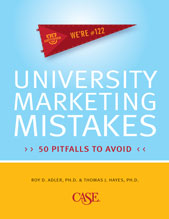
 It’s been more than a month since I claimed I was “working on” a review of the book University Marketing Mistakes: 50 Pitfalls to Avoid, by Roy D. Adler (a marketing prof at Pepperdine) and Thomas J. Hayes (same, from Xavier) and published earlier this year by CASE. (Adler and Hayes kindly responded to a Friday Five Q&A request last month.) It’s also been more than a month since I finished reading the book, so I guess I’d better get to that review before the lessons from this nifty little book start to fade from memory.
The review, like the book, is going to be succinct and to the point.
University Marketing Mistakes is a dandy little book for several reasons.
- It’s a quick read, only 127 pages in all. You could finish it on a two-hour flight.
- It’s loaded with excellent advice based on real-world examples from the world of academia. Many of the examples hit close to home. For example, there’s the story of the president of a university in our state and with nearly identical enrollment who is bent on moving his institution into the upper echelons (Case 2.4: Next, World Domination!). While reading it, I could have sworn the authors had been reading our strategic plan. But then I remembered we have a chancellor instead of a president, and that we’re a public university, not a private college like the one Adler and Hayes describe.
- It over-delivers. The subtitle promises you “50 pitfalls,” but the authors give you 53.
- The examples will make you chortle, if not laugh out loud, because they are universal truths exposed. Who among us hasn’t heard our institution described as “the best-kept secret” in the realm of education? (Can there really be more than one best-kept secret? Maybe our trustees and administrators call our institutions “well-kept secrets,” instead.) Who in higher ed hasn’t naively offered up a proposal to address a campus marketing issue without understanding the political terrain? What communications staffer hasn’t argued with their admissions staff about the need to emphasize benefits (what prospective students will get) instead of features (what we offer)?
- You’ll actually pick up some useful ideas for your own marketing efforts. (At least I did.) That in itself should make the book worth reading.
So, there you have it. A short, glowing review about a short, useful book. If any readers of this blog who have also read the book would like to share their thoughts, please do so in the comments section below.
—————-
Now playing: Basia Bulat – I Was A Daughter
via FoxyTunes

 Andrew Careaga