
We know how seriously our deans, presidents and other top-level administrators take that annual beauty pageant known as the U.S. News college rankings. Every fall we endure the wringing of hands, the gnashing of teeth, the comparisons of our school’s scores with our competition’s, the complaints that our schools should be higher in the rankings than they are, because we’re better than University of X or College of Y.
You probably won’t hear any complaints from your boss if your school doesn’t show up on CollegeHumor.com’s 2006 Power Rankings. These rankings, released earlier this week, use a “highly scientific formula” to determine which schools offer “the maximum amount of fun” for “the least amount of effort.” The criterial includes:
- Percentage of females on campus. “This is the only interesting statistic that the Princeton Review measures,” the editors proclaim. They also note that it could be misleading: “A higher number here may just mean more girls that won’t hook up with you.” So they also measure…
- Percentage of females in a relationship. “Somebody from each school helped us determine the percentage of single girls on campus by taking a random sample of 20 females from Facebook, and letting us know how many were ‘in a relationship.’ To avoid tainting the data, sorority girls in relationships with their BFF4Eva’!!!s were discarded.”
- SAT scores. The higher the average, the lower the CollegeHumor rating.
- Number of all-male vocal groups. A deduction of 25 points for each all-male vocal group on your campus.
- Bar closing time. The later, the better.
Unlike U.S. News and other organizations that keep their ratings formulae a secret, CollegeHumor posts its formula right out there on the internet. Here it is.
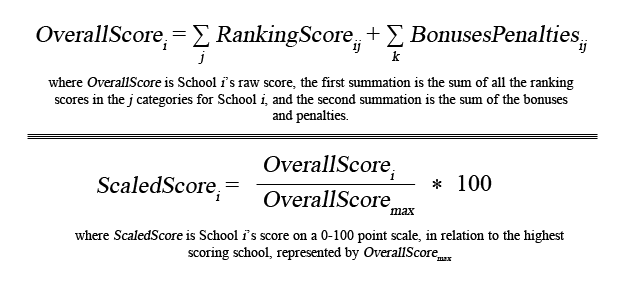
Now that you know what goes into the secret sauce, you can start working on how to bump your ranking for next year. Unless CollegeHumor follows the U.S. News model and changes the formula.

 Andrew Careaga