[blatant, gratuitous gloating]
We made the New York Times today. When I say we, I mean one of our most popular summer camps, one that lets kids blow stuff up. How much fun is that? And great news coverage, just in time for Independence Day.
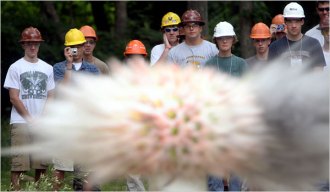
Students at UMR’s Explosives Camp watch a watermelon go boom (photo by Peter Newcomb for the New York Times).
Yeah, I know the timing isn’t the best, with all that’s been happening with car bombs in the U.K. this past weekend. Some people might think we’re training future terrorists at this camp (though regular readers of the Times should know better). Anyway, timing schmiming. It’s the New York Times! UMR doesn’t often get this kind of coverage in the Times.
This camp has gotten some terrific coverage this year, its fourth year. Beyond the Times coverage, explosives camp also made:
But what does all this mean? Were we lucky? Sure, there’s always some element of luck. But the coverage UMR got from this summer camp boils down to more than sheer luck. It’s about having a great story to tell, and telling it well. We didn’t back off from the controversial nature of the camp. Instead, we embraced it. Hence the headline in that news release: Summer campers to practice the art of blowing stuff up
It also boils down to having a unique story. When it comes to explosives and explosives camp, UMR is one of a kind. And our PR staff, building on Seth Godin‘s famous purple cow theory, has been trumpeting this program as being truly remarkable. Because it is. Ours is the only university in the nation to host an explosives camp. Ours is the only university in the nation to offer a minor in explosives engineering. And if all goes as planned, one day soon we’ll be the only university to offer a degree in explosives engineering.
[/blatant, gratuitous gloating]
Wishing all of you a happy, safe Independence Day.
 This is not a Best Of selection. Some of the logos are embarrassing: Half-cooked, half-assed, off-topic ideas with sloppy kerning and poor execution. Equally, there are some very competent logos in there, ready to be printed and shipped. Most of these, if not all actually, were shown to a client. Some were mocked, others praised and a few more ignored. … Going through all this work proved to be a soothing/stressing experience as I was able to reflect on the work that I have shown as responses to briefs and made me wonder what would I do differently now. I also noticed a lot of patterns and repetitive executions in my proposals: Plenty of sans serif type and centered arrangements, and a few too many instances of Mrs. Eaves.
 Andy writes!