
 In the world of college admissions, rejection is just part of life. (That’s also true in the world of trying to get a book published, as experience has taught me.)
But these days, in an era of college-bound American teens reared on self-esteem, rejection is a foreign concept, and can be a bitter pill. So, if you’re a high schooler applying for college and you might be on the bubble in terms of academics, or if you’re the parent of such a person, you might want to think about the possible tone of rejection letters that may come your way.
Sue Shellenbarger of the Wall Street Journal offers some guidance in her article Rejection: Some Colleges Do It Better Than Others (hat tip to Julie Wight, aka @socialjulie, who pointed this out in a retweet).
According to Shellenbarger’s “highly unscientific survey of actual letters, student interviews and message boards,” Harvard College offers the kindest rejections. “Despite an estimated admission rate of about 7% this year, this hotly sought-after school sends a humble rejection letter. ‘Past experience suggests that the particular college a student attends is far less important than what the student does to develop his or her strengths and talents over the next four years.'”
Duke also goes easy on those who can’t make the cut. “Undergraduate admissions dean Christoph Guttentag won particular praise from students and parents for the line, ‘I know you will find an institution at which you will be happy; I know, too, that the school you choose will benefit from your presence.’ Says Mr. [Daniel] Beresford, who was one of the 18,000 recipients: “It made me feel like I was a good applicant, not just another rejection.”
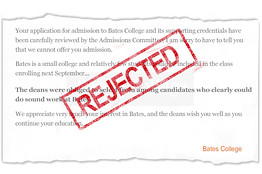
The toughest rejection letters came from Bates College in Lewiston, Maine. “The deans were obliged to select from among candidates who clearly could do sound work at Bates,” the letter says. Ouch.
The article includes other categories of rejections, including best spin, most confusing and most discouraging. Then there’s the best student response: “Living well.” Shellenbarger notes that one student, rejected by Harvard and Yale, “posted these words of advice for other rejected candidates on CollegeConfidential.com: ‘When you’re in the dough,” he wrote, “fax the colleges that denied you a copy of your rejection letter every day — letting them know just how badly they screwed up.'”
 Andrew Careaga