
 I just finished reading Charlene Li’s book Open Leadership: How Social Technology Can Transform the Way You Lead.
The book’s title is apt; there’s no way I could better describe what the book is about. It’s a quick read, and a good resource for anyone leading an organization — or a department within an organization — that is using social networking tools in any way. I obviously came to the book with a bias, having a love for the power of social media, so I’m not sure how people not so enamored with tools like Twitter would view the book and Li’s ideas about openness. But I took away quite a few things from the read. Here are five:
1. Openness can be structured. A lot of us tend to think of the idea of openness as chaotic — no structure, no governance, no rules. But as Li points out in Chapter 5, openness can be structured. In fact, it should be.
2. Think in terms of “covenants,” not policies. In that same chapter about structuring openness, Li introduces the idea of covenants as a means for setting expectations. When I think of that word covenant, my mind’s eye see this image of a wild-eyed, bearded old man stepping down a mountain carrying two stone tablets. But Li has caused me to reconsider that image. “Covenants,” she writes, “are promises that people make with each other, which differ form traditional corporate policies and procedures that dictate how things will operate within organizations. The philosophy behind covenants is more suited to openness strategies, because the promises, bargains, and contracts reflect a real trade-off and transfer of power and responsibility. When leaders open up and give up control, they trust that employees will do what they promise, that customers will respond and engage in a civil manner.” Li talks about “sandbox” covenants, in which an organization first defines the walls of its sandbox — “how big it will be, and what activities do and do not belong there.”
3. Different organizations do openness differently. Institutional culture can be a strong thing, and there is no one-size-fits-all strategy for managing openness in the social media sphere. Li discusses three organizational models — organic, centralized and coordinated — and points out that each has its benefits and drawbacks. For many college and university campuses, a coordinated approach, with strong centralized direction and guidance but with execution at the edges (the various departments and offices), may work better than the centralized approach.
4. I am a (gag) ‘Transparent Evangelist.’ Using the classic two-by-two matrix, Li breaks open leadership styles into four categories: the Cautious Tester (collaborative but pessimistic), Realist Optimist (collaborative and optimistic), Fearful Skeptic (independent and pessimistic) and Transparent Evangelist (independent and optimistic). As you might guess, “the Realist Optimist is the most powerful and effective of the open leader archetypes, somebody who can see the benefits of being open but also understands the barriers.” Fortunately, I have one or two Realist Optimists on my team who can drive our openness strategy. As for my archetype, Li says we “can play an important role in working with external stakeholders, especially customers and partners who are already eager to engage the organization. They can also help identify other optimistic open leaders in the organization, finding the other ‘zealots’ who will help support your open strategy.” I just wish Li hadn’t used that term “evangelist.” I’m so sick of it. Can I get an Amen, anyone?
5. Open Leadership extends beyond social media. Li’s focus with this book is to get leaders to be more open in the world of online communication. But I think many of the lessons of Open Leadership extend beyond that realm. Structured openness within an organization is a good thing, offline as well as on.
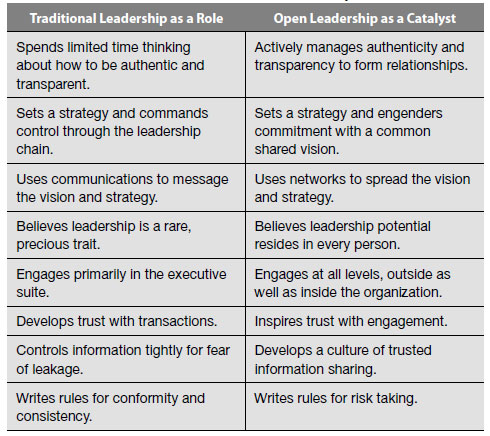
Friday Five bonus. Take a look at the table below from Chapter 8 of Open Leadership to see how open leadership (on the right) differs from traditional leadership. Where does the leadership of your organization fall?
 Andrew Careaga