
Friday Five: A half-decade on Twitter

Tomorrow marks my five-year anniversary as a tweeter. It is, as the Twitter-anniversary-tracking tool @TwBirthday reminded me this morning, the eve of my TwBirthday.
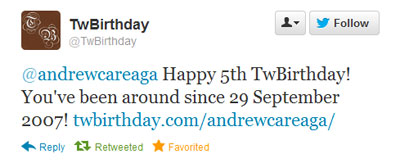
I suppose I should get all retrospective, talk about how few of us there were back then, how it was a nice, close-knit community, blah blah blah. But frankly, I wasn’t even thinking about the personal historic significance of this day from the perspective of my social media use. I rolled out of bed with thoughts of GSD on my mind this Friday. Hell, I didn’t even have a Friday Five in mind.

But then the twitterverse and Domagoj Pavlesic, who developed the TwBirthday tool, handed me this gift. So, on the eve of my five-year anniversary on Twitter, I offer you my five favorite posts on this blog about Twitter.

  1. Twitter: My go-to learning network. This post really captures why I enjoy Twitter so much, and why it’s my social network of choice, far and above all others. And this post isn’t even original. I borrow heavily from the ideas articulated in a post by Nigel Cameron, who puts it much better than I can.
  2. Best Twitter guide ever — another recycled (read: stolen) post, one that lent itself nicely to a Friday Five.
  3. TwitterVerse (for World Poetry Day) — in which I offer this bit of doggerel: Social media’d be less sweet/Were it not for @jack‘s first tweet
  4. Fun with Twitter StreamGraphs. Remember StreamGraphs? I haven’t played with StreamGraphs since, well, probably since soon after posting this entry.
  5. Your tweet was over 140 characters. You’ll have to be more clever. This is the blog post I wish I’d written, by the pretty damned clever Todd Sanders (@tsand).

Uncertain future for America’s public research universities

If past is prologue to the future, then the recent past for America’s public research universities should be a cause for concern.

According to a National Science Board report released this week, the past decade has been a tough one for public research universities in the United States. This is no news flash for most of us in higher ed, especially those of us employed by public research universities. Still, the extent of the decline in state support over the past several years is troubling.

This study of the nation’s 101 major public research universities — those an Associated Press report calls “the pride and backbone of American higher education, doing essential research and educating en masse the next generations of scientists and engineers” — finds that state per-student funding has declined by an average of 20 percent in inflation-adjusted dollars between 2002 and 2010. Ten states experienced declines ranging from 30 to as high as 48 percent.

This AP map shows the state-by-state decline in funding for the U.S.’s top public research universities.

What will happen if the nation’s public research universities continue to wither away? Since the post-Sputnik era, public research universities have become some of the nation’s most important centers of innovation, scientific discovery and economic development.

Yes, public institutions must find a way to become more efficient and control costs. And yes, states aren’t the only source of funding for research universities. Perhaps by necessity, institutions are looking to corporate and business interests for more support for research, but those dollars often come with strings attached. Applied research for companies is often tied to specific corporate interests. Federal dollars, a resource for more exploratory research in the past, have also become more tightly controlled, and a significant chunk of federal funding is expected to go away next January. That’s when some $500 billion in Defense Department funding may evaporate if sequestration takes effect. Those cuts would reverberate across the U.S. — our universities, as well as our military-industrial complex.

A case must be made that public funding that supports public higher education is an investment in our future, not a cost. If not, then the future may look even bleaker for public higher education.