
Books that matter: Sam Waterson on ‘The Five Most Important Questions…’

The latest installment in our books that matter series of guest posts is from Sam Waterson (@slwaterson), executive vice president for RHB.

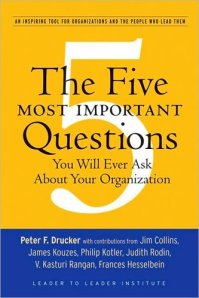
The Five Most Important Questions You Will Ever Ask Your Organization

Review by Sam Waterson
The_Five_Most_Important_Questions-744583If you’re visiting this blog, you’re aware of the state of higher education in the United States. You understand the crossroads that the industry faces and can easily re-trace the steps that brought it there. But despite these challenges, you value the transformative nature of higher education in creating a more informed public and better citizenry. And you’ll do whatever it takes to protect it, solve its challenges and help it flourish.

In the quest to market higher education, there is one volume that every marketer must read: The Five Most Important Questions You Will Ever Ask Your Organization (FMIQ), written by one of the most trusted marketing sages, Peter Drucker.

FMIQ is a guide for the self-study of non-profit organizations. Why self-study? Drucker writes, “The self-assessment tool forces an organization to focus on its mission.” In a higher education landscape wrought with mission adultery, this volume is not only practical and insightful, but also necessary.

FMIQ presents timeless strategy that is as relevant today as it was when it was published. This doesn’t mean that non-profit marketing is without innovation, but rather that Drucker presents the fundamentals that need to be understood before we start building our new “app.” Or making it “sticky.” Or “disrupting” something.

Those fundamentals are examined in the following questions:

What is our mission? “A mission can not be impersonal; it has to have deep meaning–something you know is right.”

Who is our customer? “Who must be satisfied for the organization to achieve results?”

What does the customer value? “What do customers value? What satisfies their needs, wants, and aspirations is so complicated that it only can be answered by customers themselves.”

What are our results? “Results…are always measured outside the organization in the changed lives and conditions…”

What is our plan? “To further the mission, there must be action today and specific aims for tomorrow.”

I bring these questions to bear in every client engagement. The questions enable us to see past the symptoms (falling enrollments, student/donor attrition, reduced gifts) to accurately diagnose what is almost always the foundational problem that the institution faces. While many marketers are tempted to address missional challenges of their higher education clients by repackaging an institution’s offerings, they run the risk of ultimately—and unknowingly—helping those institutions abandon their missions. And when that happens, scores of young minds remain unchanged, their potentials unmet.

If you can help a client articulate a compelling answer to every one of Drucker’s questions, it will make your job easier and your client’s institution stronger.

FMIQ is the volume that higher ed marketers should begin with.
Books that matter: Tim Nekritz on ‘The Business of Awesome/The Business of UnAwesome’

When I asked Tim Nekritz to contribute a piece to this series on books that matter for higher ed marketing/branding/PR folks, he was already working on a post on his own excellent blog about his selection for that one book he believes all higher ed marketers should read. So here it is, reproduced for your reading pleasure, complete with Tim’s original headline. Enjoy!

When unicorns fight bears, we all win: Book(s) on Business of Awesome/Unawesome reviewed

Review by Tim Nekritz

Awesome_UnAwesomeBusinesses and organizations have opportunities to be awesome and spread awesome in person and on the Internet every day. Businesses and organizations also have opportunities to be unawesome and spread unawesome in person and on the Internet every day. Fortunately, author/blogger/speaker Scott Stratten (aka Unmarketing) has these phenomena more than covered with his must-read two-headed book, The Business of Awesome/The Business of UnAwesome.

It’s two books in one, unflinchingly honest and unstoppably funny, but it makes one unifying point: How much you care about your customers says far more about your brand than anything else. We’ve all had good customer service and bad customer service, and these experiences linger with us long after we remember our purchase, our meal or our stay.

The Business of UnAwesome side chronicles the many awful things companies do in customer service, marketing and social media. The misguided case of the unfortunately named Boners BBQ, which assailed a customer via social media for her even-handed review (and incorrectly claimed she didn’t leave a tip). Using social media to blast information but never respond to questions. Unbelievably awful marketing gimmicks. Lavishing gifts on new customers while ignoring your loyal customers. Poor use of QR codes. So many truly terrible things somehow conveyed with great entertainment.

If that side says beware the trolls, the Business of Awesome side asks you to embrace the unicorns. Stratten repeats the beautiful story he told at #pseweb about how one man’s heartfelt apology saved his whole view of Hilton Hotels. Even awesome people and businesses make mistakes, but he shows how they make things right. Stratten lovingly details customer service that brings a smile instead of a frown, social brands that make loving them fun, small gestures that make huge impressions, companies that don’t take themselves too seriously but are very serious about pleasing their customers.

A unicorn boxing a bear, or why Chad Frierson from Austin's Pizza is awesome.

A unicorn boxing a bear, or why Chad Frierson from Austin’s Pizza is awesome.

He saves perhaps the greatest example for last: John, a customer who placed an online pizza order and added a small, silly request in the comment field, “Please draw a unicorn fighting a bear on the box.” Chad Frierson from Austin Pizza’s Call Center took the order and knew it wasn’t something the stores were equipped to do. So he drew a picture of a unicorn boxing a bear on a Post-It and sent along with a nice explanatory note ending with “I hope this suits your needs.”

“Needless to say this is the greatest thing of all time,” Stratten worte. “John uploaded the picture to display its awesomeness, which then went viral and was seen by millions of people. This story reigns supreme over all others, not just because it includes a unicorn, although that certainly helps. This was done by somebody in a frontline position with seemingly little autonomy, at no cost to the company, in an industry not known for being mind-blowing. It was done with immediacy and personality, without focus groups or a meeting beforehand. … He simply decided that unawesome is unacceptable, saw the window and acted on the awesome …”

If you’ve enjoyed perusing Stratten’s @unmarketing Twitter feed, checking out his blog or seeing him speak live, you’ll love this book. If you haven’t, yet you work in social media management and/or customer service, you really should catch up on his awesome work.