
WeightWatchers’ Incredible You project: Personalized storytelling

I’ve been doing quite a bit of research lately about how we higher ed marketers can better incorporate storytelling to build brand identity and achieve our institutional goals. (This is more than just a personal interest; I’ll be co-presenting on the topic with Heather Swain of Michigan State University during the upcoming CASE Annual Conference on Marketing and Branding, which you should attend.) As part of my research, I recently discovered — thanks to this post on Adverblog — an innovative and highly personal approach to brand-building through storytelling.
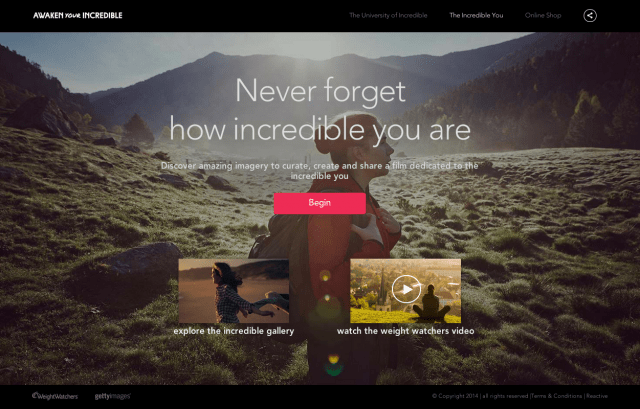
The WeightWatchers "Incredible You" campaign lets you tell your own story.
The WeightWatchers “Incredible You” campaign lets you tell your own story.

WeightWatchers recently launched its Incredible You campaign, and it leverages the power of storytelling with the power of the Internet to let the customers tell their own stories about their own incredible lives.

Visit the Incredible You website, and you are invited to create a short film based on a series of statements that you complete (starting with “When I reflect on my life the happiest memory was ______” and ending with “This year my goal is to ______”) and related photos from Getty Images’ archive of creative photos. The result is a 60-second movie of your life to remind you of how incredible you are. (Here’s my little life story, and here’s an online gallery of many others.)

This is such a simple yet effective twist on the idea of brand storytelling because it involves the audience and makes the story all about them, rather than all about the organization and their products. What a great way to build engagement. And what a refreshing approach to storytelling and brand-building.

Imagine the possibilities for a similar campaign in higher ed? With a bit of creativity, access to archives of campus photographs and back-end know-how, a college or university could create its own incredible opportunities to engage its audiences.

  • An invitation to attend the golden alumni reunion could also invite attendees to create their own digital memory books to share with classmates online.
  • Members of the graduating class could tell the of their fondest college memories, all shared in an online gallery.
  • Prospective students could be invited to create similar movies about what they hope to achieve based on their college education — and institutions could respond accordingly, based on the customized information that is shared.

Those are just a few ideas that popped into my mind as I checked out the Incredible You campaign. Maybe you have other ideas to share?


Of brochures and bike racks

A long time ago, during my days as a newspaper reporter, one evening I struck up a conversation with a city administrator who was bemoaning one of the challenges of his office.

This conversation followed a city council meeting that had featured a spirited debate about the purchase of a new pickup truck for the public works department. The discussion devolved into a sharing of opinions on the merits of one brand or model of truck over another, or a third or fourth brand or model. The discussion had gotten out of hand, and the business of awarding the bid had taken much longer than it should have.

Embed from Getty Images

Earlier in the meeting, however, a motion to fund an upgrade to the city’s sewer system, at a cost well into the six figures, passed with little discussion and even less debate.

All of which caused the city administration to say something along the lines of: “We can spend a million dollars of taxpayer money on a sewer project without batting an eye. But when it comes to buying a truck, everybody’s an expert.”

I was reminded of this exchange recently while reading Avoiding The Bike Rack Effect in Meetings, by Tomasz Tungus. (Thanks to Beth Cudney for sharing a link to Tungus’ post via Twitter.)

Tungus’ “bike rack effect” operates on the same principle as my former city administrator friend’s “pickup effect.” City council discussions about bike rack purchases (in bicycle-friendly communities, anyway) bear a lot of resemblance to the truck discussion I related above. (The truck discussion occurred in a community that, at the time, was more pickup-friendly than bicycle-friendly. A bike rack debate, in those days and in that community, would never have occurred.)

“The bike rack … is tangible,” Tungus writes. “Each member has used a bike rack, and an opinion on which type is the best. In addition, the money at stake rests within a typical person’s spending. So, everyone involved wants to inject their point of view and derive satisfaction from having added value. The discussion drags on and the majority of the meeting time is spent on a relatively trivial topic.”

After reading the article, I shared Beth Cudney’s link myself and added that in our realm, this could be called “the brochure effect.”

Or it could be called the website effect. Everybody’s received a brochure, and everybody’s used the web, so everybody’s an expert and has an opinion on how to make one. So, whenever marketing of a major event is discussed in a meeting, you’re bound to get a lot of opinions from a lot of people who like to discuss what the brochure or website should look like because those communication vehicles, like the bike rack and the pickup, are tangible and familiar. There is discussion on font size, photography, logo placement, links, QR codes, everything but the communications goals. (I’m sure event planners have their own version. There’s probably the “menu effect,” because everybody knows which vegetable goes best with which main course, or which wines pair best with lamb, etc. And fundraisers probably deal with the “scholarship effect,” because so many potential donors received scholarships or had children who did or didn’t.)

Trying to steer meeting participants toward discussing actual communication, branding or marketing goals and strategies can be a lot like getting the city council to discuss a multi-million dollar power plant or six-figure sewer system. These ideas are too complex or too large in scope to grasp.

It’s hard work trying to define an audience and the objectives of communications to that audience. But, to stretch the sewer system analogy too far, without a communications strategy to channel all of that effort, you could end up with a big mess.