
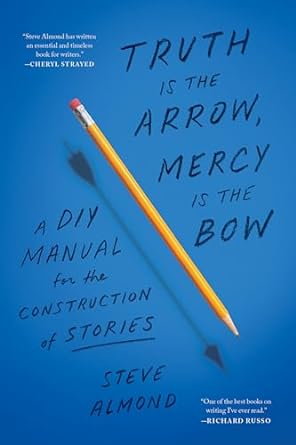
I’ve read my share of books about writing in my time, and most of them have given me at least a nugget or two of wisdom or inspiration. A new entry to the craft genre by Steve Almond, Truth Is the Arrow, Mercy Is the Bow: A DIY Manual for the Construction of Stories, which came out in April, is one of the best I’ve read in a while.
If you’re a writer, you should read this book. Here are five reasons why:
- A teacher’s perspective. Not all good writers are effective teachers, and not all great teachers are good writers. Almond has the chops for both. He’s written a dozen books (fiction and non-fiction) and teaches creative writing at the Nieman Foundation and Wesleyan University. But he doesn’t come across as professorial or pedantic. His background as a journalist probably helps in that regard. The style of Truth Is the Arrow is conversational and engaging.
- A humble, human voice. I’ll refrain from describing Almond’s voice as “authentic,” because that term has been so overused as to become meaningless. But he writes in a truly human and at times vulnerable style, which is refreshing. He opens himself up with personal tales about his struggles as a writer, his self-doubt and trepidations, his personal trauma and therapy, and times he was not always the best human in the room. These peeks into Almond’s fallible self enrich the book, making it relatable and enjoyable.
- Uncommon examples. When writing about plot, character, and chronology — common topics for a craft book like this — Almond could trot out the usual literary suspects as examples of what works. Instead, he introduces readers to some lesser-known writers through the use of brilliant snippets of writing. Yes, Joan Didion, Kurt Vonnegut, and Gabriel Garcia Marquez make cameo appearances, and there is a Star Wars reference, but more interesting are examples from writers like Natasha Trethewey, Meg Wolitzer, and Almond’s personal favorite, John Williams. (Note to self: read Williams’s novel Stoner.) Bringing the work of these writers to light, and splashing examples of his own work into the mix, provides a broader perspective to inform those who want to improve their craft. (I should also mention Aristotle, who shows up more than once and is pretty famous, but not necessarily for writing a best-seller.)
- Dynamite writing prompts. If for no other reason, get this book for the writing prompts alone. They’ll help make you a better writer.
- Beautiful, and beautifully paced, humor. Throughout Truth Is the Arrow, Mercy Is the Bow, Almond weaves a thread of beautiful humor. Sometimes it’s understated, other times more obvious, always human and humane, but never inappropriate or forced. It’s as though Almond heeds his own advice about attempting to infuse prose with humor. “The goal,” he writes on page 100, “isn’t to crack jokes but to engage in a ruthless pursuit of the truth. … The comic impulse isn’t some wrench you hoist out of your writer’s toolbox when the action flags. It’s what arises when you meet a moment that is too painful to confront without some form of self-forgiveness. It’s not a conscious decision, but an unconscious necessity.”
If this were a Saturday Six instead of a Friday Five, I would add a point about the FAQ chapter at the end. It’s great reading. Don’t skip it. Even if it doesn’t answer your particular questions, you’ll enjoy the style.
Anyway, Truth In the Arrow, Mercy Is the Bow is a worthwhile read for anyone wanting to improve their writing. I highly recommend you buy it.

 Andrew Careaga
Thank you for this recommendation!
You’re welcome. I think you’ll enjoy this one.