
Not too long ago, on a whim, I was browsing a list of Kindle deals on Amazon and discovered the book Ernest Hemingway on Writing was available for less than a cup of coffee. (The price has since gone up.) This collection of quotes about writing, pulled from Papa’s letters, interviews, and writings and edited by Larry W. Phillips, offers a glimpse into the thoughts and ideas of one of the greatest writers of the 20th century, someone who took the craft of writing seriously. As Charles Scribner Jr. explains in his introduction to the book, Hemingway was “an artist wholly committed to the craft” who sometimes “showed an almost superstitious reluctance to talk about writing, seeming fearful that saying too much might have an inhibiting effect on his muse.”
Fortunately for us, that was not always the case. As Phillips maintains in the preface to this book, “Hemingway wrote as well and as incisively about the subject as any writer who ever lived.”
I could have copied and pasted dozens of excerpts from this book but, in keeping with the Friday Five ethos, I’ve limited myself to sharing these five salient quotes for writers from one of the masters.
- “All good books are alike in that they are truer than if they had really happened and after you are finished reading one you will feel that all that happened to you and afterwards it all belongs to you; the good and the bad, the ecstasy, the remorse and sorrow, the people and the places and how the weather was.” — By-Line: Ernest Hemingway, p. 184
- “I love to write. But it has never gotten any easier to do and you can’t expect it to if you keep trying for something better than you can do.” — Letter to L. H. Brague, Jr., 1959 Selected Letters, p. 893
- “Listen now. When people talk listen completely. Don’t be thinking what you’re going to say. Most people never listen. Nor do they observe. You should be able to go into a room and when you come out know everything that you saw there and not only that. If that room gave you any feeling you should know exactly what it was that gave you that feeling. Try that for practice. When you’re in town stand outside the theatre and see how the people differ in the way they get out of taxis or motor cars. There are a thousands ways to practice. And always think of other people.” — By-Line: Ernest Hemingway, pp. 219–20
- “He wanted to write like Cezanne painted.
“Cezanne started with all the tricks. Then he broke the whole thing down and built the real thing. It was hell to do. He was the greatest. The greatest for always. It wasn’t a cult. He, Nick, wanted to write about country so it would be there like Cezanne had done it in painting. You had to do it from inside yourself. There wasn’t any trick. Nobody had ever written about country like that. He felt almost holy about it. It was deadly serious. You could do it if you would fight it out. If you’d lived right with your eyes.” — The Nick Adams Stories, p. 239
- “I’ve seen the marlin mate and know about that. So I leave that out. I’ve seen a school (or pod) of more than fifty sperm whales in that same stretch of water and once harpooned one nearly sixty feet in length and lost him. So I left that out. All the stories I know from the fishing village I leave out. But the knowledge is what makes the underwater part of the iceberg.” — From George Plimpton, “An Interview with Ernest Hemingway,” The Paris Review 18, Spring 1958.
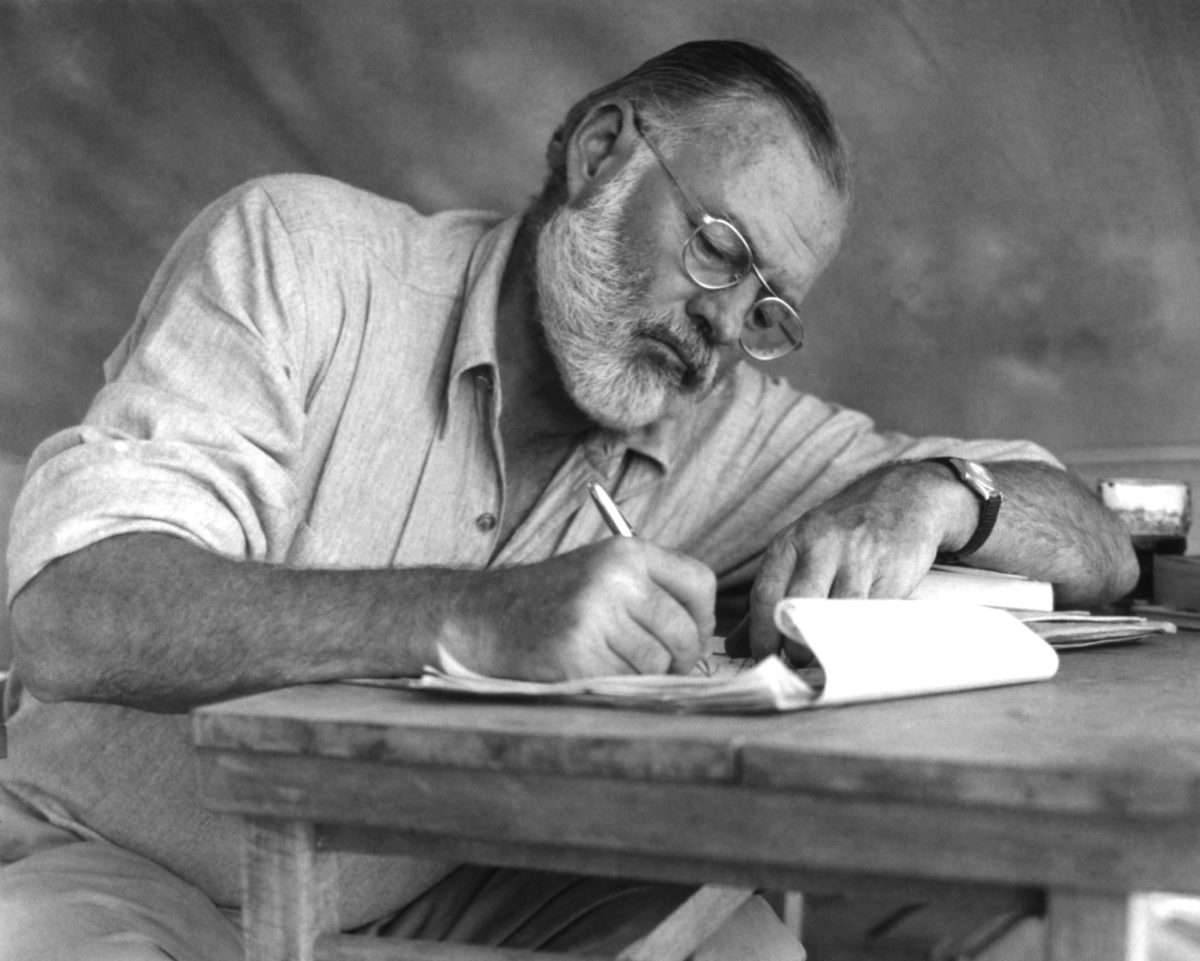
Image via PBS.

 Andrew Careaga
I love that quote about knowledge as the unseen mass of an iceberg. I also like this nod to graphite metrics from the same 1958 Paris Review interview: “Wearing down seven number-two pencils is a good day’s work.”